Structural repairs · UK-wide
Structural repairs for cracked, sinking and bowing walls
Crack stitching, underpinning, wall ties, lintels and subsidence claim repairs across England, Wales, mainland Scotland and Northern Ireland. We find the cause first, then fix it properly.
- Free initial assessment from your photos
- No-obligation written quote, fixed in writing once specified
- We can price to your loss adjuster’s or engineer’s schedule
- Engineer, building control and party wall steps arranged where needed
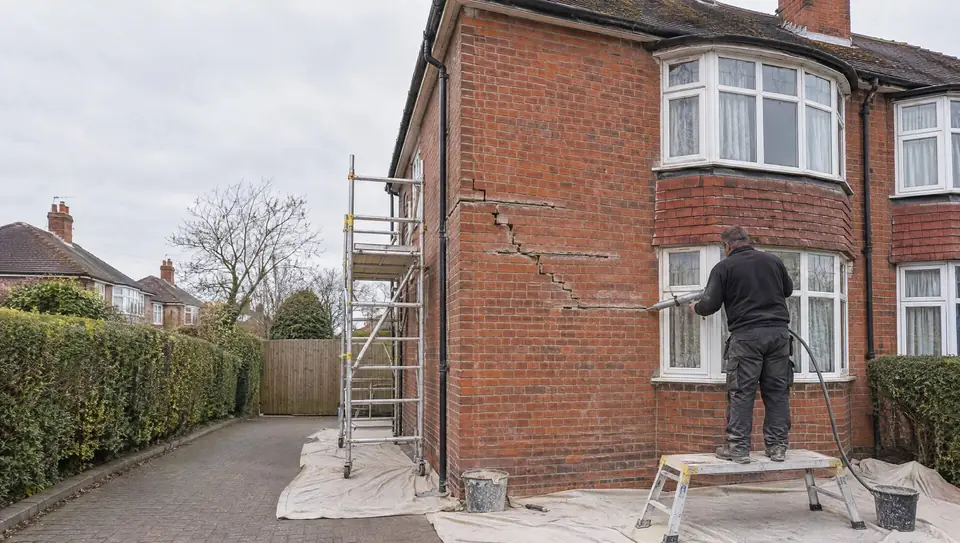 Crack stitching across a stepped crack
- Free assessment from photos
- Written, itemised quotes
- Cause found before repair
- Insurance claim repairs
- England, Wales, Scotland, NI
How we work
What makes a structural repair last?
A repair lasts when the cause has stopped. Stitching a crack over a leaking drain, or underpinning a wall that only needed a tree managing, wastes money. That is why every job starts with the question of why the building moved.
Cause first
Drains, trees, failed ties or old mine workings are checked before anyone talks about underpinning.
Insurance claims
We can price your loss adjuster’s or engineer’s repair schedule and carry it out.
Rules handled
Building control, building warrants and party wall notices are dealt with where the work needs them.
Clear guide prices
Published guide prices for every repair, adjusted for your region, then a fixed written price.
Find your repair
Which structural repair do you need?
Every repair we carry out, grouped by where the problem is. Each page explains the signs, the causes, the methods, guide prices and what happens on site.
Ground and foundations
All foundation repairsSubsidence repairs
Find the cause, stop the movement, then repair the cracks properly.
Learn moreUnderpinning
Deepening or strengthening foundations where the ground below has failed.
Learn moreResin injection ground stabilisation
Expanding resin injected beneath footings to firm up weak ground, without deep digging.
Learn moreMining subsidence repairs
Repairs to homes damaged by old coal workings or other historic mining.
Learn moreBay window subsidence repairs
Repairing bays that have dropped or cracked away from the main house wall.
Learn moreExtension pulling away repairs
Repairs where an extension has cracked or separated at the joint with the house.
Learn moreWalls and masonry
All wall repairsStructural crack repairs
Find out what a wall crack means, then repair it once the cause is known
Learn moreCrack stitching
Stainless helical bars bonded into the joints to tie cracked masonry back together
Learn moreWall tie replacement
Surveying and replacing rusted cavity wall ties before the outer brickwork bulges
Learn moreBowing wall repairs
Tying bulging or leaning walls back to the floors and roof that should hold them
Learn moreGable end wall repairs
Securing gable walls that lean, crack or pull away from the roof timbers
Learn moreLintel replacement
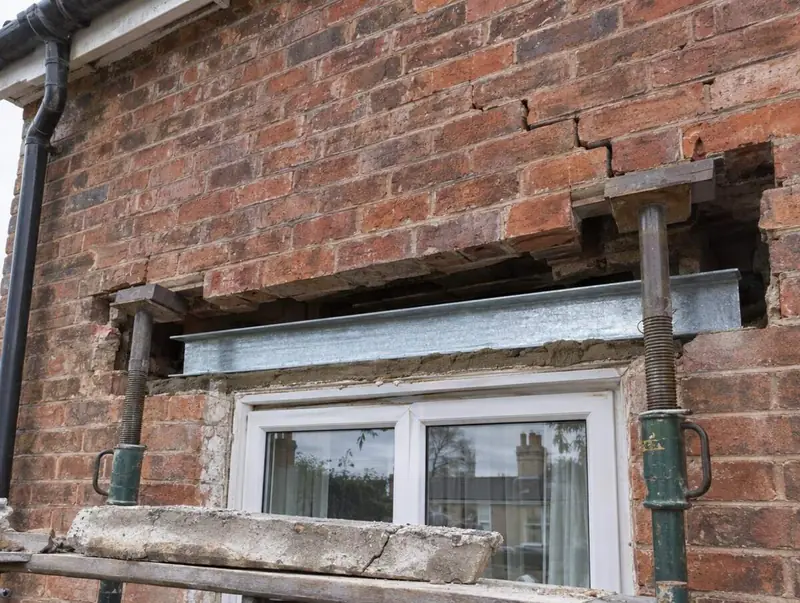
Replacing sagging, cracked, rotten or rusted lintels over existing windows and doors
Learn moreBrick arch repairs
Reinforcing or rebuilding dropped, slipped and cracked brick arches above openings
Learn moreChimney stack repairs
Repointing, restraining or rebuilding leaning, cracked and weathered chimney stacks
Learn moreFloors, roofs and outside walls
All floor, roof and wall repairsFloor joist repairs
Sagging, bouncy or rotten floors fixed by sistering, splicing or replacing joists
Learn moreRoof structure repairs
Sagging ridges, spreading roofs and weak purlins strengthened and tied back in
Learn moreConcrete repairs
Spalling concrete, rusting steel and cracks repaired on homes, flats and small units
Learn moreRetaining wall repairs
Leaning or bulging garden retaining walls drained, repaired or rebuilt on footings
Learn moreBoundary and garden wall repairs
Leaning, cracked or frost-damaged front and garden walls repaired, pierced or rebuilt
Learn moreSurveys and insurance claims
All surveys and claimsCrack width checker
How serious is the crack in your wall?
Crack width is a rough first guide to how much damage a wall has. The Building Research Establishment’s Digest 251 sorts damage into six categories, from hairline cracks you can fill when decorating to cracks over 25 mm that may affect stability. Width is not a diagnosis: whether the crack is still growing matters more.
Measure the widest point with a crack gauge, or slide a coin in: a 1p coin is about 1.6 mm thick.
Category 2 · slight
Easily filled. Some repointing may be needed outside, and doors or windows may stick slightly.
| Category | Typical width | What it usually means |
|---|---|---|
| 0 · negligible | under 0.1 mm | Hairline; usually no repair beyond decoration. |
| 1 · very slight | up to 1 mm | Fine cracks treated during normal decoration. |
| 2 · slight | up to 5 mm | Easily filled; some repointing; doors and windows may stick. |
| 3 · moderate | 5–15 mm, or several about 3 mm | Opening up and patching by a builder; weather-tightness may suffer. |
| 4 · severe | 15–25 mm | Extensive repair; frames distort, walls may lean or bulge. |
| 5 · very severe | usually over 25 mm | May affect stability; major repair or partial rebuild. |
On site
What does structural repair work look like?
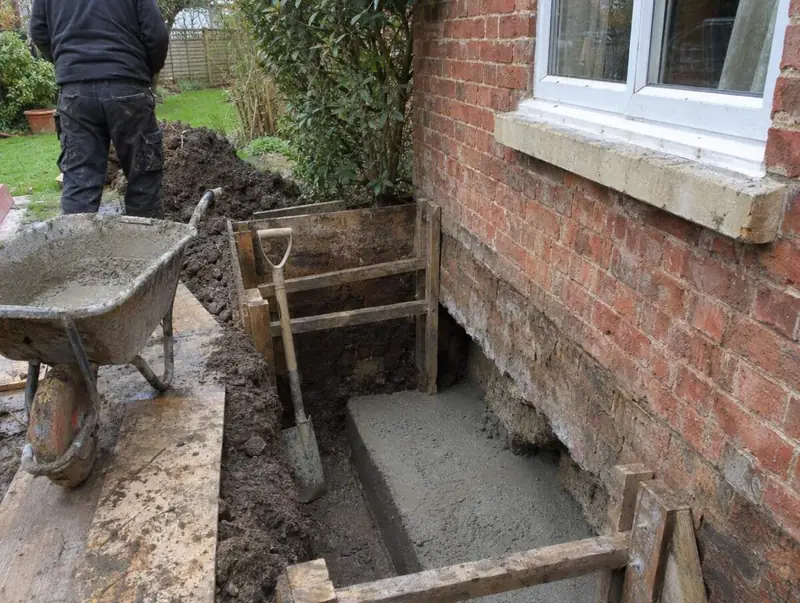
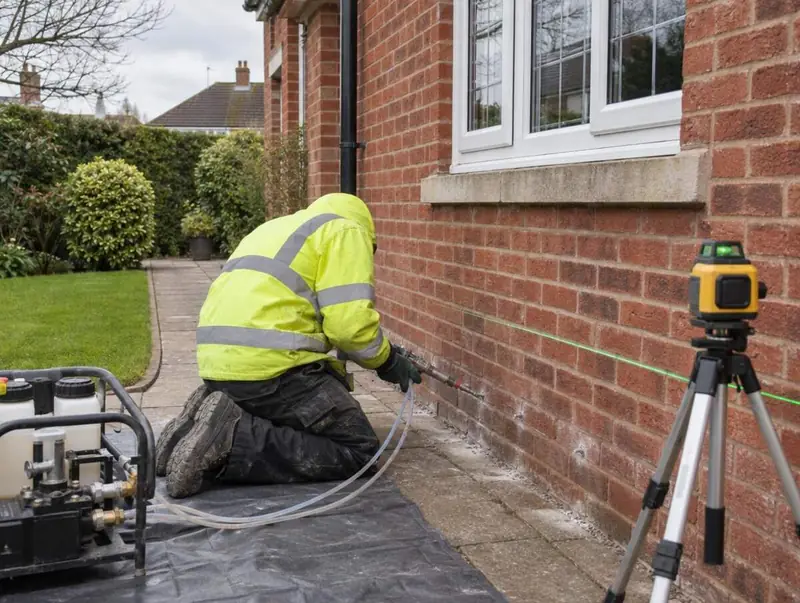
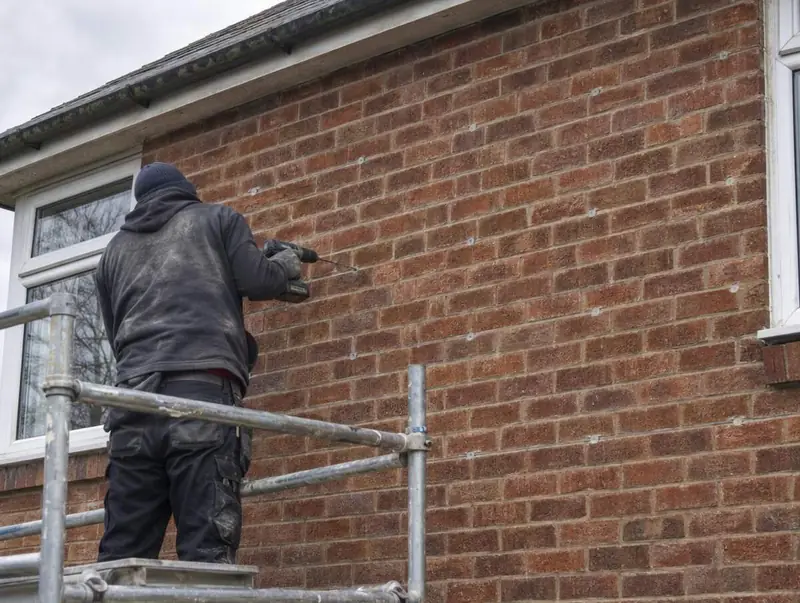
Underpinning, resin injection, wall tie replacement and lintel work each look different on site. These computer-generated images show the kind of work involved.
Genuine reviews only
We only publish reviews from real customers, linked to the platform they were left on. There are no reviews to show yet because this site is new. If we have repaired your home, we would be grateful for an honest review.
What happens next
How does a structural repair job run, start to finish?
Send photos or call
Photos of the cracks inside and out, with a coin or tape against them for scale, tell us most of what we need for a first view.
Find the cause
Repairs only last if the cause is dealt with. Where it is needed we arrange a drain survey, an independent engineer’s report or a period of monitoring.
Written quote, fixed price
You get a written, itemised quote. Once the repair is specified, the price is fixed in writing before work starts.
Repair and sign-off
We carry out the repair, deal with building control where the work needs it, and make good inside and out.
Insurance-work route
Already have a subsidence claim open?
Most buildings policies cover subsidence, usually with an excess of around £1,000. Your insurer will normally appoint a loss adjuster and often an engineer, investigate drains and trees, and may monitor the cracks through the seasons before agreeing a repair.
Once a repair schedule exists, we can price it and carry out the work. Anything outside the claim, such as upgrades while the walls are open, is priced separately and clearly. Tell your insurer before any permanent repairs start.
Guides
Plain-English guides to cracks and subsidence
How serious is this crack?
A crack is usually serious when it is wider than about 5 mm, keeps growing, tapers, or shows on both sides of the same wall. Most hairline cracks are cosmetic, but width, direction and change over time tell you whether one needs an expert look.
Read the guideSigns of subsidence and what to do first
Subsidence is the downward movement of the ground beneath a building’s foundations, and its typical signs are new diagonal cracks near doors and windows, sticking doors and cracks that widen after dry weather. The first steps are to photograph and measure the cracks, check for leaking drains, tell your insurer, and leave nearby trees alone until you have advice.
Read the guideSubsidence insurance claims explained
A subsidence insurance claim is a claim on your buildings policy for damage caused by the ground moving beneath your foundations, and it usually runs in stages: report, investigate, deal with the cause, monitor, then repair. Claims often take many months, and the subsidence excess is commonly about £1,000.
Read the guideUnderpinning vs resin injection
Underpinning strengthens a building’s foundations by taking them down to firmer ground, while resin injection stabilises the existing ground by injecting an expanding resin beneath the foundations. Which fits depends on the soil, the depth of firm ground, access and the engineer’s diagnosis, and many subsidence problems need neither.
Read the guideWall tie failure
Wall tie failure is when the metal ties linking the two leaves of a cavity wall corrode and stop holding them together, letting the outer leaf crack, bulge or lose stability. The usual sign is horizontal cracking in the mortar every few courses, and the fix is a survey followed by new remedial ties, with old ties isolated or removed where needed.
Read the guideStructural repair costs in 2026
Structural repair costs in 2026 range from about £80 per metre for crack stitching to £3,500 per metre of wall for mini-piled underpinning, with most single repairs falling between a few hundred pounds and a few thousand. All figures here are guide prices including VAT; they vary by region and access and are confirmed in writing after a survey.
Read the guideQuestions
Structural repair questions, answered
How much do structural repairs cost?
Most structural repairs cost from a few hundred pounds to several thousand, depending on the problem. As a guide, crack stitching is usually £80–£180 per metre of crack, a lintel £750–£2,500 per opening, wall tie replacement on a semi-detached house £2,500–£5,000 and underpinning £1,000–£3,500 per metre of wall. These are guide prices inc VAT; they vary by region and access and are confirmed in writing after a survey.
Why do your prices vary by region?
Prices vary mainly because labour, materials, parking, waste disposal and access costs differ across the UK. Guide prices are usually highest in London and the South East and lower in Wales, the North and Northern Ireland. Access matters as much as location: scaffolding, a narrow terrace or a busy road can add more than the region does. Your written quote reflects your own property.
Is the initial assessment free?
Yes, the initial assessment from your photos or a call is free. From it we tell you whether the problem looks cosmetic, needs a site survey or calls for an engineer. After a survey you receive a no-obligation written quote, which becomes a fixed price in writing once the repair is specified. You are under no obligation to go ahead at any stage.
How can I tell if a crack in my wall is serious?
A crack is more likely to be serious if it is wider than about 5 mm, tapers from wide to narrow, runs diagonally from a window or door, passes right through the wall or keeps growing. BRE Digest 251 treats cracks up to about 5 mm as aesthetic in most cases. Sticking doors and windows alongside a crack are also worth noting. Width is a guide, not a diagnosis, and your engineer will confirm.
Should I fill a crack before it has been looked at?
It is usually better not to fill a crack until it has been assessed, especially if it is new or getting wider. Filling hides the evidence of movement and can make an insurance claim harder to prove. Photograph it first with a tape measure across it, and mark the ends in pencil with the date. Fine, long-standing hairline cracks can be filled when you next decorate.
What are the signs of subsidence?
The usual signs are new diagonal cracks that are wider at one end, especially near windows, doors and bay junctions, plus doors and windows that suddenly stick. Cracks that appear or widen in late summer and close in winter often point to shrinkable clay and nearby trees. Rippling wallpaper, gaps under skirting boards and an extension pulling away can also be signs.
Does subsidence always need underpinning?
No, most subsidence claims are fixed without underpinning. Once the cause, such as a leaking drain or a thirsty tree, has been dealt with, the ground often stabilises and the cracks can be stitched and the walls made good. Underpinning is used only where monitoring shows movement is continuing or the foundations are clearly inadequate, and the engineer decides that.
Can I sell a house that has had subsidence?
Yes, houses that have had subsidence are sold regularly, though buyers and lenders will want evidence that it has been dealt with. Disclose past movement and claims honestly on the property information form. A certificate of structural adequacy from the engineer, the claim records and proof of continued buildings insurance usually help. Some buyers can take over the existing insurer’s cover, which is worth asking about.
Areas covered
Where do we carry out structural repairs?
England, Wales, mainland Scotland and Northern Ireland. Scottish islands and the Isles of Scilly are by arrangement. Choose your county or area for local ground conditions, guide prices and the towns we cover.
England
- Bedfordshire
- Berkshire
- Bristol
- Buckinghamshire
- Cambridgeshire
- Cheshire
- Cornwall
- Cumbria
- Derbyshire
- Devon
- Dorset
- County Durham
- East Riding of Yorkshire
- East Sussex
- Essex
- Gloucestershire
- Greater London
- Greater Manchester
- Hampshire
- Herefordshire
- Hertfordshire
- Isle of Wight
- Kent
- Lancashire
- Leicestershire
- Lincolnshire
- Merseyside
- Norfolk
- North Yorkshire
- Northamptonshire
- Northumberland
- Nottinghamshire
- Oxfordshire
- Rutland
- Shropshire
- Somerset
- South Yorkshire
- Staffordshire
- Suffolk
- Surrey
- Tyne and Wear
- Warwickshire
- West Midlands
- West Sussex
- West Yorkshire
- Wiltshire
- Worcestershire