Floors, roofs and outside walls
Boundary and garden wall repairs
Boundary and garden wall repairs are repairs to freestanding masonry walls along the front, side or back of a property, from repointing and new copings to rebuilding a leaning section. Unlike retaining walls, these walls have soil at roughly the same level on both sides.
Guide price from£300per wall inc VAT
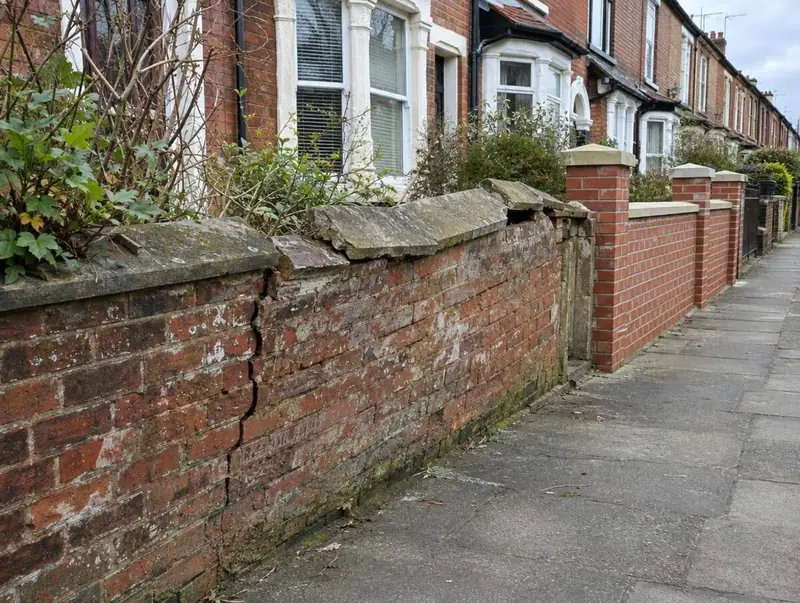
Freestanding garden walls are some of the most exposed masonry on any property. They get rain on both faces and the top, freeze and thaw every winter, and are often built on shallow footings with no damp-proof course. Long runs without piers or movement joints crack, and walls near trees can be lifted or pushed by roots. Most problems develop slowly, but a leaning front wall next to a pavement can become a hazard.
Many boundary walls can be saved with repointing, new copings and a few new piers, and only the worst sections need taking down and rebuilding. Because the wall sits on a boundary, ownership and your neighbour matter as much as the brickwork, and in England and Wales the Party Wall etc. Act 1996 may apply. We assess from your photos and quote section by section.
What are the signs you need boundary and garden wall repairs?
- Wall leaning towards the pavement, drive or neighbour’s garden
- Vertical cracks at regular intervals along a long run of wall
- Crumbling mortar, or bricks with faces flaking away
- Coping stones or brick-on-edge tops loose, cracked or missing
- A tree close to the wall, with the base lifted or cracked
- Wall rocking or moving slightly when pushed at the top
What causes it?
Tree roots
Roots growing under or alongside a wall can lift the footing, push the wall sideways or, on clay, dry the ground so it shrinks beneath it. Large trees close to a wall are a common cause of leaning sections, but removing one has its own risks, so take advice first.
Missing piers and movement joints
A long, thin freestanding wall needs piers at intervals to stiffen it against wind and movement joints to let it expand and contract. Walls built without them crack vertically every few metres and are more likely to lean or blow over. Adding piers is often the key part of a lasting repair.
Frost damage and failed copings
Water soaking into the top and faces of a wall freezes, expands and breaks up soft mortar and bricks. A missing or cracked coping lets far more water in, so damage starts at the top and works down, worst where the bricks or mortar do not suit the exposure.
Shallow footings and soil pushed against the wall
Older garden walls were often built on very shallow footings, or none at all, so small ground movements tip them. Raised beds, compost heaps or soil banked against one side turn a freestanding wall into a retaining wall it was never built to be, and it gradually leans away from the load.
Impact and gate loads
Vehicles clipping a front wall, heavy gates hung on undersized piers, and fence panels fixed to the top that catch the wind all add forces the wall was not built to take. Damage often shows first at the pier or at the end of the wall nearest the gate.
How is it repaired?
Repointing and minor repairs
Weak mortar is raked out and the wall repointed in a mortar that suits the bricks, and damaged bricks are replaced with matching ones. Loose copings are rebedded or replaced with a design that throws water clear of both faces. This is often enough for an upright wall.
Best for: Upright walls with weathered joints, loose copings or spalled bricks
Rebuilding a leaning section
The leaning or badly cracked section is taken down, sound bricks cleaned for reuse, and the wall rebuilt on a new footing at a suitable depth. A damp-proof course and a proper coping are added, and the new work is jointed to the sound wall either side.
Best for: Sections that lean, rock or have cracked right through
New piers and movement joints
Brick piers are built at intervals along the wall, bonded in or tied with stainless fixings, to stiffen it against wind and lean. Vertical movement joints are cut where a long run keeps cracking. Gate piers are rebuilt larger and on deeper footings where they carry heavy gates.
Best for: Long walls with regular cracks, or weak gate piers
Dealing with roots and soil loading
Soil banked against the wall is dug back. Where roots are the cause, the wall can be rebuilt with a lintel bridging the root zone, or realigned to give the tree room. Decisions about the tree are made with its owner and, where needed, a tree specialist.
Best for: Walls lifted by roots or pushed over by banked soil
How much will boundary and garden wall repairs cost?
The price depends on the length and height of wall affected, whether sections are repointed or rebuilt, the number of new piers, the bricks and coping chosen and access for removing spoil. Matching old or reclaimed bricks, and working beside a pavement, add to the cost.
| Item | Guide price | Per |
|---|---|---|
| Repointing and minor repairsest. | £300 – £1,200 | per wall |
| Rebuilding a leaning sectionest. | £150 – £350 | per m² of wall face |
| New brick piersest. | £250 – £600 | per pier |
See regional prices on the prices page or work out a guide price for your home with the guide price tool.
What happens, step by step?
Photos and ownership
Send photos of the whole wall and close-ups of cracks, the lean and the coping, plus any nearby trees. Tell us whether the wall is yours, shared or your neighbour’s, as that affects who can instruct the work.
Site assessment
On site we check the lean with a level, look at the footing where it can be seen, note the bricks and mortar, and check for trees, soil loading and gate loads. If the wall turns out to be retaining soil, we treat it as a retaining wall.
Written quote
You receive a no-obligation written quote that separates repointing, rebuilt sections, new piers and copings, so you or your neighbour can see each part. It becomes a fixed price in writing once the repair is specified.
Neighbour and notices
Where the wall is shared or on the line of junction in England and Wales, the Party Wall etc. Act 1996 may require notice before work starts. We can explain what is likely to be needed, and work is agreed with neighbours first.
Repair and rebuild
Sections are taken down, footings dug, and the wall rebuilt or repointed with a damp-proof course and coping. Reclaimed or matched bricks keep the wall consistent, and spoil and old materials are removed at the end.
How long will boundary and garden wall repairs take?
Repointing and minor repairs usually take one to three days, and rebuilding a leaning section of garden wall with new piers typically takes three days to a week.
Do you need building control or a party wall notice?
England and Wales
Freestanding garden walls rarely need building control, though front walls next to a highway can need planning permission if rebuilt higher, and conservation areas and listed buildings have their own rules. The Party Wall etc. Act 1996 can apply to boundary walls on the line of junction, so notice may be needed before work starts.
Scotland
Most garden wall repairs need no building warrant, though height limits and conservation areas can bring planning controls. There is no Party Wall Act in Scotland, so ownership and repair of boundary walls follow the title deeds and common law.
Northern Ireland
Garden wall repairs rarely need building control approval in Northern Ireland, but planning and conservation rules can apply to front walls. There is no Party Wall Act, so agree repairs to a shared boundary wall with your neighbour in advance.
What if you have an insurance claim open?
Many buildings policies exclude garden walls, gates and fences, or cover them only for certain events such as a vehicle impact or storm, and wear, frost and tree root damage are usually excluded. If a car has hit your wall, the driver’s motor insurer may be the right route. Check your policy wording, and tell your insurer before permanent repairs start if you plan to claim.
Boundary and garden wall repairs: frequently asked questions
How much does it cost to repair a garden wall?
Repointing and minor repairs usually cost £300–£1,200 per wall, rebuilding a leaning section is typically £150–£350 per m² of wall face, and new brick piers are usually £250–£600 each. These are guide prices inc VAT; they vary by region and access and are confirmed in writing after a survey.
Is a leaning garden wall dangerous?
It can be, particularly a tall wall, a front wall by a pavement or one that moves when pushed. A slight lean that has not changed for years may be stable, but a wall leaning more each year should be kept clear and repaired before a storm finds it.
Who is responsible for a boundary wall?
Responsibility depends on who owns the wall, which is shown in your title deeds and plans, or may be shared. A wall built on the line between two properties is often jointly owned. Check the deeds first and agree repairs with your neighbour, and in England and Wales check whether the Party Wall Act applies.
Does the Party Wall Act apply to garden walls?
It can, in England and Wales. A boundary wall that stands astride the line of junction, used by both owners, can be a party fence wall under the Party Wall etc. Act 1996, and some work to it needs notice. A wall wholly on one side is not covered in the same way. Scotland and Northern Ireland have no Party Wall Act.
Can a leaning wall be pushed back upright?
Usually not in a way that lasts. Masonry does not bend back, and forcing a wall upright tends to crack it further. The normal repair is to rebuild the leaning section on a proper footing, reusing sound bricks, and add piers to stop it happening again.
Can tree roots damage a garden wall?
Yes, they often do. Roots can lift footings, push walls sideways and, on clay soils, dry the ground so it shrinks under the wall. A wall can sometimes be rebuilt to bridge roots. Take advice before removing a large tree, as it may be protected and removal on clay can cause heave.
Do I need permission to rebuild a front wall?
Usually not for a like-for-like rebuild. Building a front wall next to a road higher than the permitted height, or work in a conservation area or to a listed building, can need planning consent. Check with your council before changing a wall’s height or appearance.
Does home insurance cover a fallen garden wall?
Sometimes, but many policies exclude garden walls or cover them only for certain events, such as vehicle impact or storm. Frost, wear and tree root damage are usually excluded. If a vehicle caused the damage, the driver’s insurer may pay. Check your policy and tell your insurer before permanent repairs start.
Where we carry out boundary and garden wall repairs
Boundary and garden wall repairs by area
Choose your area for local ground conditions, regional guide prices and the towns we cover.
England
- Bedfordshire
- Berkshire
- Bristol
- Buckinghamshire
- Cambridgeshire
- Cheshire
- Cornwall
- Cumbria
- Derbyshire
- Devon
- Dorset
- County Durham
- East Riding of Yorkshire
- East Sussex
- Essex
- Gloucestershire
- Greater London
- Greater Manchester
- Hampshire
- Herefordshire
- Hertfordshire
- Isle of Wight
- Kent
- Lancashire
- Leicestershire
- Lincolnshire
- Merseyside
- Norfolk
- North Yorkshire
- Northamptonshire
- Northumberland
- Nottinghamshire
- Oxfordshire
- Rutland
- Shropshire
- Somerset
- South Yorkshire
- Staffordshire
- Suffolk
- Surrey
- Tyne and Wear
- Warwickshire
- West Midlands
- West Sussex
- West Yorkshire
- Wiltshire
- Worcestershire