Walls and masonry
Gable end wall repairs
Gable end repairs are repairs to the triangular wall at the end of a pitched roof, typically tying it back to the roof structure with restraint straps or rebuilding its upper part where it has leaned or loosened.
Guide price from£1,000per gable inc VAT
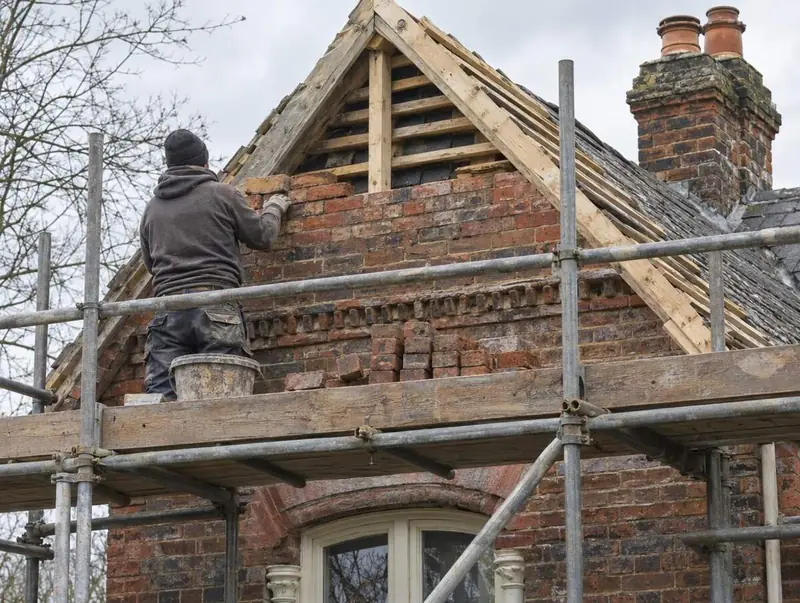
The gable is the tallest, thinnest and most exposed part of most houses. Above the top floor ceiling it rises as an unsupported triangle of brickwork, often a single leaf thick inside the loft, with only the roof timbers alongside it. If nothing fixes those timbers to the wall, wind pressure and suction can gradually work the gable loose until it leans out, cracks along the ceiling line or parts company with the roof.
Building standards since the 1980s have required gables to be strapped to the roof, but many older houses were built without any such connection. The fix is usually straightforward: steel straps fixed across the rafters or ceiling joists and into the gable masonry. Where the top of the gable has already moved too far, cracked through or lost its bond, that section is taken down and rebuilt with restraint built in, working from scaffold.
What are the signs you need gable end wall repairs?
- Daylight visible between the gable wall and the roof timbers in the loft
- The verge or bargeboard pulling away from the gable brickwork
- A horizontal crack across the gable at top-floor ceiling height
- The gable leaning outward when viewed from the side
- Loose or missing bricks near the apex or around the chimney
- Gable cracks that open after storms or very windy spells
What causes it?
No connection to the roof
Older roofs simply sit against the gable without fixings. Nothing stops the wall rocking in high winds, and over years the mortar joints loosen and the gable creeps outward. It is the single most common reason gables need repair, and is often found during loft conversions or reroofing.
Wind suction on exposed sites
Wind blowing across a roof creates suction on the leeward gable that tries to pull it away from the house. Detached and end-terrace houses on high, open or coastal ground take the worst of it. Gables facing the prevailing weather also suffer more frost and rain damage.
Roof timbers pushing outward
Purlins that bear on the gable can push it outward if the roof is spreading, sagging or has been altered. Heavier replacement roof coverings, such as concrete tiles laid over a roof designed for slate, can make this worse. The roof may need attention alongside the wall.
Rusted ties and weathered mortar
Cavity gables lose their strength when wall ties fail, and solid gables weaken as mortar erodes. Gables that carry a chimney stack or have been cut into for a loft window concentrate extra load at the weakest point, so they often show cracking first.
How is it repaired?
Gable restraint straps
Steel straps are fixed across at least three rafters or ceiling joists, with blocking packed tight between the last timber and the wall, then turned down and fixed into the gable masonry. They are fitted from inside the loft, so the outside of the house is usually untouched.
Best for: Sound gables with no connection to the roof
Remedial ties through the gable
Where loft access is poor or the timbers sit away from the wall, stainless ties are drilled in from outside and fixed into the roof structure or the inner leaf. This suits gables where boarding, insulation or a converted loft makes internal strapping awkward.
Best for: Converted lofts or gables with difficult internal access
Rebuilding the top of the gable
If the apex has leaned, cracked right through or lost its bond, the roof covering is stripped back along the verge, the upper courses are taken down to sound brickwork and the gable is rebuilt with straps and ties built in. Original bricks are reused where they are in good condition.
Best for: Gables leaning or cracked beyond tying back
How much will gable end wall repairs cost?
The main cost drivers are whether the gable can be strapped from inside or must be partly rebuilt, its height, the scaffold needed and how much roofing has to be stripped and relaid along the verge.
| Item | Guide price | Per |
|---|---|---|
| Gable restraint straps and ties | £1,000 – £3,000 | per gable |
| Rebuilding the top of a gableest. | £3,000 – £9,000 | per gable |
| Scaffolding for a two-storey gableest. | £700 – £1,800 | per gable |
See regional prices on the prices page or work out a guide price for your home with the guide price tool.
What happens, step by step?
Check from the loft
Much of the diagnosis happens in the roof space. Photos of where the rafters, purlins and joists meet the gable, plus outside shots of the verge, tell us a great deal before we visit.
Measure the lean
On site we plumb the gable, look for cracks at ceiling line and apex, and check the chimney and verge. Large movement or an unclear cause is a job for an engineer, whom we can bring in for you.
Scaffold and protect
Strapping from the loft rarely needs scaffold, but rebuilds and outside tie work usually do. We plan the scaffold, any council licence and protection for the loft contents and rooms below.
Strap, tie or rebuild
Straps and blocking are fitted at the spacing required, ties drilled and fixed, or the upper gable rebuilt course by course with restraint built in. Roofing along the verge is relaid and bedded or dry-fixed.
Weatherproof and record
Verges, flashings and pointing are finished so the gable sheds water properly. You receive photos of the straps in place, which helps with any future loft conversion, sale or building control query.
How long will gable end wall repairs take?
Strapping a gable from the loft is usually done in a day, while rebuilding the top of a gable takes about three to seven days including scaffold.
Do you need building control or a party wall notice?
England and Wales
Adding restraint to an existing gable is usually a repair, but rebuilding a gable is structural work that may need building control under Part A. If the gable is shared with a neighbour, the Party Wall etc. Act 1996 can apply.
Scotland
Rebuilding a gable is likely to need a building warrant before work starts and a completion certificate afterwards. Fitting straps alone to a sound gable is generally treated as a repair, but your verifier can confirm.
Northern Ireland
A gable rebuild is likely to need building control approval from your council under the Building Regulations (Northern Ireland) 2012. Strapping a sound gable is usually treated as a repair.
What if you have an insurance claim open?
Storm damage to a gable, such as bricks blown out during a named storm, may be covered by your buildings policy, subject to its terms. A gable that has leaned slowly through lack of restraint is usually treated as gradual deterioration and not covered. If you think the damage is storm-related, photograph it, tell your insurer before permanent repairs start, and make the gable safe if it is at risk of falling.
Gable end wall repairs: frequently asked questions
How much do gable end repairs cost?
Gable restraint straps and ties usually cost £1,000–£3,000 per gable, while rebuilding the top of a gable is typically £3,000–£9,000. Scaffolding for a two-storey gable adds about £700–£1,800. All figures are guides inc VAT, they move with region and access, and yours is confirmed in writing after we have surveyed the gable.
Why is my gable wall pulling away from the roof?
A gable usually pulls away because it was never fixed to the roof structure, and wind has gradually worked it loose. Spreading roof timbers, failed wall ties and weathered mortar can add to it. The repair is to tie the wall back, or rebuild it if it has moved too far.
Is a leaning gable dangerous?
A leaning gable can be dangerous, because the top of the wall is heavy and high. A slight, long-standing lean is often stable, but fresh cracks, loose bricks near the apex or a lean that worsens after storms should be checked quickly. If bricks are loose, fence off the ground beneath it.
What are gable restraint straps?
Gable restraint straps are steel straps that tie the gable wall to the roof timbers so it cannot move outward. They run across several rafters or joists with blocking between, then turn down to fix into the masonry. Modern houses have them built in.
Can a gable be repaired without scaffolding?
Often yes, if straps can be fitted from inside the loft and the outside brickwork is sound. Rebuilding the top of a gable, repointing high up or fixing ties from outside usually needs scaffold. We confirm the access needed when we quote.
Does a gable rebuild affect the roof?
Yes, usually along the verge. Tiles or slates next to the gable are stripped back so the brickwork can be rebuilt, then relaid with new verge bedding or dry-fix verge. The rest of the roof is normally left undisturbed.
Should I strap my gable before a loft conversion?
Gable restraint is normally checked as part of any loft conversion, because the new floor and roof changes alter how the wall is held. If your gable has no straps and shows movement, it is worth dealing with before or during the conversion.
How long does gable restraint last?
Properly fixed galvanised or stainless straps should last for the life of the roof in a dry loft. What matters is that they are fixed into sound masonry and solid timber with tight blocking. A strapped gable can still be weakened by failed wall ties or poor pointing, so those are checked too.
Where we carry out gable end wall repairs
Gable end wall repairs by area
Choose your area for local ground conditions, regional guide prices and the towns we cover.
England
- Bedfordshire
- Berkshire
- Bristol
- Buckinghamshire
- Cambridgeshire
- Cheshire
- Cornwall
- Cumbria
- Derbyshire
- Devon
- Dorset
- County Durham
- East Riding of Yorkshire
- East Sussex
- Essex
- Gloucestershire
- Greater London
- Greater Manchester
- Hampshire
- Herefordshire
- Hertfordshire
- Isle of Wight
- Kent
- Lancashire
- Leicestershire
- Lincolnshire
- Merseyside
- Norfolk
- North Yorkshire
- Northamptonshire
- Northumberland
- Nottinghamshire
- Oxfordshire
- Rutland
- Shropshire
- Somerset
- South Yorkshire
- Staffordshire
- Suffolk
- Surrey
- Tyne and Wear
- Warwickshire
- West Midlands
- West Sussex
- West Yorkshire
- Wiltshire
- Worcestershire