Walls and masonry
Lintel replacement over windows and doors
Lintel replacement is the removal of a failed lintel above an existing window or door and its replacement with a new one of the right size and bearing, with the wall above temporarily supported while the work is done.
Guide price from£750per opening inc VAT
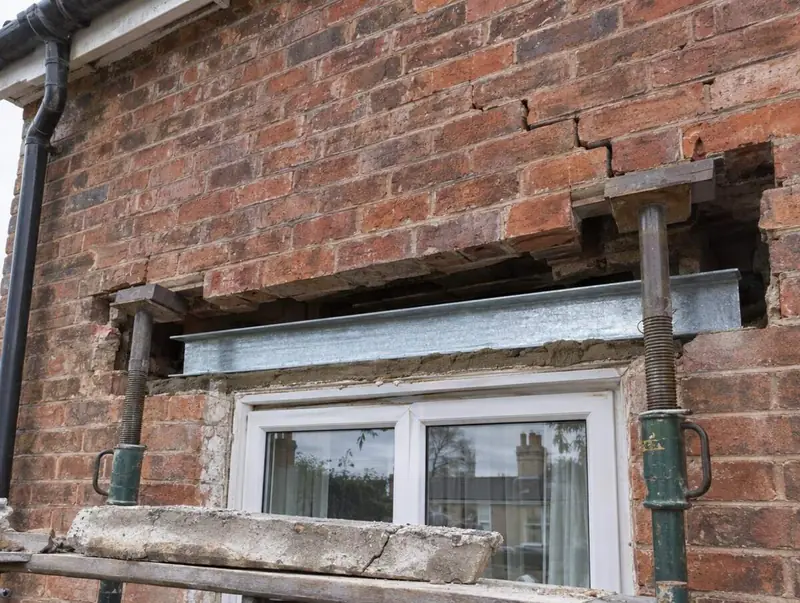
Every window and door in a masonry wall has something spanning the gap above it, carrying the brickwork overhead. In older houses that might be a timber bressummer hidden behind the brick face, a concrete lintel, a steel bar or a brick arch. When that support rots, cracks, rusts or sags, the brickwork above starts to drop and cracks climb from the corners of the opening. Windows may stick, and the frame itself can end up carrying load it was never designed for.
Replacing a lintel is a careful but routine repair. The wall above is propped or needled so nothing moves, the old lintel is cut out, and a new one is set on proper bearings at each end. Where the wall has a cavity, a tray goes in above so that water drains outward instead of soaking the new work. Inside and out, the opening is then made good so the repair is hard to spot.
What are the signs you need lintel replacement?
- A diagonal crack climbing away from a window head
- Brickwork above an opening visibly dipping in the middle
- Window or door frames that have started to bind or distort
- Rust stains or flaking steel showing above the frame
- Soft, crumbly timber visible behind the brick face over a bay
- Damp patches on the inside wall just above a window
What causes it?
Rotten timber lintels
Many Victorian and Edwardian houses have timber lintels behind the outer brick skin or across the inner face of solid walls. Once rain gets in through failed pointing or a leaking sill, the timber rots and slowly compresses. The brickwork above then drops, often most visibly over wide bay windows.
Corroded steel lintels
Steel lintels from the mid-twentieth century onward can rust where their protective coating has failed or where water collects on the flange. Rust expands, lifting and cracking the brickwork bedded on it. Severe corrosion eventually thins the steel until it bends under load.
Cracked concrete lintels
Concrete lintels crack when their reinforcement rusts and swells, or when they were undersized for the wall above. Spalling concrete with exposed bars on the underside, or a crack running through the middle of the lintel, are both signs it has stopped doing its job.
Short bearings and replaced windows
Some lintels were set with too little length resting on the wall at each end, so the masonry under the ends crushes. Older replacement windows were sometimes fitted after removing the original timber frame that was quietly carrying load, leaving the lintel above to sag.
How is it repaired?
Like-for-like replacement
The failed lintel comes out and one of suitable type and size is bedded on mortar with adequate bearing at each end. Bricks above are relaid to match the original bond and the joints are pointed to blend with the surrounding wall.
Best for: Standard windows and doors with a single failed lintel
Propping and needling
Adjustable props carry the wall above while the old lintel comes out. For heavier walls, short steel needles are passed through holes cut above the opening and propped on both sides, taking the load off the lintel completely. The supports stay until the new work has set.
Best for: Openings with heavy walls, upper floors or bay windows above
Replacement with a cavity tray
A damp-proof membrane is laid over the new lintel with stop ends and weep holes, so water running down the cavity is directed out rather than into the house. Many older lintels were installed without one, which is often why they failed.
Best for: Cavity walls with damp above windows
Inner and outer lintel replacement
Solid walls and some cavity walls carry separate lintels on the inside and outside faces. Where both have failed, each is replaced in turn, keeping the wall supported throughout. Internal plaster and reveals are then made good and redecorated where included.
Best for: Older solid walls with rotten timber across the inner face
How much will lintel replacement cost?
The price depends mainly on the width of the opening, whether it is a bay, how much wall sits above, whether inner and outer lintels both need replacing, and the access. Removing and refitting windows and internal making good add to it.
| Item | Guide price | Per |
|---|---|---|
| Standard window or door opening | £750 – £2,500 | per opening |
| Wide or bay openingest. | £2,000 – £4,500 | per opening |
| Making good inside and outest. | £150 – £600 | per opening |
See regional prices on the prices page or work out a guide price for your home with the guide price tool.
What happens, step by step?
Inspect the opening
We look at the crack pattern, the type of lintel and what sits above it. Pictures of both faces of the window, plus any visible lintel edge, help us judge it before visiting.
Specify the replacement
We confirm the lintel type, length and bearing needed. For wide openings, bays or walls with unusual loads, an engineer may specify it, and where the repair needs an engineer’s design or sign-off we can arrange one.
Support the wall
Props or needles are set so the brickwork above carries no load on the old lintel. Windows are protected or temporarily removed where the work demands it, and the room inside is sheeted against dust.
Remove and replace
Brickwork is carefully taken out above the lintel, the old lintel removed and the new one bedded level on full bearings. A cavity tray goes in where relevant, then the brickwork above is relaid.
Remove supports and make good
Once the mortar has gained strength, props and needles come out and their holes are made good. Pointing, reveals and plaster are finished, and the window is refitted or checked for smooth operation.
How long will lintel replacement take?
Replacing a single lintel usually takes one to two days on site, with wide bay openings taking longer.
Do you need building control or a party wall notice?
England and Wales
Replacing a lintel is structural work, so building control will often need to approve it, and we deal with building control where the work needs it. If the opening is in a party wall, the Party Wall etc. Act 1996 may apply.
Scotland
Lintel replacement is structural work and may need a building warrant before it starts, depending on its scope. Your local authority verifier can confirm what applies to your opening.
Northern Ireland
Under the Building Regulations (Northern Ireland) 2012, your council may need to approve a lintel replacement. A like-for-like repair is sometimes treated more simply, so check first.
What if you have an insurance claim open?
Insurers normally treat a lintel lost to rot, rust or age as wear and tear, which policies tend to exclude. If cracking around an opening is part of wider movement you think could be subsidence, tell your insurer before permanent repairs start, so the cause is investigated rather than the symptom repaired. We can price to your loss adjuster’s or engineer’s schedule where the lintel forms part of a claim.
Lintel replacement: frequently asked questions
How much does lintel replacement cost?
Replacing a lintel over a standard window or door opening usually costs £750–£2,500, and a wide or bay opening is typically £2,000–£4,500. Making good inside and out adds about £150–£600 per opening. Prices shown are guides inc VAT; they vary by region and by access to the opening, and are confirmed in writing after a survey.
How do I know if a lintel has failed?
The most common sign is a diagonal or stepped crack running up from the top corner of a window or door. Others include a dip in the brickwork above, rust or rot visible at the lintel edge, and windows that start to stick. A crack alone can have other causes, so it is worth checking.
Can a lintel be replaced without removing the window?
Often yes. With the wall propped or needled, the old lintel can usually be cut out above the frame. If the frame has been carrying load or the lintel sits tight on it, the window may need removing and refitting, which we include in the quote.
What does needling a wall mean?
Needling means passing short steel members through holes cut in the wall just above the opening and supporting them on props on both sides. The needles take the weight of the wall above, so the old lintel can be removed safely without any brickwork dropping.
Do I need building regulations approval to replace a lintel?
In England and Wales, replacing a lintel is structural work and building control will usually need to approve it. Rules differ in Scotland and Northern Ireland. We deal with building control where the work needs it, and include the cost in the quote.
What is a cavity tray and do I need one?
A cavity tray is a damp-proof membrane above a lintel that catches water running down inside a cavity wall and sends it out through weep holes. If your wall is cavity construction and the original lintel had no tray, fitting one with the new lintel is usually sensible.
How long does it take to replace a lintel?
Most single lintels are replaced in one to two days. The props stay in until the mortar has gained enough strength, and wide bays or openings with both inner and outer lintels can take longer. The window can usually be used again once the supports come out.
Is it safe to live in the house during lintel replacement?
Yes, in almost all cases. The wall is fully supported before anything is removed, and the work is confined to one opening at a time. The affected room is sheeted against dust and kept clear while props are in place.
Where we carry out lintel replacement
Lintel replacement by area
Choose your area for local ground conditions, regional guide prices and the towns we cover.
England
- Bedfordshire
- Berkshire
- Bristol
- Buckinghamshire
- Cambridgeshire
- Cheshire
- Cornwall
- Cumbria
- Derbyshire
- Devon
- Dorset
- County Durham
- East Riding of Yorkshire
- East Sussex
- Essex
- Gloucestershire
- Greater London
- Greater Manchester
- Hampshire
- Herefordshire
- Hertfordshire
- Isle of Wight
- Kent
- Lancashire
- Leicestershire
- Lincolnshire
- Merseyside
- Norfolk
- North Yorkshire
- Northamptonshire
- Northumberland
- Nottinghamshire
- Oxfordshire
- Rutland
- Shropshire
- Somerset
- South Yorkshire
- Staffordshire
- Suffolk
- Surrey
- Tyne and Wear
- Warwickshire
- West Midlands
- West Sussex
- West Yorkshire
- Wiltshire
- Worcestershire