Floors, roofs and outside walls
Floor joist repairs for sagging and rotten floors
Floor joist repairs are repairs to the timber beams that carry a floor, strengthening, splicing or replacing joists that have rotted, been cut or sagged. They often include the sleeper walls, ventilation and hangers that support the joists and keep them dry.
Guide price from£250per joist inc VAT
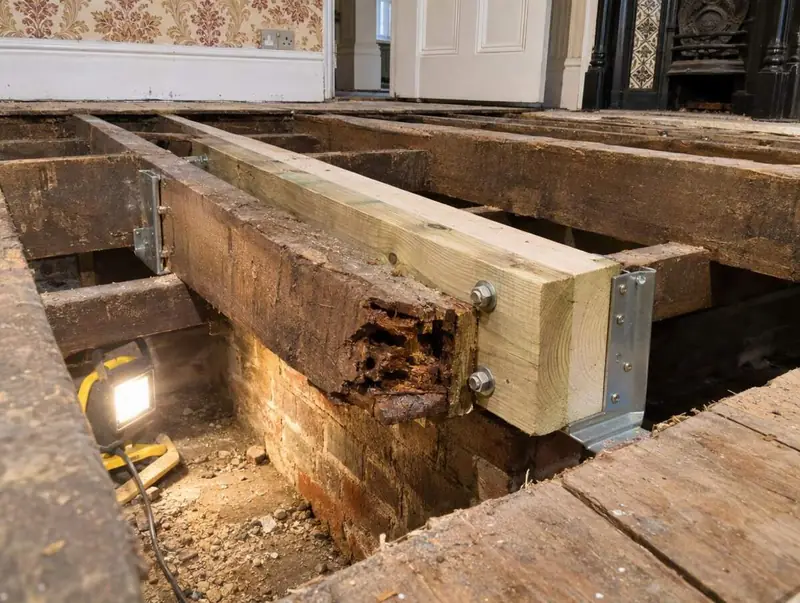
A floor that dips, bounces or creaks more each year is usually telling you something about the joists underneath. In older houses the commonest fault is rot at the joist ends, where they sit in damp walls or over a poorly ventilated void. In newer ones it is often joists notched or drilled for pipes and cables. The floorboards themselves are rarely the real problem.
The repair depends on how much timber is affected and why. A single cut or rotten joist can usually be sistered or spliced after lifting a few boards. Widespread rot means stopping the damp first, by clearing air bricks, repairing sleeper walls or lowering outside ground levels. We start with a free initial assessment from your photos or a call, then lift a few boards on site before quoting.
What are the signs you need floor joist repairs?
- Floor dipping towards an outside wall or in the middle of the room
- Floor bouncing, or ornaments rattling, when someone walks across
- A gap opening up between the skirting board and the floor
- Soft or spongy boards near outside walls, hearths or the bathroom
- A musty smell, or fungal strands showing between the boards
- Ceiling cracks below that follow the line of the joists
What causes it?
Rot at the joist ends
In solid-walled houses, joist ends often sit in pockets in the outside wall. If that wall stays damp from high ground levels, failed pointing or a leaking gutter, the timber rots where you cannot see it. The joist looks sound mid-room but has lost its bearing, so the floor drops along that edge.
Blocked or missing ventilation
Suspended timber ground floors need air moving through the void beneath. Air bricks get buried by raised patios, covered by render or painted over, and the void turns damp. High moisture leads to wet rot and, at worst, dry rot, which can spread through timber and along masonry.
Notches, holes and extra load
Trades cut joists to run pipes and cables. Guidance generally keeps notches shallow and near the ends of the span, and holes on the centre line. Deep cuts mid-span weaken a joist badly. Heavy baths and stud walls built on the floor add load the joists were never sized for.
Failed sleeper walls
Ground floor joists are often carried mid-room on low brick sleeper walls. Where these were built without proper footings or a damp-proof course, they settle, crack or pass moisture into the timber plates on top. The floor then sinks in a line across the room.
How is it repaired?
Sistering a joist
A new length of treated timber, the same depth as the original, is bolted or screwed alongside the damaged joist so the two share the load. It is the quickest fix for a notched, cracked or sagging joist that is otherwise sound, usually after lifting a few boards.
Best for: Cut, cracked or sagging joists with sound ends
Splicing ends and fitting hangers
Where only the end has rotted, it is cut back to sound timber and a new piece is fixed alongside, bearing on the wall or on a new joist hanger. Missing or under-nailed hangers elsewhere are replaced at the same time. The damp in the wall must be fixed too.
Best for: Rotten joist ends in damp solid walls
Replacing joists and boards
When rot or woodworm runs through most of a floor, it is usually cheaper to replace the joists, strutting and boards together. Where joists run parallel to an outside wall, restraint straps tie the new floor back to it so the wall keeps its lateral support.
Best for: Widespread rot, or a whole floor that has dropped
Sleeper walls and ventilation
Settled or damp sleeper walls are rebuilt on a sound base with a damp-proof course under new timber plates. Blocked air bricks are cleared, extra ones added where the void has dead spots, and soil or paving heaped against the outside wall is lowered.
Best for: Damp ground floor voids or joists on poor supports
How much will floor joist repairs cost?
The price depends on how many joists are affected, ground or upper floor, how much is lifted and replaced, and any sleeper wall or ventilation work. Floors under fitted kitchens and tiled bathrooms cost more to open up and reinstate.
| Item | Guide price | Per |
|---|---|---|
| Splicing or sistering a damaged joist | £250 – £400 | per joist |
| Whole room of joists and boards | £2,000 – £6,000 | per room |
| Sleeper wall rebuild and ventilationest. | £400 – £1,500 | per room |
See regional prices on the prices page or work out a guide price for your home with the guide price tool.
What happens, step by step?
Photos and a call
Send photos of the dip or soft area, the outside wall at ground level and any air bricks. A short call about when it started, and any recent plumbing or heating work, tells us whether the problem is local or widespread.
Lift boards and inspect
On site we lift a few boards where the floor is worst and check the joist ends, sleeper walls and void with a moisture meter. Outside, we look for high ground, blocked vents and leaks keeping the timber wet.
Written quote
You get a no-obligation written quote listing which joists are sistered, spliced or replaced and any sleeper wall or ventilation work. It becomes a fixed price in writing once the repair is specified.
Repair the structure
Boards are lifted and numbered if they are going back, and rotten timber is cut out. New treated timber is fixed and checked with a level before strutting, hangers and any restraint straps go in.
Relay and ventilate
Boards are relaid or replaced, skirting refitted and air bricks cleared or added outside. We point out anything that would let damp back in, such as soil heaped against the wall, so the repair lasts.
How long will floor joist repairs take?
A few sistered joists usually take a day, and a whole room of joists and boards typically takes two to four days.
Do you need building control or a party wall notice?
England and Wales
Like-for-like joist repairs are usually treated as repairs, but replacing a floor structure can be building work under Part A (Wales has its own version), and we deal with building control where the work needs it. Reseating joists in a party wall may need notice under the Party Wall etc. Act 1996.
Scotland
Like-for-like joist repairs often need no building warrant, but replacing or altering a floor structure generally does, before work starts. There is no Party Wall Act, so work to a shared wall follows title deeds and common law.
Northern Ireland
Council building control, under the Building Regulations (Northern Ireland) 2012, can confirm whether replacing a floor needs approval. There is no Party Wall Act, so agree work to a shared wall with your neighbour.
What if you have an insurance claim open?
Rot, woodworm and gradual wear are usually excluded from buildings policies, so most joist repairs are paid for privately. A sudden event can differ: a burst pipe that soaks a floor may fall under escape of water, and a sleeper wall that dropped through subsidence may form part of a subsidence claim. If either applies, tell your insurer before permanent repairs start, and we can price to your loss adjuster’s schedule.
Floor joist repairs: frequently asked questions
How much does it cost to repair floor joists?
Sistering or splicing a joist usually costs £250–£400 per joist, and a whole room of joists and boards is typically £2,000–£6,000. Sleeper wall rebuilds with ventilation are usually £400–£1,500 per room. These are guide prices inc VAT; they vary by region and access and are confirmed in writing after a survey.
Why is my floor bouncy?
A bouncy floor usually means the joists are deflecting too much, often because they span too far, have lost their strutting or have been weakened by notches. It rarely means imminent failure, but it is worth checking, especially if the bounce appeared after work in the room.
Is a sagging floor dangerous?
A gentle, long-standing sag is usually not dangerous, and many older floors have moved slightly over a century. A sag that is getting worse, soft boards or a floor dropping near a wall needs checking soon, because rotten joist ends can lose their bearing.
What is sistering a floor joist?
Sistering is fixing a new length of timber alongside an existing joist so the two share the load. It strengthens a notched, cracked or sagging joist without removing it, so it is quicker and less disruptive than replacement.
Can floor joists be repaired without taking up the whole floor?
Yes, in most cases only the boards over the affected joists need lifting, and three or four boards are often enough to sister a joist or splice a rotten end. Widespread rot is the exception, because the whole floor must come up to remove the decay.
What causes rot in floor joists?
Damp causes almost all joist rot. Joist ends in damp walls, voids with blocked air bricks, leaking pipes and high outside ground levels keep timber wet enough for fungi to grow. Replacing timber without fixing the damp usually means the rot returns.
Do I need building control for floor joist repairs?
Usually not for like-for-like repairs to a few joists, but replacing a whole floor structure can be building work. In Scotland that generally needs a building warrant, and in Northern Ireland council building control applies. We deal with building control where the work needs it.
Will my insurance pay for rotten floor joists?
Usually not, because rot, woodworm and gradual wear are standard exclusions. Damage from a sudden escape of water, or a floor that dropped through subsidence, may be treated differently. Check your policy, and tell your insurer before permanent repairs start if either applies.
Where we carry out floor joist repairs
Floor joist repairs by area
Choose your area for local ground conditions, regional guide prices and the towns we cover.
England
- Bedfordshire
- Berkshire
- Bristol
- Buckinghamshire
- Cambridgeshire
- Cheshire
- Cornwall
- Cumbria
- Derbyshire
- Devon
- Dorset
- County Durham
- East Riding of Yorkshire
- East Sussex
- Essex
- Gloucestershire
- Greater London
- Greater Manchester
- Hampshire
- Herefordshire
- Hertfordshire
- Isle of Wight
- Kent
- Lancashire
- Leicestershire
- Lincolnshire
- Merseyside
- Norfolk
- North Yorkshire
- Northamptonshire
- Northumberland
- Nottinghamshire
- Oxfordshire
- Rutland
- Shropshire
- Somerset
- South Yorkshire
- Staffordshire
- Suffolk
- Surrey
- Tyne and Wear
- Warwickshire
- West Midlands
- West Sussex
- West Yorkshire
- Wiltshire
- Worcestershire