Walls and masonry
Chimney stack repairs and rebuilds
Chimney stack repairs are repairs to the brickwork that rises above the roof, from repointing and renewing the flaunching around the pots to restraining a leaning stack or rebuilding it from the roofline up.
Guide price from£500per stack inc VAT
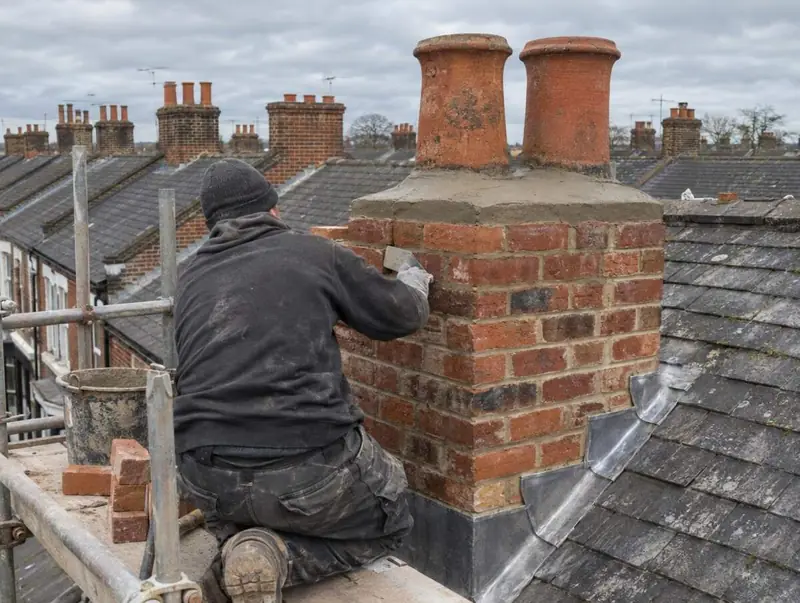
A chimney stack is the most exposed brickwork on a house. It stands above the roof in wind, rain and frost on every face, and for decades it carried warm, damp, acidic flue gases up its inside. That combination wears stacks out faster than the walls below. Loose pots, cracked flaunching, crumbling joints and a gentle lean away from the prevailing weather are all common on older houses, and none of them improves with time.
Most stack problems are fixed by repointing, renewing the flaunching and replacing a few damaged bricks. A stack that has started to lean, usually because sulphates from old flue gases have attacked the mortar on one side, may need restraining or taking down and rebuilding. All of this needs safe access, normally a scaffold with a platform at stack height, which is often a large share of the cost.
What are the signs you need chimney stack repairs?
- A stack visibly leaning when you look along the roof ridge
- Chimney pots that are loose, tilted or cracked at the base
- Cracked or missing flaunching around the top of the stack
- Mortar washed out of joints, leaving bricks standing proud
- Damp patches on the chimney breast inside, especially after rain
- Bits of brick, mortar or render landing in the garden or gutter
What causes it?
Sulphate attack in the mortar
Flue gases from coal and some other fuels carry sulphates that soak into the mortar inside the stack. With moisture, they react and expand. The side that stays wetter, usually facing the prevailing weather, swells more, so the stack bends away from it. Leaning stacks on older houses are very often caused this way.
Weathering and frost
Rain soaks into exposed joints and bricks, then freezes and expands. Over many winters, faces spall and mortar crumbles away. Stacks with no cap or cowl, or with porous bricks, deteriorate fastest, and failed pointing lets water travel down into the house.
Failed flaunching and loose pots
Flaunching is the sloped mortar bed that holds the pots and sheds water off the top of the stack. When it cracks, water runs into the brickwork and pots work loose. A pot moving in the wind can fall, so loose pots are best dealt with promptly.
Removed chimney breasts below
Sometimes a chimney breast has been taken out inside the house while the stack above was left in place. If the remaining masonry has not been properly supported, that is a structural concern. Signs include cracking in the ceiling or walls around the old breast and a stack that has dropped or moved.
How is it repaired?
Repointing and brick repairs
Eroded joints are raked out and repointed in a mortar suited to the brick, often a lime-based mix on older stacks. Spalled or cracked bricks are cut out and replaced with matched reclaimed or new bricks. On many stacks this, with new flaunching, is all that is needed.
Best for: Upright stacks with weathered joints and some damaged bricks
Flaunching and pot resetting
Old cracked flaunching is broken out, pots are lifted and reset or replaced, and new flaunching is formed to a fall so water runs off. Unused flues can be capped with ventilated caps, which keeps rain out while letting the flue breathe.
Best for: Loose pots and cracked mortar at the top of the stack
Stack restraint or strapping
A stack that has leaned slightly but is otherwise sound can be restrained with stainless straps or ties fixed back to the roof structure or the gable. This stops further movement without taking the stack down, and is often combined with repointing.
Best for: Slightly leaning stacks with sound brickwork
Partial or full rebuild
Where the lean is pronounced or the brickwork is badly decayed, the stack is taken down to sound masonry, often to roof level, and rebuilt plumb with new flashings and flaunching. Original bricks are cleaned and reused where possible to keep the appearance.
Best for: Badly leaning or decayed stacks
How much will chimney stack repairs cost?
Price is driven largely by access, because a scaffold to stack height can be a major cost, and then by whether the stack needs repointing, restraint or a rebuild. Its height, the number of pots and shared terrace stacks also affect the figure.
| Item | Guide price | Per |
|---|---|---|
| Repointing, flaunching and minor brick repairs | £500 – £2,000 | per stack |
| Partial or full stack rebuild | £3,000 – £10,000 | per stack |
| Stack restraint or strappingest. | £400 – £1,200 | per stack |
See regional prices on the prices page or work out a guide price for your home with the guide price tool.
What happens, step by step?
Look from the ground
Photos from the street and garden, ideally with a zoom, show us the lean, the pots, the flaunching and the state of the pointing. Damp patches inside are worth photographing too, as they help trace the route water is taking.
Check what is below
We ask whether any chimney breasts have been removed, and check the loft and rooms below for cracking. If a breast has gone without proper support, we recommend an independent chartered structural engineer before any stack work.
Scaffold to the stack
Safe access is set up with a working platform around the stack. On terraces we may need to agree access over a neighbour’s roof, and a council licence is arranged where the scaffold stands on the pavement.
Repair, restrain or rebuild
The agreed work is carried out: repointing, new flaunching and pots, restraint, or taking the stack down and rebuilding it. Lead flashings where the stack meets the roof are checked and renewed if needed.
Weatherproof and clear
Caps or cowls are fitted where agreed, the roof around the stack is checked for slipped tiles, and debris is cleared from gutters. You receive photos of the finished stack taken from the scaffold, since it is hard to see from the ground.
How long will chimney stack repairs take?
Repointing and flaunching a stack usually takes one to two days once scaffold is up, and a rebuild about three to five days.
Do you need building control or a party wall notice?
England and Wales
Repairs to an existing stack are usually treated as maintenance, but a rebuild, or any work linked to a removed chimney breast, may need building control approval. A stack shared with a neighbour falls under the Party Wall etc. Act 1996.
Scotland
Maintenance to a stack is generally outside the warrant system, but rebuilding or altering one may need a warrant, along with any work to support it after a breast removal. In tenements, the stack is often common property, so check the title deeds.
Northern Ireland
Your council may want to approve a stack rebuild under the Building Regulations (Northern Ireland) 2012. Shared stacks should be agreed with your neighbour, as there is no Party Wall Act.
What if you have an insurance claim open?
Where high winds have blown pots or bricks off a stack, a buildings policy can respond, depending on its wording and any storm definition. Insurers generally exclude gradual weathering, sulphate attack and a slow lean as wear and tear. If a storm has caused damage, photograph it, make the area below safe, and tell your insurer before permanent repairs start.
Chimney stack repairs: frequently asked questions
How much do chimney stack repairs cost?
Repointing, flaunching and minor brick repairs usually cost £500–£2,000 per stack. Stack restraint or strapping is typically £400–£1,200, and a partial or full rebuild £3,000–£10,000 per stack. Figures are guide prices inc VAT; region and, above all, access change them, and they are confirmed in writing after a survey.
Why is my chimney stack leaning?
Most leaning stacks are caused by sulphate attack, where chemicals from old flue gases make the mortar expand more on the wetter side, so the stack bends away from the weather. Frost damage and failed pointing can make it worse. A recently leaning stack can also signal problems below.
Is a leaning chimney dangerous?
A leaning chimney can become dangerous, because stacks are heavy and stand high above the roof. A slight, long-standing lean may be stable for now, but a lean that is worsening, or loose bricks and pots, should be looked at quickly. Keep people away from below if anything looks loose.
What is chimney flaunching?
Flaunching is the sloped bed of mortar on top of a chimney stack that holds the pots in place and throws rainwater off. When it cracks, water gets into the stack and pots can work loose. Renewing it is one of the most common stack repairs.
Can a leaning stack be straightened?
Not by pushing it back, because the brickwork would crack. A slight lean on a sound stack can be restrained so it moves no further. A pronounced lean is fixed by taking the stack down to sound masonry and rebuilding it plumb.
Do I need scaffolding for chimney repairs?
In almost all cases, yes. Safe work on a stack needs a stable platform at stack height, which usually means scaffold. Ladders and roof ladders do not give a safe place to repoint, lift pots or rebuild brickwork.
Should I remove my chimney stack instead of repairing it?
It depends on whether you use the flue, the stack’s condition and how it relates to the house next door. Taking a stack down below the roofline changes the structure and the roof, and on a terrace it can affect your neighbour. We can price both options.
What if a chimney breast below has been removed?
Where the breast has gone but the stack is still on the roof, how that stack is now held up is a structural question. Cracking in nearby ceilings or a dropped stack are warning signs. An independent chartered structural engineer should assess it before any repair, and we can arrange one.
Where we carry out chimney stack repairs
Chimney stack repairs by area
Choose your area for local ground conditions, regional guide prices and the towns we cover.
England
- Bedfordshire
- Berkshire
- Bristol
- Buckinghamshire
- Cambridgeshire
- Cheshire
- Cornwall
- Cumbria
- Derbyshire
- Devon
- Dorset
- County Durham
- East Riding of Yorkshire
- East Sussex
- Essex
- Gloucestershire
- Greater London
- Greater Manchester
- Hampshire
- Herefordshire
- Hertfordshire
- Isle of Wight
- Kent
- Lancashire
- Leicestershire
- Lincolnshire
- Merseyside
- Norfolk
- North Yorkshire
- Northamptonshire
- Northumberland
- Nottinghamshire
- Oxfordshire
- Rutland
- Shropshire
- Somerset
- South Yorkshire
- Staffordshire
- Suffolk
- Surrey
- Tyne and Wear
- Warwickshire
- West Midlands
- West Sussex
- West Yorkshire
- Wiltshire
- Worcestershire