Ground and foundations
Extension pulling away from the house
An extension pulling away is differential movement between an extension and the original house, which opens a crack or gap where the two meet. It usually happens because the extension sits on different, often shallower, foundations from the main building.
Guide price from£600per junction inc VAT
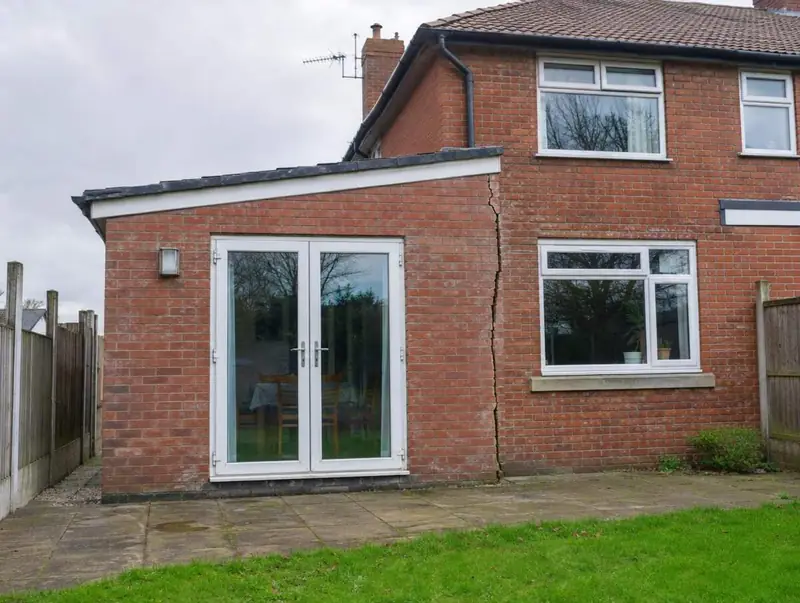
An extension and the house it joins rarely share a foundation. The original walls may be on deep, settled footings from decades ago, while the extension was built later on new, sometimes shallower concrete. The two parts settle and react to the ground differently, and the junction takes the strain. A crack there does not always mean the extension is failing.
Some separation is minor settlement that stopped years ago. Some is continuing movement caused by clay, roots, a leaking drain under the extension or poor original tie-ins. The repair depends on which. Where the cause or the fix needs an engineer’s judgement, an independent chartered structural engineer is appointed, and we can arrange this. We then repair the junction and any foundation work specified.
What are the signs you need extension pulling away repairs?
- A vertical crack or gap where the extension meets the house
- Daylight or draughts showing through the internal corner joint
- Extension roof flashing lifting off the original wall
- Floor level dropping where the extension and house floors meet
- Patio doors or windows in the extension starting to bind
- Mastic or render at the joint repeatedly splitting open
What causes it?
Shallower extension foundations
Older or small extensions, especially rear kitchens and porches, were sometimes built on shallower footings than the house. On clay those footings sit in ground that shrinks and swells, so the extension moves seasonally while the house stays still, and the junction opens and closes.
Drains running under or beside the extension
Extensions are often built over or next to existing drains. If a pipe was damaged during construction or has cracked since, leaking water softens clay or washes out sandy ground under the new footing. A CCTV drain survey is one of the first checks on any separating extension.
Weak or missing tie-ins
Where the new walls meet the old, builders should connect them with wall starter ties or bonding. Some extensions were simply butted up, or tied with too few fixings. Even small differential movement then opens a gap, though the foundation itself may be sound.
No movement joint where one was needed
Long extensions or ones built in different materials often need a designed movement joint to let each part move slightly on its own. Without one, the stress finds the weakest line, usually the junction or the wall next to it, and cracks appear.
Trees and roots near the extension
Extensions push the house closer to garden trees and hedges. Roots under a shallow extension footing can dry clay through the summer, causing the extension to drop and tilt away. Removing trees on clay can cause heave, so take advice before felling.
How is it repaired?
Junction crack repair with stainless ties
The open joint is cut out, stainless ties or helical bars are fixed across it into both the old and new masonry, and the joint is repointed or rendered to match. Inside, the corner is replastered. This suits extensions that moved once and have since stopped.
Best for: Settled extensions with a stable gap at the junction
Movement joint and making good
Where some seasonal movement is expected to continue, the junction is formed into a proper flexible movement joint with a compressible filler and sealant, so the two parts can move without cracking. Flashings and internal finishes are detailed to suit.
Best for: Minor ongoing movement that does not threaten the structure
Underpinning the extension
If the extension is still dropping because its footings are too shallow or on poor ground, they are taken deeper by mass concrete, beam-and-base or mini-piles. The engineer designs the scheme, and the junction is repaired once the new foundation is in.
Best for: Active movement from shallow footings, roots or soft ground
How much will extension pulling away repairs cost?
The cost mainly depends on whether the junction only needs tying or the extension needs new foundations, and on the length of the affected wall. Drain repairs, roof flashings, access and internal finishes also affect the price.
| Item | Guide price | Per |
|---|---|---|
| Junction crack repair with stainless tiesest. | £600 – £2,000 | per junction |
| Movement joint and making goodest. | £400 – £1,200 | per junction |
| Underpinning the extension where needed | £1,000 – £2,500 | per metre of wall |
See regional prices on the prices page or work out a guide price for your home with the guide price tool.
What happens, step by step?
Show us the junction
Send photos of the crack outside, the internal corner and any flashing above, with a measure for scale. We give a free initial assessment and an initial view on whether the gap is likely old or still opening.
Find what is moving
An independent chartered structural engineer can inspect, and we can arrange one. A drain survey under the extension, a trial pit at its footing and tell-tale monitoring across the joint are common checks before choosing the repair.
Choose the fix
The engineer decides between ties, a movement joint or underpinning. We confirm a fixed price in writing once the repair is specified, covering the junction, flashings, internal finishes and any foundation work.
Repair the junction
Drains are repaired first if they are leaking. The joint is then tied, formed as a movement joint or rebuilt after underpinning, with roof flashings reset so the junction stays watertight. Building control is handled where needed.
Finish and hand over
Internal corners are replastered, skirtings and coving refixed, and doors or windows in the extension eased where the movement affected them. Records of the repair and any approvals are passed to you.
How long will extension pulling away repairs take?
A junction tie-in or movement joint usually takes 1–2 days, and underpinning a small extension typically about a week on site.
Do you need building control or a party wall notice?
England and Wales
Junction repairs rarely need approval, but underpinning an extension is building work under Part A and needs building control approval and inspections; Wales has its own version of the regulations. If the extension is close to a neighbour’s wall or foundations, the Party Wall etc. Act 1996 may require notice.
Scotland
Strengthening an extension’s foundations generally needs a building warrant from the local authority verifier before work starts. There is no Party Wall Act, so check your title deeds and speak to neighbours if the extension is on or near a boundary.
Northern Ireland
Foundation work on an extension falls under the Building Regulations (Northern Ireland) 2012 and is checked by council building control. With no Party Wall Act, agree any boundary work with the neighbour first.
What if you have an insurance claim open?
Whether a separating extension is covered depends on the cause and your policy. Subsidence and heave are usually covered, subject to terms and the excess, but settlement of new construction and poor workmanship often are not. Tell your insurer before permanent repairs start. If a claim proceeds, we can price to the loss adjuster’s or engineer’s schedule and carry out the work. Any work outside the claim is priced separately.
Extension pulling away repairs: frequently asked questions
How much does it cost to fix an extension pulling away?
A junction crack repair with stainless ties is a guide £600 to £2,000 per junction inc VAT, and a movement joint with making good £400 to £1,200. Underpinning the extension, where needed, is around £1,000 to £2,500 per metre of wall. These are guides that vary by region and access, confirmed in writing after a survey.
Is it normal for an extension to crack at the join?
A fine crack at the junction is fairly common, especially in the first few years as a new extension settles. It becomes a concern when the gap is widening, tapering, letting in water or matched by sticking doors and sloping floors. Those signs point to continuing movement.
Why is my extension pulling away from my house?
Usually because the extension and the house sit on different foundations that react differently to the ground. Shallow extension footings, leaking drains under the extension, nearby roots and weak tie-ins between old and new walls are the common causes.
Can I just fill the gap with mastic?
Mastic can keep water out short term, but it does not stop movement or reconnect the walls. If the gap reopens after filling, something is still moving. Photograph and measure it over a few months first, so an engineer can see the trend.
Will my extension need underpinning?
Often not. Many separating extensions are fixed by repairing a drain, tying the junction or forming a movement joint. Underpinning is for extensions that keep dropping because their footings are too shallow or the ground beneath is poor, as shown by monitoring.
Who is responsible if a recent extension is moving?
If the extension is recent, the original builder, the designer or building control records may be relevant, and you may have rights against the builder. Gather the plans, completion certificate and contract. Insurance often excludes defects in new construction, so check your policy.
Can a drain under my extension cause it to move?
Yes, a cracked or displaced drain beneath or beside an extension can soften clay or wash away fine soil. A CCTV drain survey usually finds it. Repairing the drain is often the first and most important step before any repair to the walls.
What is a movement joint?
A movement joint is a deliberate, flexible break in a wall that lets two parts of a building move slightly without cracking. It is filled with a compressible material and sealed. At an extension junction it can replace a rigid joint that keeps cracking.
Where we carry out extension pulling away repairs
Extension pulling away repairs by area
Choose your area for local ground conditions, regional guide prices and the towns we cover.
England
- Bedfordshire
- Berkshire
- Bristol
- Buckinghamshire
- Cambridgeshire
- Cheshire
- Cornwall
- Cumbria
- Derbyshire
- Devon
- Dorset
- County Durham
- East Riding of Yorkshire
- East Sussex
- Essex
- Gloucestershire
- Greater London
- Greater Manchester
- Hampshire
- Herefordshire
- Hertfordshire
- Isle of Wight
- Kent
- Lancashire
- Leicestershire
- Lincolnshire
- Merseyside
- Norfolk
- North Yorkshire
- Northamptonshire
- Northumberland
- Nottinghamshire
- Oxfordshire
- Rutland
- Shropshire
- Somerset
- South Yorkshire
- Staffordshire
- Suffolk
- Surrey
- Tyne and Wear
- Warwickshire
- West Midlands
- West Sussex
- West Yorkshire
- Wiltshire
- Worcestershire