Walls and masonry
Brick arch repairs over windows and doors
Brick arch repairs are repairs to the arched brickwork spanning a window or door, either reinforcing a sound arch with stainless bars or taking down a failed one and rebuilding it over a temporary timber former.
Guide price from£400per arch inc VAT
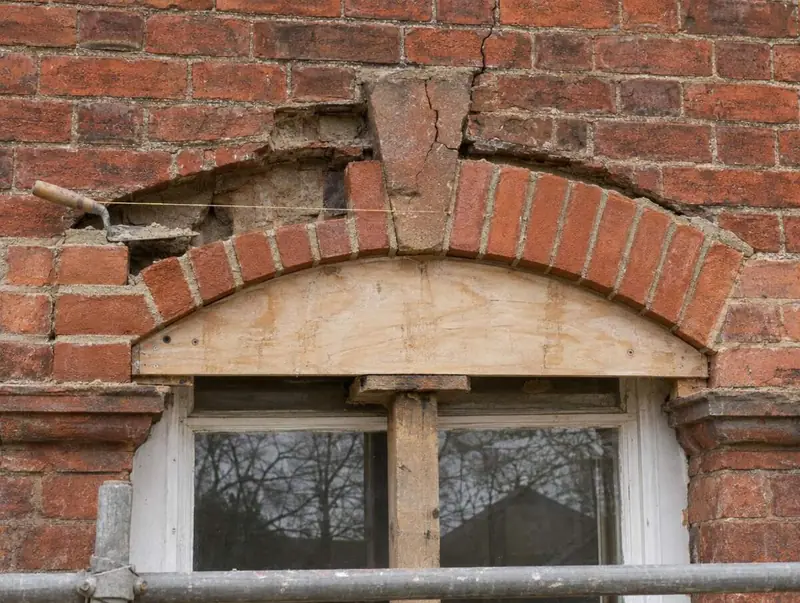
Many older houses carry the brickwork over their windows on arches rather than lintels: flat soldier courses, gently curved segmental arches or full semicircles. An arch works by wedging its bricks, the voussoirs, tightly against each other so the load flows out to the sides. As long as the bricks stay wedged and the wall at each side holds firm, an arch can stand indefinitely without any steel at all.
Trouble starts when that wedge loosens. Mortar erodes, the wall beside the opening moves slightly, or a hidden timber behind the arch rots, and the central keystone or a group of voussoirs slips down. Once an arch has dropped, it is carrying less and the brickwork above begins to crack. A sound but slightly loose arch can usually be reinforced in place, while a badly dropped one is taken down and rebuilt over a former.
What are the signs you need brick arch repairs?
- The centre bricks of an arch sitting lower than the rest
- A vertical crack running up from the middle of the arch
- Gaps opening between arch bricks at the top or bottom edge
- A flat arch that has started to sag into a shallow curve
- Cracks stepping out from the arch ends into the wall
- Mortar falling out of the arch joints after frosty weather
What causes it?
Spreading at the abutments
An arch pushes sideways as well as down. If the brickwork at either side of the opening moves even slightly, perhaps through settlement, a nearby crack or a window that is too close to a corner, the arch loses its wedge and the middle drops. Flat arches are especially sensitive to this.
Eroded or unsuitable mortar
Arches rely on full, tight joints. Weathered mortar, or hard cement mortar used in earlier repairs to soft brick, can let individual voussoirs work loose. Cement repointing also traps moisture, so frost damages the brick faces and the joints open further each winter.
Rotting timber behind the arch
Many Victorian arches are only one brick deep on the face, with a timber lintel behind carrying the inner part of the wall. When that timber rots, the inner wall drops and drags the arch with it. The arch may look like the problem when the real failure is the hidden timber.
Shallow or poorly built arches
Some flat soldier arches were little more than bricks stood on end with no real arch action, relying on a hidden bar or the window frame. When the frame is replaced or the bar rusts, they drop. These are among the most common arch repairs on terraced streets.
How is it repaired?
Reinforcing a sound arch
Where the arch has only dropped slightly and the bricks are sound, stainless helical bars are bonded into the bed joints just above it, extending well into the wall on each side. The bars turn the courses above into a reinforced band of masonry, so the arch no longer has to carry the full load. Joints are repointed to match.
Best for: Slightly dropped or cracked arches with sound bricks
Rebuilding over a former
A timber former is cut to the arch profile and propped under the opening. The old arch is carefully taken down, bricks cleaned for reuse, and the arch rebuilt over the former with tight joints and a properly set keystone. The former stays until the mortar is strong enough to carry the load.
Best for: Badly dropped arches or ones with loose voussoirs
Rebuilding both faces
Where the arch shows inside as well as outside, or a rotten timber behind it has also failed, both faces are rebuilt. The inner timber is replaced with a suitable lintel, and the outer arch is reformed in front. The two are worked in sequence so the wall is supported throughout.
Best for: Arches with a failed timber or inner face
Lime mortar repairs
On older houses built in soft brick and lime, the arch is rebuilt or repointed in a lime mortar matched to the original. Lime lets moisture escape and moves slightly with the wall, so it protects the bricks rather than forcing damage into them, as hard cement mortar can.
Best for: Pre-1919 houses and soft historic brick
How much will brick arch repairs cost?
Cost depends on whether the arch can be reinforced in place or must be rebuilt, the width and shape of the opening, whether both faces are involved, and how closely bricks and lime mortar must be matched.
| Item | Guide price | Per |
|---|---|---|
| Stitching and reinforcing a sound archest. | £400 – £1,200 | per arch |
| Rebuilding an arch (one side) | £900 – £1,300 | per opening |
| Rebuilding an arch (both sides) | £1,800 – £2,600 | per opening |
See regional prices on the prices page or work out a guide price for your home with the guide price tool.
What happens, step by step?
Look at the arch closely
Straight-on photos of the arch and the wall either side show us how far it has dropped, whether the bricks are sound and whether the cause seems to be the arch itself or the wall around it.
Choose reinforce or rebuild
We recommend reinforcement where the arch is sound and only slightly displaced, and a rebuild where it has dropped badly or bricks are loose. If the wall beside the opening is moving, that is dealt with first.
Support the opening
Props carry the brickwork above, and for a rebuild a former is made to the exact profile of the arch. The window or door frame is protected so it is not asked to carry any load.
Repair the arch
Bars are bonded into the joints above a sound arch, or the arch is taken down and relaid over the former using the original bricks where possible, with matched replacements for any that are damaged.
Strike the former and point
Once the mortar has cured enough, the former and props are removed. Joints are finished to match the surrounding wall, and any cracks running from the arch into the wall are repaired at the same visit.
How long will brick arch repairs take?
Reinforcing an arch usually takes a day, and rebuilding one typically takes one to two days, with the former left in while the mortar cures.
Do you need building control or a party wall notice?
England and Wales
Reinforcing or rebuilding an arch over an existing opening is usually a repair, though building control may want to see a rebuild of a wide opening. In conservation areas or on listed buildings, check with the council before changing materials or appearance.
Scotland
Like-for-like arch repairs do not usually need a building warrant. Listed buildings and conservation areas need consent for changes to appearance, so the arch should be rebuilt to match.
Northern Ireland
Arch repairs to an existing opening are generally treated as repair work under the Building Regulations (Northern Ireland) 2012. Listed buildings need consent for any alteration.
What if you have an insurance claim open?
A dropped arch caused by gradual weathering or a rotting timber is usually treated as wear and tear and not covered by buildings insurance. If the arch has dropped as part of wider cracking that may come from ground movement, tell your insurer before permanent repairs start so the cause can be investigated. We can price to your loss adjuster’s or engineer’s schedule if the arch forms part of a claim.
Brick arch repairs: frequently asked questions
How much do brick arch repairs cost?
Stitching and reinforcing a sound arch usually costs £400–£1,200 per arch. Rebuilding an arch on one side is typically £900–£1,300 per opening, or £1,800–£2,600 where both sides need rebuilding. These guide prices include VAT, vary by region and access, and are only confirmed in writing once we have surveyed the arch.
Why has the middle of my brick arch dropped?
The centre of an arch usually drops because the bricks have lost their wedge, either because the wall at the sides has moved or the mortar has worn away. A rotting timber hidden behind the arch is another common cause. The keystone slipping is the visible result.
Can a dropped arch be repaired without rebuilding it?
Yes, if the drop is small and the brickwork is in good condition. Bars bonded into the joints above can take the load off the arch and hold it in place. If the bricks are loose or the arch has dropped badly, rebuilding is the more reliable repair.
What is a former in arch building?
A former, sometimes called a centre, is a temporary timber frame cut to the exact shape of the arch. It supports the bricks while the arch is laid and the mortar cures, and is removed once the arch can carry itself.
Should a brick arch be repaired with lime mortar?
On older houses built with soft bricks and lime, yes, in most cases. Lime mortar lets the wall breathe and is weaker than the brick, so any movement or frost damage happens in the joints rather than the bricks. Modern hard brickwork can take a cement-based mortar.
Is a dropped brick arch dangerous?
A slightly dropped arch is not usually an immediate danger, but it is no longer carrying load as it should and tends to worsen. Loose bricks that could fall, or a fast-growing crack above, need prompt attention. Do not rely on the window frame to hold it.
Can you match the original bricks?
Usually, because most arches are rebuilt with their own cleaned bricks, which is the best match of all. Damaged bricks are replaced with reclaimed or new bricks chosen for size, colour and texture, and the mortar is matched to the surrounding joints.
Do flat brick arches need a lintel?
Many flat soldier arches were built with a hidden steel bar or timber behind, because they have little true arch action. When repairing one, we check what is supporting it and, where needed, reinforce it with bars or add suitable support behind.
Where we carry out brick arch repairs
Brick arch repairs by area
Choose your area for local ground conditions, regional guide prices and the towns we cover.
England
- Bedfordshire
- Berkshire
- Bristol
- Buckinghamshire
- Cambridgeshire
- Cheshire
- Cornwall
- Cumbria
- Derbyshire
- Devon
- Dorset
- County Durham
- East Riding of Yorkshire
- East Sussex
- Essex
- Gloucestershire
- Greater London
- Greater Manchester
- Hampshire
- Herefordshire
- Hertfordshire
- Isle of Wight
- Kent
- Lancashire
- Leicestershire
- Lincolnshire
- Merseyside
- Norfolk
- North Yorkshire
- Northamptonshire
- Northumberland
- Nottinghamshire
- Oxfordshire
- Rutland
- Shropshire
- Somerset
- South Yorkshire
- Staffordshire
- Suffolk
- Surrey
- Tyne and Wear
- Warwickshire
- West Midlands
- West Sussex
- West Yorkshire
- Wiltshire
- Worcestershire