England · East Midlands
Structural repairs in Northamptonshire
Structural repairs across Northamptonshire: subsidence, cracks, underpinning, wall ties, lintels and claim repairs. Much of Northamptonshire sits on clay that shrinks in dry summers and swells in wet winters.
- Nation
- England
- Pricing region
- East Midlands
- Towns listed
- 6
- Mining legacy
- Ironstone
What is the ground like in Northamptonshire?
Northamptonshire sits largely on Lias clay and Jurassic ironstones and limestones, with historic ironstone quarrying around Corby and Kettering. The clay vales are prone to shrinkage near trees.
Historic ironstone working has left disturbed ground in places.
What usually causes cracking in Northamptonshire?
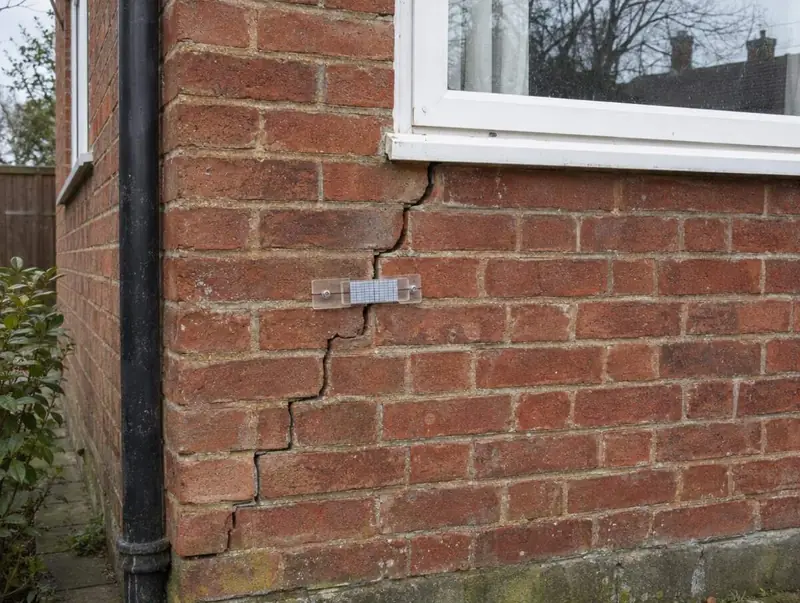
In Northamptonshire, cracking usually comes back to one of these. We rule each in or out before recommending a repair.
- Clay subsoil that shrinks and swells with the seasons, especially near trees and hedges
- Disturbed ground from historic ironstone working
- Heavy stone chimneys and gables pulling away from the house
- Weathered lime mortar letting stone walls spread
- Extensions and bays moving differently from the main house
What kind of buildings are common here?
Ironstone and limestone cottages, Victorian terraces in Northampton and Kettering, and new-town estates in Corby.
Which repairs do we carry out in Northamptonshire?
- Boundary and garden wall repairs
- Subsidence insurance claim repairs
- Structural surveys and crack monitoring
- Extension pulling away repairs
- Crack stitching
- Subsidence repairs
- Roof structure repairs
- Wall tie replacement
- Structural crack repairs
- Retaining wall repairs
- Resin injection ground stabilisation
- Floor joist repairs
- Gable end wall repairs
- Concrete repairs
- Underpinning
- Chimney stack repairs
- Bay window subsidence repairs
- Brick arch repairs
- Bowing wall repairs
- Lintel replacement
Guide prices in Northamptonshire
A selection of guide prices on East Midlands rates, including VAT. Each repair page has the full table.
| Item | Guide price | Per |
|---|---|---|
| Crack stitching: crack stitching with stainless helical bars | £80 – £175 | per metre of crack |
| Underpinning: mass-concrete underpinning | £980 – £1,450 | per metre of wall |
| Wall tie replacement: semi-detached house | £2,450 – £4,900 | per house |
| Bowing wall repairs: lateral restraint for a typical gable | £980 – £2,950 | per wall |
Towns we cover in Northamptonshire
We list 6 towns in Northamptonshire, covering 12 postcode districts in the NN postcode area. The largest are Northampton (about 250,000 people), Corby (about 68,000 people) and Kettering (about 57,000 people). Each town page has local postcodes, nearby places and the repairs we carry out there.
Do repairs in Northamptonshire need approval?
Stitching and like-for-like repairs rarely need approval in England. Underpinning and other strengthening work goes through building control, and work near a neighbour’s foundations can need a party wall notice.
Questions about structural repairs in Northamptonshire
Do you cover the whole of Northamptonshire?
Yes. We take enquiries from across Northamptonshire, including Northampton, Corby, Kettering and Wellingborough. A free initial assessment from your photos is the first step.
Is Northamptonshire affected by subsidence?
Northamptonshire is one of the parts of the UK where clay soils are most likely to move with the seasons. Historic ironstone working has left disturbed ground in places. Whether a particular building has moved, and why, needs an investigation on site.
How much do structural repairs cost in Northamptonshire?
It depends on the repair. On East Midlands rates, wall tie replacement on a semi-detached house from about £2,450 per house and lateral restraint for a bowing gable from about £980 per wall, including VAT. Your written price follows photos or a survey.
What should I send for a free assessment in Northamptonshire?
Photos of each crack inside and out with a coin or tape for scale, a wider shot showing where it is on the building, your postcode in Northamptonshire, and when you first noticed it. If an insurer is involved, include the claim reference.