Floors, roofs and outside walls
Concrete repairs for spalling and cracked concrete
Concrete repairs are repairs to reinforced concrete that has cracked, spalled or lost its cover, usually because the steel inside has started to rust. The damaged concrete is cut out, the steel treated and the section rebuilt, or cracks are sealed by injection.
Guide price from£85per m² inc VAT
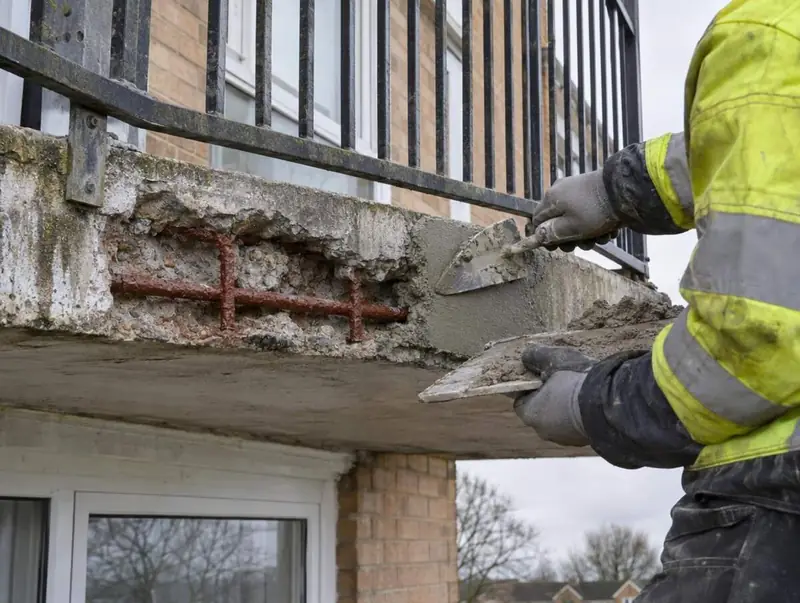
Concrete on homes and small buildings, from balconies, canopies and lintels to the frames of low-rise flats, is usually reinforced with steel bars. While the concrete around them stays alkaline and thick enough, the steel is protected. Over decades, carbon dioxide from the air slowly neutralises the outer layer, and once it reaches the steel, moisture can start it rusting. Rust takes up more space than steel, so it pushes the concrete off.
That is why spalling usually appears as flakes or chunks breaking away along a straight line, often with brown staining and a bare bar showing. Left alone, the steel keeps losing section and pieces can fall, which matters over a doorway or from a balcony. Repairs are routine for most small structures. We work on houses, flats and small commercial buildings, and bring in an independent chartered structural engineer where the damage affects strength.
What are the signs you need concrete repairs?
- Chunks or flakes of concrete breaking away from edges and soffits
- Rust-coloured stains or streaks running down the concrete surface
- Exposed steel bars showing where concrete has fallen away
- Fine cracks running in straight lines along the line of the reinforcement
- Hollow sound when the surface is tapped with a hammer
- Damp patches, white deposits or drips on a balcony or canopy underside
What causes it?
Carbonation
Carbonation is the slow reaction between carbon dioxide in the air and the alkaline concrete, which steadily lowers its alkalinity from the surface inward. Once the carbonated layer reaches the steel, the protection is lost and rust can begin. Older concrete, porous mixes and thin cover over the bars carbonate through sooner.
Thin cover to the reinforcement
The depth of concrete between the steel and the surface is called cover. On older balconies, lintels and canopies the bars were sometimes placed too close to the face, so carbonation and moisture reach them early. Thin cover is the reason spalling often follows the exact line of a bar.
Water and poor drainage
Balconies and canopies that hold standing water, or have failed drips and coatings, stay wet for long periods. Water carries the oxygen and moisture that rusting steel needs. Blocked outlets, missing upstands and cracked asphalt or membranes are common reasons a balcony deteriorates faster than the rest of the building.
De-icing salts and coastal exposure
Chlorides from road salt, de-icers spread on steps and paths, and sea spray can attack steel even where the concrete has not carbonated. Chloride-induced corrosion often causes local pitting that is deeper than the surface damage suggests, so suspected salt damage is usually tested before a repair is specified.
Movement and shrinkage cracking
Concrete shrinks as it dries and moves with temperature, and slabs without movement joints crack to relieve it. Overloading, settling supports and impact damage cause cracks too. Cracks let water reach the steel, so even a non-structural crack can start corrosion.
How is it repaired?
Patch repair
Loose and contaminated concrete is broken out behind the bar, the steel is cleaned of rust and primed, and the section is rebuilt with a repair mortar. The edges are cut square so the patch does not feather out and fail. A protective coating may be applied over the whole surface afterwards.
Best for: Localised spalling around rusting bars
Crack injection
Cracks are sealed at the surface, then a low-viscosity resin is injected under pressure through ports until it fills the crack. A rigid resin bonds the two faces back together, while a flexible one seals live cracks against water. The choice depends on whether the crack is still moving.
Best for: Cracks letting water in, or splitting a slab or beam
Protective coatings and sealing
After repair, an anti-carbonation coating, a waterproof deck membrane on a balcony, or a penetrating sealer slows the return of moisture and carbon dioxide. Restoring drips, upstands and falls so water drains away is as important as the coating itself.
Best for: Extending the life of repaired balconies and canopies
Recasting or strengthening
Where steel has lost much of its section, or a lintel or canopy is too far gone to patch, the element is propped and rebuilt, replaced or strengthened to an engineer’s design. It is less common, but sometimes the more lasting option for small canopies and old precast lintels.
Best for: Badly corroded lintels, canopies and balcony edges
How much will concrete repairs cost?
The price depends on the area to be broken out, how deep the corrosion goes, the length of any crack injection, coatings, and access such as towers, scaffold or work over a public footpath. Hidden damage found once concrete is opened up can change the area, so the quote states how that is measured.
| Item | Guide price | Per |
|---|---|---|
| Concrete patch repair | £85 – £180 | per m² |
| Crack injection | £180 – £480 | per metre |
| Small jobs (minimum visit)est. | £450 – £900 | per visit |
See regional prices on the prices page or work out a guide price for your home with the guide price tool.
What happens, step by step?
Photos and a description
Send photos of the damage close up and from a distance, plus the whole balcony, canopy or elevation. Tell us roughly how old the building is and whether anything has fallen, so we can judge whether to make it safe first.
Survey and tapping test
On site we tap the surface to find hollow areas, check the steel where it is exposed and note drainage. Where the extent is unclear, a cover meter, carbonation test or chloride test may be advised before repair.
Engineer where needed
If the steel has lost significant section, or the element carries a balcony, stair or wall, an independent chartered structural engineer is appointed to assess and specify. We can arrange this, and the repair follows their scope.
Written quote
You receive a no-obligation written quote setting out the estimated area of patching, the length of crack injection, coatings and access. It becomes a fixed price in writing once the repair is specified, with any re-measure terms stated clearly.
Break out, repair, protect
Damaged concrete is cut back to sound material, steel cleaned and primed, and the section rebuilt and cured. Cracks are injected, then the surface is coated and drainage details put right so water runs off rather than sitting.
How long will concrete repairs take?
Patch repairs to a single balcony, canopy or lintel usually take one to three days, plus curing time before any coating is applied.
Do you need building control or a party wall notice?
England and Wales
Like-for-like concrete repairs are usually treated as repairs, but rebuilding or strengthening a balcony, canopy or structural element can be building work under Part A, and we deal with building control where the work needs it. In blocks of flats, the freeholder or managing agent normally has to agree the work first.
Scotland
Small concrete repairs often need no building warrant, but rebuilding or strengthening a structural element generally does, before work starts. In tenements and flatted blocks, the title deeds and the tenement rules decide who repairs common parts.
Northern Ireland
Council building control, under the Building Regulations (Northern Ireland) 2012, can confirm whether rebuilding a balcony or canopy needs approval. In flats, the lease or management company usually controls work to the structure.
What if you have an insurance claim open?
Carbonation, rusting reinforcement and spalling are gradual deterioration, which buildings policies usually exclude, so most concrete repairs are paid for privately or through a block’s service charge. Damage from a sudden impact, such as a vehicle hitting a canopy or column, may be covered. If you think a sudden event caused the damage, tell your insurer before permanent repairs start, and we can price to your loss adjuster’s schedule.
Concrete repairs: frequently asked questions
How much do concrete repairs cost?
Concrete patch repair usually costs £85–£180 per m², crack injection is typically £180–£480 per metre, and small jobs carry a minimum visit charge of about £450–£900. These are guide prices inc VAT; they vary by region and access and are confirmed in writing after a survey.
What is spalling concrete?
Spalling is concrete breaking away from the surface in flakes or chunks. In reinforced concrete it is usually caused by the steel inside rusting and expanding, which pushes the cover off. It often follows a straight line where a bar sits close to the surface, with rust staining nearby.
Is spalling concrete dangerous?
It can be, mainly because pieces may fall from balconies, canopies and soffits above doors or paths. It also means the steel is losing strength over time. Fence off the area below any loose concrete, keep people off a balcony that is badly affected, and have it assessed soon.
What is carbonation in concrete?
Carbonation is the gradual reaction between carbon dioxide in the air and concrete, which lowers its alkalinity from the surface inward. Alkaline concrete protects the steel inside, so when carbonation reaches the bars, they can start to rust. A simple test on a freshly broken surface shows how deep it has gone.
Can a concrete balcony be repaired rather than replaced?
In most cases, yes. Patch repairs, crack injection, a new waterproof deck and restored drips usually extend a balcony’s life considerably. Replacement is generally only needed where the steel has lost a lot of section or the balcony’s fixing to the building is compromised.
Can you repair a cracked concrete lintel?
Often, yes. Spalling and small cracks in a concrete lintel can be patch repaired and the steel treated. If the lintel is badly cracked, sagging or the bars have lost much of their section, replacement is usually better, and the opening is propped while it is done.
Why does concrete crack and rust?
Concrete cracks as it shrinks, moves with temperature or carries more load than intended. Steel inside it rusts when carbonation or salts reach it and moisture gets in. The two feed each other: cracks let water in, and rusting steel expands and cracks the concrete further.
Do you repair concrete on blocks of flats?
Yes, we repair concrete on houses, flats and small commercial buildings, including balconies, walkway edges, canopies and lintels. For flats, the freeholder, managing agent or owners’ association normally instructs the work. We can price to an engineer’s schedule where one has been prepared.
Where we carry out concrete repairs
Concrete repairs by area
Choose your area for local ground conditions, regional guide prices and the towns we cover.
England
- Bedfordshire
- Berkshire
- Bristol
- Buckinghamshire
- Cambridgeshire
- Cheshire
- Cornwall
- Cumbria
- Derbyshire
- Devon
- Dorset
- County Durham
- East Riding of Yorkshire
- East Sussex
- Essex
- Gloucestershire
- Greater London
- Greater Manchester
- Hampshire
- Herefordshire
- Hertfordshire
- Isle of Wight
- Kent
- Lancashire
- Leicestershire
- Lincolnshire
- Merseyside
- Norfolk
- North Yorkshire
- Northamptonshire
- Northumberland
- Nottinghamshire
- Oxfordshire
- Rutland
- Shropshire
- Somerset
- South Yorkshire
- Staffordshire
- Suffolk
- Surrey
- Tyne and Wear
- Warwickshire
- West Midlands
- West Sussex
- West Yorkshire
- Wiltshire
- Worcestershire