Walls and masonry
Wall tie replacement for cavity walls
Wall tie replacement is the installation of new stainless remedial ties to reconnect the two leaves of a cavity wall when the original metal ties have corroded, with the old ties isolated or removed where specified.
Guide price from£1,800per house inc VAT
A cavity wall is two thin walls standing side by side, held together by metal ties built into the mortar joints. In many houses built before the 1980s those ties were mild steel with a zinc coating that has since worn away. As the steel rusts, it swells to several times its original thickness, lifting the outer brickwork at every row of ties and gradually loosening the bond between the two leaves.
The tell-tale result is a set of fine horizontal cracks along the bed joints, repeating every few courses up the wall, often with a slight bulge or a roofline that has risen. Left alone, the outer leaf can lose its support and, in the worst cases, part of it can fall. The repair itself is routine: survey the ties, fit new stainless remedial ties, and deal with the old ones so they cannot cause further cracking.
What are the signs you need wall tie replacement?
- Horizontal cracks along mortar joints, repeating every few brick courses
- Outer brickwork bowing or bulging, often worst near the top
- The roof edge or verge lifting slightly above the brickwork
- Mortar joints that look wider or opened up on one elevation
- Cracked render with a regular horizontal pattern
- A house built before the 1980s on an exposed or coastal site
What causes it?
Corrosion of mild steel ties
Older galvanised steel ties rely on a thin zinc coating, which slowly sacrifices itself to protect the steel. Once it has gone, the steel rusts quickly. Rust occupies far more space than the original metal, so each tie acts like a small jack in the mortar joint, lifting the brickwork above it.
Black mortar and aggressive conditions
Some older mortars made with ash or clinker are acidic and speed up corrosion. Walls facing prevailing wind and rain, coastal sites with salt in the air, and walls that stay damp all lose their ties sooner. One elevation often fails years before the others.
Too few or badly placed ties
Some houses were built with fewer ties than they should have, or with ties that barely reach into one leaf. Survey sometimes finds ties missing entirely or only bedded in the cavity, leaving the outer leaf poorly restrained even where nothing has rusted.
Wire ties that thin rather than swell
Thinner wire ties rarely crack the wall, because there is too little metal to swell. Instead they corrode until they snap, and the outer leaf loses its restraint without obvious warning. These are usually only found by a survey, which is why age and exposure matter as much as visible cracking.
How is it repaired?
Remedial tie installation
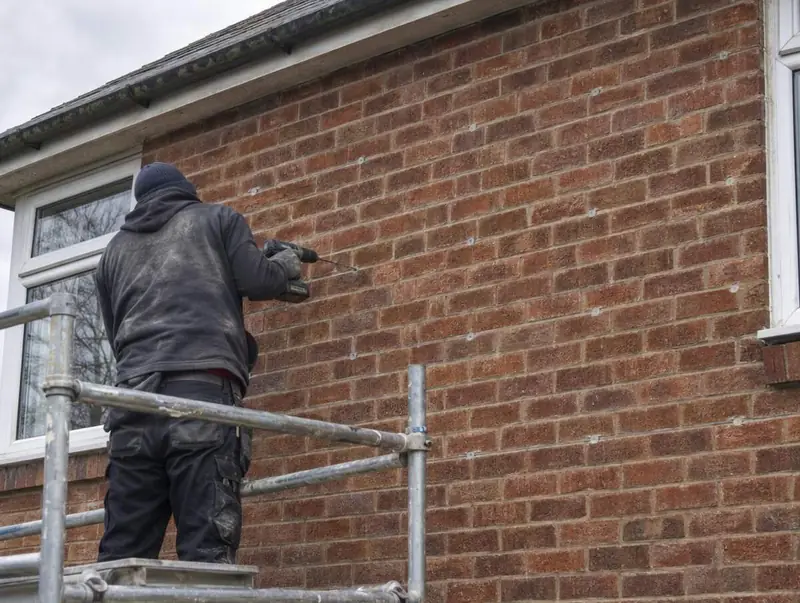
New stainless ties are drilled through the outer leaf into the inner leaf, then fixed by mechanical expansion or resin, depending on the masonry. They are placed to a set grid across each elevation, with extra ties around openings and at the edges. Holes are made good in matching mortar.
Best for: Walls where the original ties have failed or are missing
Isolating the old ties
Where the old ties are swelling and cracking the brickwork, fitting new ties alone may not stop further damage. Each old tie can be isolated, usually by cutting it through within the cavity or sleeving its outer end, so it can no longer lift the outer leaf as it continues to corrode.
Best for: Thick mild steel ties still causing horizontal cracking
Removing old ties and rebedding
On badly cracked elevations the old ties are cut out from the outer face, the joints raked and rebedded, and the brickwork repointed. It is more work than isolation but removes the source of expansion entirely. An engineer or the survey report usually specifies where this is needed.
Best for: Elevations with severe cracking or lifting
Partial rebuild of the outer leaf
If a section of the outer leaf has bulged too far to be tied back, it is carefully taken down and rebuilt with new ties built in as the work goes up. This is uncommon, and is usually limited to a gable top, a parapet or a panel under a window.
Best for: Outer leaf too distorted to tie back safely
How much will wall tie replacement cost?
Price is driven by the number of elevations needing ties, the wall area, whether old ties must be isolated or removed, and the scaffold. Rendered walls, tall gables and difficult access cost more.
| Item | Guide price | Per |
|---|---|---|
| Mid-terrace houseest. | £1,800 – £3,500 | per house |
| Semi-detached house | £2,500 – £5,000 | per house |
| Detached houseest. | £3,500 – £7,000 | per house |
| Scaffolding where neededest. | £600 – £1,800 | per elevation |
See regional prices on the prices page or work out a guide price for your home with the guide price tool.
What happens, step by step?
Tie survey
A metal detector locates the existing ties and shows their pattern. Small holes are then drilled at sample points and a borescope passed into the cavity to see the tie condition, type and embedment. The holes are made good afterwards.
Report and quote
You receive a written summary of what the survey found on each elevation, which walls need new ties, whether old ties should be isolated or removed, and a no-obligation written quote with scaffold shown separately.
Access
Ties are fitted across the whole of each affected elevation, so scaffold or a tower is usually needed above ground floor. We plan access around conservatories, extensions, neighbours’ land and any parking that must be suspended.
Install the new ties
New stainless ties are drilled and fixed to the specified grid, with closer spacing around windows, doors and the roofline. Sample ties can be pull-tested to confirm they are holding in your particular brick and block.
Deal with the old ties and make good
Old ties are isolated or removed where the report calls for it, cracked joints are raked out and repointed, and drilled holes are filled in matching mortar. A written note of tie positions and findings goes in your property file.
How long will wall tie replacement take?
Replacing the wall ties on a typical semi-detached house usually takes two to three days once scaffold is up.
Do you need building control or a party wall notice?
England and Wales
Remedial wall tie work is usually treated as a repair, but where an outer leaf is rebuilt or an engineer redesigns the restraint, building control may need to be involved. Scaffold on a pavement or road needs a licence from the council.
Scotland
Like-for-like tie replacement does not usually need a building warrant, though rebuilding part of a wall may. Scaffold on a public road or footway needs a permit from the council.
Northern Ireland
Tie replacement is generally a repair under the Building Regulations (Northern Ireland) 2012, but your council’s building control can confirm for any rebuild. Scaffold on the pavement needs permission first.
What if you have an insurance claim open?
Wall tie failure is gradual deterioration, so home insurance does not usually cover it, and most policies exclude wear and tear. It is different from subsidence, although the cracks are sometimes confused at first. If an insurer or surveyor has suggested your cracks might be ground movement, tell your insurer before permanent repairs start and let the cause be confirmed. A mortgage valuation that flags tie failure usually expects a specialist report and quote.
Wall tie replacement: frequently asked questions
How much does wall tie replacement cost?
Wall tie replacement usually costs about £1,800–£3,500 for a mid-terrace, £2,500–£5,000 for a semi and £3,500–£7,000 for a detached house. Scaffolding, where needed, is typically £600–£1,800 per elevation. Treat these as guide prices inc VAT: they shift with region and access, and we confirm the actual figure in writing after a survey.
How do I know if my wall ties have failed?
The clearest sign is horizontal cracking in the mortar joints repeating every few courses, often with a bulge or a lifted roofline. Wire ties can fail with no cracking at all, so a tie survey with a metal detector and borescope is the only reliable check.
Which houses are most at risk of wall tie failure?
Cavity-walled houses built before the 1980s are most at risk, especially those with mild steel ties, black ash mortar or an exposed position. Coastal and hilltop houses, and elevations facing the prevailing weather, tend to fail first.
Do the old wall ties have to be removed?
Not always, because thin wire ties that cannot swell are usually left in place once new ties are fitted. Thicker ties that are still expanding and cracking the wall are isolated or removed so they stop causing damage. The survey decides which applies.
Do all walls of the house need new ties?
Not necessarily, because ties often fail on one exposed elevation long before the others. The survey checks each wall, and the quote covers only the elevations where ties have failed or are close to it. Sheltered walls may simply be noted for future checks.
Is wall tie failure covered by insurance?
Usually not, because insurers treat it as gradual deterioration. Damage caused by a sudden event, such as part of a wall collapsing in a storm, may be treated differently under some policies. Check your policy wording, and tell your insurer if you are unsure.
Can wall ties be replaced on a rendered house?
Yes, new ties can be fitted through render, with each drill hole made good afterwards. The repairs can show on painted render, so redecoration of the affected elevation is often worth including. Render can also hide the cracking pattern, so a survey matters more.
Will a mortgage lender accept wall tie replacement?
Lenders generally accept properly carried out tie replacement, but they may want to see the survey, the quote or a record of the completed work. If a valuation has flagged wall ties, a written report and itemised quote are usually what the lender or buyer needs next.
Where we carry out wall tie replacement
Wall tie replacement by area
Choose your area for local ground conditions, regional guide prices and the towns we cover.
England
- Bedfordshire
- Berkshire
- Bristol
- Buckinghamshire
- Cambridgeshire
- Cheshire
- Cornwall
- Cumbria
- Derbyshire
- Devon
- Dorset
- County Durham
- East Riding of Yorkshire
- East Sussex
- Essex
- Gloucestershire
- Greater London
- Greater Manchester
- Hampshire
- Herefordshire
- Hertfordshire
- Isle of Wight
- Kent
- Lancashire
- Leicestershire
- Lincolnshire
- Merseyside
- Norfolk
- North Yorkshire
- Northamptonshire
- Northumberland
- Nottinghamshire
- Oxfordshire
- Rutland
- Shropshire
- Somerset
- South Yorkshire
- Staffordshire
- Suffolk
- Surrey
- Tyne and Wear
- Warwickshire
- West Midlands
- West Sussex
- West Yorkshire
- Wiltshire
- Worcestershire