Walls and masonry
Structural crack repairs for cracked walls
Structural crack repairs are repairs to cracked masonry walls that restore strength and keep the weather out, chosen after the crack’s type, width and cause have been identified. They range from repointing a hairline crack to stitching or rebuilding a wide one.
Guide price from£80per metre of crack inc VAT
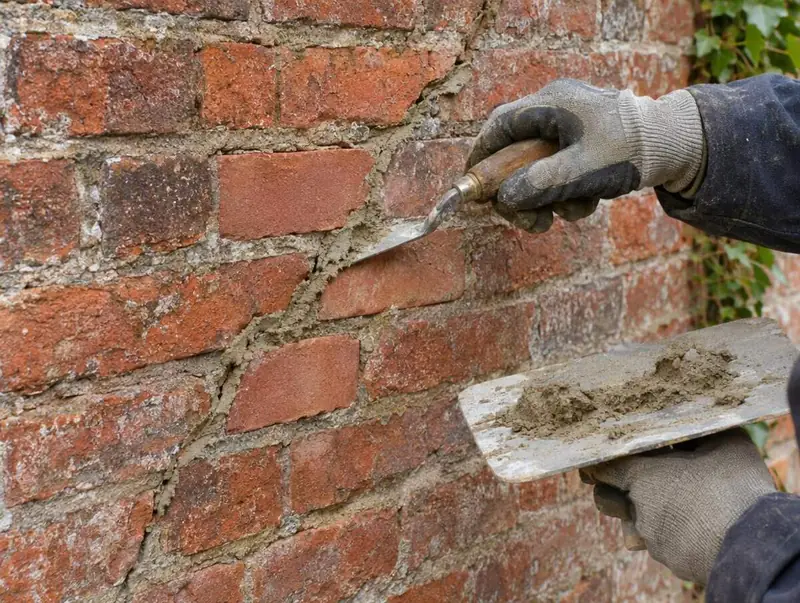
A crack in a wall is a symptom, not a diagnosis. Its shape, where it starts, how wide it is and whether it is still moving tell you far more than its length. Stepped cracks along the mortar joints, vertical cracks near corners, horizontal cracks along a course and cracks that taper from wide to narrow each point to a different cause. So the order of work matters: find the cause, deal with it, then repair the wall.
Most cracks in houses are cosmetic. BRE Digest 251 grades damage by typical crack width, and anything up to about 5 mm usually falls in the aesthetic categories, where filling, repointing and redecorating are enough. Wider or growing cracks, sticking doors and cracks that pass right through the wall need closer attention. We start with a free initial assessment from your photos or a call, and bring in an independent chartered structural engineer when the repair needs one.
What are the signs you need structural crack repairs?
- Stepped cracks zigzagging through the mortar joints of outside brickwork
- A crack noticeably wider at the top than the bottom, or the reverse
- Doors or windows that have started sticking or no longer latch
- Cracks that reappear in the same place after filling and painting
- Daylight or a draught coming through a crack in an outside wall
- Diagonal cracks running from the corners of windows and doors
What causes it?
Ground movement under the foundations
Subsidence and heave move the foundations, and the walls above crack to follow them. Shrinkable clay drying out near trees, or ground softened by a leaking drain, are the usual culprits. These cracks are often tapered and run diagonally from openings.
Thermal and moisture movement
Brick and block expand and contract with temperature and moisture. Long walls without movement joints, and junctions between different materials, crack as a result. Such cracks tend to be vertical and even in width, and are usually cosmetic, though they can let rain in.
Rusting wall ties
In cavity walls built before the 1980s, the metal ties linking the two leaves can rust and swell. That expansion lifts the outer brickwork at each row of ties, leaving horizontal cracks every few courses. It is a specific defect with its own repair.
Failing lintels, arches and restraint
Openings are the weak points in a wall. A corroded or sagging lintel, or a dropped arch, sends cracks up from the top corners of a window or door. Walls that have lost their connection to floors or roof can bow and crack horizontally instead.
How is it repaired?
Filling and repointing
For hairline and narrow cracks that have stopped moving, the crack line is raked out and repointed in mortar matched to the original for strength, colour and texture. Inside, plaster cracks are cut out, filled with a flexible filler and redecorated.
Best for: Cracks up to about 5 mm that are no longer moving
Crack stitching with helical bars
Stainless steel helical bars are grouted into slots cut along the bed joints, bridging the crack so the masonry works as one piece again. It is the standard repair for wider stepped and vertical cracks once whatever caused them has stopped.
Best for: Stable cracks wider than about 5 mm, or ones that keep reopening
Rebuilding a cracked section
Where bricks have split or the wall has moved out of line, the damaged area is taken down and rebuilt, bonded into sound masonry on either side. Reclaimed or matched bricks keep the repair discreet, with temporary support used where needed.
Best for: Badly displaced or broken brickwork
How much will structural crack repairs cost?
The price depends mainly on how many cracks there are, their total length, whether work is needed inside as well as out, and how easy the wall is to reach. Scaffold, matching old bricks and any engineer’s design add to the cost.
| Item | Guide price | Per |
|---|---|---|
| Crack stitching with helical bars | £80 – £180 | per metre of crack |
| Single crack, outside only (up to about 2 m)est. | £400 – £900 | per crack |
| Internal making good and redecoration of the crack lineest. | £150 – £500 | per room |
See regional prices on the prices page or work out a guide price for your home with the guide price tool.
What happens, step by step?
Send photos
Photograph the crack from a distance and close up, with a coin or tape measure for scale. From these we say whether it looks cosmetic, needs a visit or calls for an engineer.
Survey and record
On site we measure the width along the crack, note its pattern and check nearby drains, trees and openings. If the cause is unclear, gauges can be fixed across it and read over several months.
Deal with the cause
Leaking drains, failed ties, a sagging lintel or ground movement are put right first, sometimes through an insurance claim. Repairing a crack before its cause is fixed usually means paying for the same job twice.
Written quote
You receive a no-obligation written quote listing each crack, the repair method chosen for it and the making good inside and out. Once the scope is settled, that becomes a fixed price in writing.
Repair and make good
Cracks are stitched, repointed or rebuilt as specified, with mortar matched to the existing wall. Internal crack lines are filled and redecorated where included, and you get a written note of what was done.
How long will structural crack repairs take?
A single crack is often repaired in a day, and a house with several stitched cracks usually takes one to three days on site.
Do you need building control or a party wall notice?
England and Wales
Repairing a crack is usually treated as a repair rather than new building work, but a rebuild or engineer-designed scheme may need building control, which we deal with where the work needs it. Work to a shared wall can fall under the Party Wall etc. Act 1996.
Scotland
Like-for-like crack repairs often need no building warrant, but structural work generally does, approved by the local authority verifier before work starts. With no Party Wall Act, shared walls are governed by title deeds and common law.
Northern Ireland
Your council’s building control, working under the Building Regulations (Northern Ireland) 2012, can confirm whether a structural repair needs approval. Northern Ireland has no Party Wall Act, so repairs to a wall you share are best settled with the owner next door beforehand.
What if you have an insurance claim open?
If a crack may be caused by subsidence or heave, tell your insurer before permanent repairs start. Buildings policies usually cover subsidence subject to their terms, and the subsidence excess is commonly about £1,000. A loss adjuster is appointed, often with an engineer, and drain checks or monitoring of up to 12 months may come before any repair is agreed. We can price to your loss adjuster’s or engineer’s schedule. Shrinkage and age cracking are not usually covered.
Structural crack repairs: frequently asked questions
How much do structural crack repairs cost?
Stitching with helical bars is typically £80–£180 per metre of crack, and a single outside crack up to about 2 m is often £400–£900. Internal making good is typically £150–£500 per room. These are guide prices inc VAT, varying by region and access, confirmed in writing after a survey.
When is a crack in a wall structural?
A crack is more likely to be structural when it is wider than about 5 mm, tapers, passes through the whole wall or keeps growing. BRE Digest 251 treats damage up to about 5 mm as aesthetic and over 25 mm as a stability concern. Width is a guide, not a diagnosis.
What do stepped cracks in brickwork mean?
Stepped cracks usually mean part of the wall has moved and the weakest path, the mortar joints, has given way. They are common with subsidence and around openings. A thin stepped crack unchanged for years is often cosmetic, while a wide or tapered one should be looked at.
Are horizontal cracks in a wall serious?
Horizontal cracks are often more serious than vertical ones, because they suggest the wall is being pushed or lifted. Cracks repeating every few courses point to rusting wall ties, while one long crack with a bulge may mean lost restraint.
What causes vertical cracks in walls?
Vertical cracks are most often caused by thermal or moisture movement in long walls, or by the joint between old and newer work. An even-width vertical crack is usually cosmetic. One clearly wider at the top or bottom can indicate foundation movement at one end.
Can I just fill a crack and paint over it?
You can fill a fine crack that is not moving, and for many hairline cracks that is the right repair. Filling a crack that is still opening hides the evidence, and it will usually come back. If a filled crack returns within a year or two, have it assessed.
Should I tell my insurer about cracks in my house?
Yes, if you think the cracks could come from subsidence or heave, tell your insurer before any permanent repair, because repairing first can make a claim harder to prove. Cracks from normal shrinkage or ageing are not usually covered, and the insurer decides which applies.
Do I need a structural engineer for a cracked wall?
Not always, since many cracks can be judged from photos and a visit. An engineer is worthwhile when cracks are wide, tapered, growing or part of a claim. Where the repair needs an engineer’s design or sign-off, an independent chartered structural engineer is appointed, and we can arrange this.
Where we carry out structural crack repairs
Structural crack repairs by area
Choose your area for local ground conditions, regional guide prices and the towns we cover.
England
- Bedfordshire
- Berkshire
- Bristol
- Buckinghamshire
- Cambridgeshire
- Cheshire
- Cornwall
- Cumbria
- Derbyshire
- Devon
- Dorset
- County Durham
- East Riding of Yorkshire
- East Sussex
- Essex
- Gloucestershire
- Greater London
- Greater Manchester
- Hampshire
- Herefordshire
- Hertfordshire
- Isle of Wight
- Kent
- Lancashire
- Leicestershire
- Lincolnshire
- Merseyside
- Norfolk
- North Yorkshire
- Northamptonshire
- Northumberland
- Nottinghamshire
- Oxfordshire
- Rutland
- Shropshire
- Somerset
- South Yorkshire
- Staffordshire
- Suffolk
- Surrey
- Tyne and Wear
- Warwickshire
- West Midlands
- West Sussex
- West Yorkshire
- Wiltshire
- Worcestershire