Walls and masonry
Crack stitching for cracked brickwork
Crack stitching is a masonry repair in which stainless steel helical bars are bonded into slots cut along the mortar bed joints, bridging a crack so the brickwork carries load as one piece again.
Guide price from£80per metre of crack inc VAT
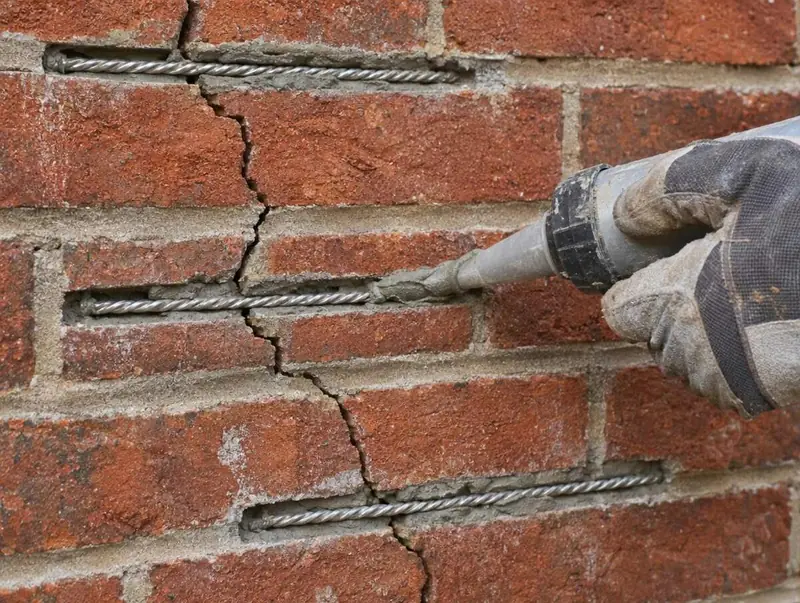
Once a wall has cracked, the two sides behave as separate panels. Stitching reconnects them. Slots are cut into the horizontal joints across the crack, a thin twisted stainless bar is bedded in grout inside each one, and the joints are pointed over so the repair almost disappears. Because the work stays within the existing wall, there is rarely any need to take brickwork down, and most houses are stitched in a day or two.
Stitching is a repair, not a cure. It does not stop a wall that is still moving, so anything driving the crack, such as a leaking drain, a thirsty tree on clay, failed wall ties or a sagging lintel, has to be dealt with first. Done in that order, a stitched wall usually stays closed. Done the other way round, a new crack often opens beside the old one within a season or two.
What are the signs you need crack stitching?
- A crack you can fit a coin into, running through bricks and mortar
- Filled cracks that keep reopening along the same line
- Stepped cracking beside a window, door or corner
- Bricks split clean through where the crack crosses them
- A crack visible on both the inside and outside face of the wall
- Cracking that a surveyor or engineer has said is now stable
What causes it?
Movement that has since stopped
Historic subsidence, settlement of a new extension or an old drain leak that has been fixed often leave cracks behind once the movement ends. This is where stitching is most useful, because the wall only needs reconnecting. Evidence that movement has stopped, such as unchanged measurements over time, gives the repair the best chance.
Weak points around openings
Walls are weakest at window and door heads, under sills and at corners. Small movements concentrate there, and cracks run from the corners of openings. Stitching above and below the opening spreads the stress back into the surrounding brickwork, often alongside work to the lintel or arch.
Thermal and drying movement
Long runs of brick or block expand and shrink with the weather. Where no movement joint was built in, a vertical crack eventually forms. Stitching closes it, but if the wall still needs room to move, a proper movement joint may be the better answer, and we will say so.
Poorly bonded junctions
Extensions, bays and later walls are sometimes butted against the original house with little or no bond. The joint opens into a crack that runs the full height. Stitching or tying across the junction can reconnect the two, provided neither part is still settling.
How is it repaired?
Helical bars in cementitious grout
The most common approach. A slot is cut along the bed joint with a twin-blade cutter, flushed out and part filled with a cement-based grout. The helical bar is pushed in, more grout is packed over it, and the joint is pointed to match. The grout cures over a few days.
Best for: Most brick and block walls, including older softer bricks
Helical bars in resin grout
A resin grout bonds quickly and strongly to the bar and masonry and suits wet conditions or work that must take load sooner. It is less forgiving of soft or crumbly bricks, so the choice of grout is made wall by wall rather than as a rule.
Best for: Dense bricks, damp walls and repairs needing a fast cure
Stitching with crack injection
Once the bars are in, the crack itself is filled. Fine cracks are pointed in matching mortar, while wider or deeper cracks can be injected with grout so the void inside the wall is filled rather than just the face. On older houses, lime mortar keeps the repair breathable.
Best for: Deep cracks running through the full thickness of the wall
How much will crack stitching cost?
The total depends on the combined length of cracks, how many need bars on both faces, the height you need to reach and whether internal making good is included. Very short runs of stitching are priced at the minimum visit charge.
| Item | Guide price | Per |
|---|---|---|
| Crack stitching with stainless helical bars | £80 – £180 | per metre of crack |
| Small jobs (minimum visit)est. | £350 – £500 | per visit |
| Repointing over the stitched line in matching mortarest. | £30 – £60 | per metre |
See regional prices on the prices page or work out a guide price for your home with the guide price tool.
What happens, step by step?
Confirm the cause has stopped
Before quoting we check what made the wall crack and whether it is still moving. If there is doubt, we suggest a period of monitoring or an engineer’s view, rather than stitching a crack that will simply open again.
Set out the bars
Bar positions are marked across the crack, typically every few courses up its full height, with each bar extending well into sound brickwork on both sides. An engineer’s specification, where there is one, sets the exact spacing and length.
Cut, clean and grout
Slots are cut into the bed joints to the right depth, dust is blown and washed out, and grout is placed. The bars are pressed home and covered, and the crack line is filled or injected.
Repoint to match
The cut joints and crack are pointed in a mortar chosen to match the colour, texture and strength of the existing work. On older houses with soft bricks, a lime mortar is used so the repair does not trap moisture.
Make good and record
Internal plaster cracks are cut out and filled where included, and dust is cleared. You receive a short note of where the bars went, which is useful for future buyers, surveyors and any insurance file.
How long will crack stitching take?
A single stitched crack is often finished in a morning, and a whole house rarely needs more than one to three days.
Do you need building control or a party wall notice?
England and Wales
Crack stitching is normally a repair that needs no building control approval, though it may form part of a larger scheme that does. If the cracked wall is a party wall, check whether the Party Wall etc. Act 1996 applies before work starts.
Scotland
Stitching an existing wall is usually a repair outside the building warrant system, unless it is part of wider structural work. Shared walls in Scotland are a matter for your title deeds and common law, so read those before stitching one.
Northern Ireland
Stitching is generally treated as a repair under the Building Regulations (Northern Ireland) 2012, but your council can confirm for a larger scheme. With no Party Wall Act, agree work to a shared wall with your neighbour first.
What if you have an insurance claim open?
Stitching is often the final repair in a subsidence claim, carried out after the loss adjuster is satisfied the movement has stopped. If you think your cracks are subsidence-related, tell your insurer before permanent repairs start, because stitching first can remove the evidence. The insurer may want the crack measured for as long as 12 months beforehand. We can price to your loss adjuster’s or engineer’s schedule, with any extra work you want quoted separately.
Crack stitching: frequently asked questions
How much does crack stitching cost?
Crack stitching usually costs £80–£180 per metre of crack, with a minimum visit of about £350–£500 for small jobs. Repointing over the stitched line in matching mortar is typically £30–£60 per metre. All three are guide prices inc VAT; your region and the access affect them, and the figure is confirmed in writing after a survey.
Does crack stitching stop a wall moving?
No, crack stitching reconnects cracked masonry but does not stop the movement that caused it. If the ground is still shrinking, a drain is still leaking or ties are still rusting, a stitched wall can crack again nearby. The cause has to be identified and dealt with first.
How long does crack stitching last?
Stainless steel bars do not rust, so a stitched repair in a stable wall should last as long as the surrounding brickwork. The repair only fails early when the wall keeps moving, which is why the cause is dealt with before the bars go in.
How far apart are helical bars placed?
Helical bars are usually placed every few courses up the full height of the crack, each one running well past the crack into sound brickwork. Spacing and bar length depend on the wall and the crack width, and where an engineer has specified the repair, their drawing sets them.
Will crack stitching be visible afterwards?
Usually only slightly, because the bars sit inside the mortar joints and are pointed over. The main giveaway is the colour of new mortar, which can take a few months to weather. Careful mortar matching keeps the line discreet, especially on older brickwork.
Is resin or cement grout better for crack stitching?
Neither is better in every case. Cement-based grout suits most walls and is kinder to soft, older bricks, while resin grout bonds faster and copes better with damp. The choice depends on the masonry, the conditions and any engineer’s specification.
Can crack stitching be done from outside only?
Often yes, especially on cavity walls where only the outer leaf has cracked. On solid walls, or where the crack shows clearly inside, bars may be needed on both faces to reconnect the full thickness. We check both sides before quoting.
Can I stitch a crack myself?
It is possible on a small, stable crack, but the work involves cutting into joints with a twin-blade cutter, controlling silica dust and placing the bars correctly. If the crack is part of an insurance claim or is wide, have it assessed first, because a poor repair can hide ongoing movement.
Where we carry out crack stitching
Crack stitching by area
Choose your area for local ground conditions, regional guide prices and the towns we cover.
England
- Bedfordshire
- Berkshire
- Bristol
- Buckinghamshire
- Cambridgeshire
- Cheshire
- Cornwall
- Cumbria
- Derbyshire
- Devon
- Dorset
- County Durham
- East Riding of Yorkshire
- East Sussex
- Essex
- Gloucestershire
- Greater London
- Greater Manchester
- Hampshire
- Herefordshire
- Hertfordshire
- Isle of Wight
- Kent
- Lancashire
- Leicestershire
- Lincolnshire
- Merseyside
- Norfolk
- North Yorkshire
- Northamptonshire
- Northumberland
- Nottinghamshire
- Oxfordshire
- Rutland
- Shropshire
- Somerset
- South Yorkshire
- Staffordshire
- Suffolk
- Surrey
- Tyne and Wear
- Warwickshire
- West Midlands
- West Sussex
- West Yorkshire
- Wiltshire
- Worcestershire