Ground and foundations
Bay window subsidence repairs
Bay window subsidence is movement of a projecting bay, usually downward or outward, independent of the main wall of the house. It is common because many bays were built on shallower footings than the rest of the building.
Guide price from£600per bay inc VAT
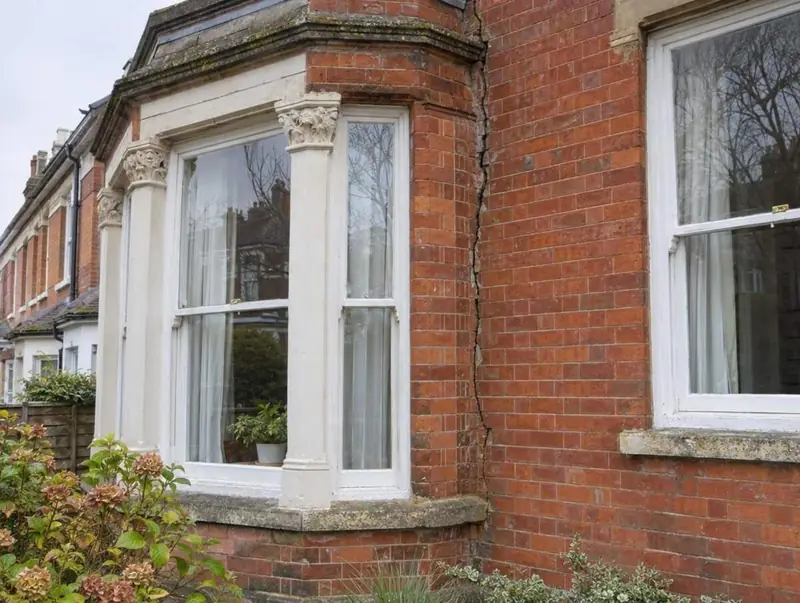
Victorian and Edwardian builders often gave the main walls deep footings but stood the bay on a shallow pad, sometimes little more than a few courses of brick. That shallow base sits in ground that dries, wets and is reached by roots and drain leaks. The bay then moves on its own, and a crack opens where it joins the house.
Not every cracked bay needs underpinning, and it is worth knowing that before spending money. Many junction cracks are old, stable and fixed with stainless ties and repointing. Where the bay is still dropping, its foundation is strengthened by traditional underpinning or mini-piles. An independent chartered structural engineer can confirm which applies, and we can arrange one. We then repair the bay and the plaster inside.
What are the signs you need bay window subsidence repairs?
- A vertical crack where the bay meets the front wall
- Bay roof or lead flashing pulling away from the main wall
- Bay window sash or casement sticking or binding
- A step or slope in the bay floor towards the window
- Cracks above the bay window head or below the sill
- Gaps opening around the internal bay window board
What causes it?
Shallow bay footings
Bays were frequently treated as an add-on, built on a narrower, shallower foundation than the house. In shrinkable clay that depth lies within the layer that changes with the seasons, so the bay moves while the main walls stay put. It is the most common reason bays crack.
Front garden trees and hedges
Street trees, front hedges and shrubs often grow within a few metres of the bay. Their roots draw moisture from clay beneath the shallow footing, causing it to shrink in dry summers. Take advice before removing anything, because felling on clay can lead to heave.
Drains and gullies near the bay
Rainwater downpipes, gullies and the main drain run often sit near the front corner of a house. A leaking joint or blocked gully can soften the ground beside the bay or wash fines away, letting the footing drop. A CCTV drain survey helps rule this in or out.
Lack of tie to the main wall
Many bays were simply butted against the front wall without bonding or ties. Even slight differential movement then opens a clean vertical joint. Sometimes the only real problem is this missing tie, with the bay foundation itself sound and stable.
How is it repaired?
Junction crack repair and tie-in
Where movement has stopped, the open joint between bay and house is raked out, stainless ties or helical bars are fixed across it, and the joint is repointed to match. Internal plaster along the crack is cut back and renewed before redecoration.
Best for: Old, stable cracks where the bay is no longer moving
Traditional underpinning of the bay
The bay footing is excavated in short sections and new mass concrete is placed down to firmer ground below the zone affected by roots and seasons. Because a bay is a short length of wall, the work is compact, but it needs building control approval.
Best for: Active bay movement on firm ground at moderate depth
Mini-piled bay underpinning
Small piles are installed to depth around or beneath the bay and linked by a reinforced beam or needles that pick up its weight. It suits deeper soft ground and heavy root activity, and the compact rigs fit into a front garden.
Best for: Deep clay, nearby trees, or poor ground below the bay
How much will bay window subsidence repairs cost?
The biggest factor is whether the bay needs only a junction tie-in or a new foundation, and if so how deep firm ground lies. Two-storey bays, scaffolding, the window and internal finishes also affect the cost.
| Item | Guide price | Per |
|---|---|---|
| Bay junction crack repair and tie-inest. | £600 – £1,800 | per bay |
| Traditional underpinning of a bay | £3,000 – £7,000 | per bay |
| Mini-piled bay underpinning | £5,000 – £12,000 | per bay |
See regional prices on the prices page or work out a guide price for your home with the guide price tool.
What happens, step by step?
Photos and first view
Send photos of the outside junction, the inside corners and the window, with a scale. We give a free initial assessment and tell you whether the crack looks old and stable or whether an engineer should inspect first.
Engineer and checks
Where the cause is unclear, an independent chartered structural engineer inspects, sometimes with a trial pit at the bay and a drain survey. We can arrange the engineer. Monitoring may be suggested if the movement could be seasonal.
Agree the repair
The engineer decides between tie-in repairs and underpinning. We confirm a fixed price in writing once the repair is specified, including scaffolding if needed, the bay window, roof flashing and internal making good.
Carry out the work
Ties are fitted across the junction, or the bay is underpinned in sequence with building control inspecting the dig. The bay window and flashings are checked and eased or resealed where the movement has disturbed them.
Make good inside
Plaster around the bay and along the junction is renewed, the window board is refixed and the room is ready for decoration. Building control paperwork, where it applies, is passed to you for your records.
How long will bay window subsidence repairs take?
A bay junction repair usually takes 1–2 days, while underpinning a bay is typically about a week on site.
Do you need building control or a party wall notice?
England and Wales
Tie-in and crack repairs rarely need approval, but underpinning a bay is building work under Part A and needs building control approval and inspections; Wales has its own version of the regulations. On a semi or terrace, digging near the neighbour’s footings may need notice under the Party Wall etc. Act 1996.
Scotland
Underpinning a bay generally needs a building warrant from the local authority verifier before work starts, and a completion certificate. There is no Party Wall Act, so check your title deeds before excavating near a shared boundary.
Northern Ireland
Bay underpinning falls under the Building Regulations (Northern Ireland) 2012 and council building control. There is no Party Wall Act, so agree any excavation near a neighbour’s bay or wall in advance.
What if you have an insurance claim open?
A dropping bay is a frequent subsidence claim, and many buildings policies cover it subject to terms and the subsidence excess. Tell your insurer before permanent repairs start. They may ask for a drain survey, vegetation checks or monitoring before deciding. If the bay is repaired as part of a claim, we price to the loss adjuster’s or engineer’s schedule, and anything you add, such as replacement windows, is priced separately.
Bay window subsidence repairs: frequently asked questions
How much does it cost to fix a subsiding bay window?
A bay junction crack repair and tie-in is a guide £600 to £1,800 per bay inc VAT. Traditional underpinning of a bay is around £3,000 to £7,000, and mini-piled bay underpinning £5,000 to £12,000. All are guide prices that vary by region and access, confirmed in writing after a survey.
Why do bay windows crack away from the house?
Bays often stand on shallower footings than the main walls, so they react to drying clay, roots and drain leaks that the deeper house foundations escape. Many bays were also never properly tied in, so any movement opens a clean vertical crack at the junction.
Is a crack between my bay and the house serious?
It is often not serious, especially if it is old, fine and unchanged for years. A crack that is widening, tapering or matched by sticking windows and a sloping bay floor needs looking at. An engineer’s inspection, sometimes with monitoring, will confirm whether the bay is still moving.
Does a bay window always need underpinning?
No, many bays are fixed by tying the junction and repointing, once any cause such as a leaking gully is put right. Underpinning is for bays still dropping after the cause has been dealt with, or with footings too shallow for the ground they sit on.
Can a bay be underpinned without underpinning the house?
Yes, underpinning only the bay is common because it is usually the part on shallower footings. The engineer designs the junction so the strengthened bay and the existing house can move slightly without cracking, sometimes with a movement joint or ties.
Will the bay window need replacing?
Usually not. Most windows can be eased, packed or resealed once the bay is stable. If the frame has twisted badly or the glass has cracked, replacement may be worth considering. Under a claim, upgrades beyond like-for-like are normally priced separately.
How long does bay underpinning take?
Traditional underpinning of a bay usually takes about a week on site, and mini-piling a little longer depending on depth. A junction tie-in without underpinning normally takes one to two days. Approvals and any monitoring beforehand add to the overall timeline.
Can I just fill the crack myself?
Filling it hides the evidence without dealing with the cause, and if the bay is still moving the crack will reopen. Photograph it with a scale and date first. If you plan to claim on insurance, tell your insurer before any repair, including filling.
Where we carry out bay window subsidence repairs
Bay window subsidence repairs by area
Choose your area for local ground conditions, regional guide prices and the towns we cover.
England
- Bedfordshire
- Berkshire
- Bristol
- Buckinghamshire
- Cambridgeshire
- Cheshire
- Cornwall
- Cumbria
- Derbyshire
- Devon
- Dorset
- County Durham
- East Riding of Yorkshire
- East Sussex
- Essex
- Gloucestershire
- Greater London
- Greater Manchester
- Hampshire
- Herefordshire
- Hertfordshire
- Isle of Wight
- Kent
- Lancashire
- Leicestershire
- Lincolnshire
- Merseyside
- Norfolk
- North Yorkshire
- Northamptonshire
- Northumberland
- Nottinghamshire
- Oxfordshire
- Rutland
- Shropshire
- Somerset
- South Yorkshire
- Staffordshire
- Suffolk
- Surrey
- Tyne and Wear
- Warwickshire
- West Midlands
- West Sussex
- West Yorkshire
- Wiltshire
- Worcestershire