Renfrewshire and Inverclyde · Scotland
Wall tie replacement in Renfrewshire and Inverclyde
Looking for wall tie replacement in Renfrewshire and Inverclyde? Send us photos for a free initial view. Most of Renfrewshire and Inverclyde is on firmer ground than the clay belts of the south-east, so we look at the ground, drains and nearby trees before recommending anything.
Guide price from£1,700per house inc VAT
- Area
- Renfrewshire and Inverclyde
- Pricing region
- Scotland
- Ground
- Mostly firmer ground
- Towns listed
- 9
Is Renfrewshire and Inverclyde prone to ground movement?
Renfrewshire has glacial till and Clyde alluvium with coal workings recorded in parts, while Inverclyde's towns climb steep slopes above the Clyde with many retaining walls.
Parts of Renfrewshire and Inverclyde lie on a former coalfield, so a coal mining search is worth checking if movement has no obvious cause. Typical buildings in Renfrewshire and Inverclyde: Sandstone tenements, villas in East Renfrewshire, and post-war estates.
What to look for before calling about wall tie replacement
- A house built before the 1980s on an exposed or coastal site
- Mortar joints that look wider or opened up on one elevation
- Cracked render with a regular horizontal pattern
- Horizontal cracks along mortar joints, repeating every few brick courses
Wall tie replacement prices in Renfrewshire and Inverclyde
Prices in Renfrewshire and Inverclyde are worked out on Scotland rates. They include VAT and are a starting point: access, the extent of the damage and whether an engineer or building control is involved all move the figure.
| Item | Guide price | Per |
|---|---|---|
| Mid-terrace houseest. | £1,700 – £3,300 | per house |
| Semi-detached house | £2,400 – £4,750 | per house |
| Detached houseest. | £3,300 – £6,650 | per house |
| Scaffolding where neededest. | £570 – £1,700 | per elevation |
How we usually approach wall tie replacement
Partial rebuild of the outer leaf
If a section of the outer leaf has bulged too far to be tied back, it is carefully taken down and rebuilt with new ties built in as the work goes up. This is uncommon, and is usually limited to a gable top, a parapet or a panel under a window.
Best for: Outer leaf too distorted to tie back safely
Remedial tie installation
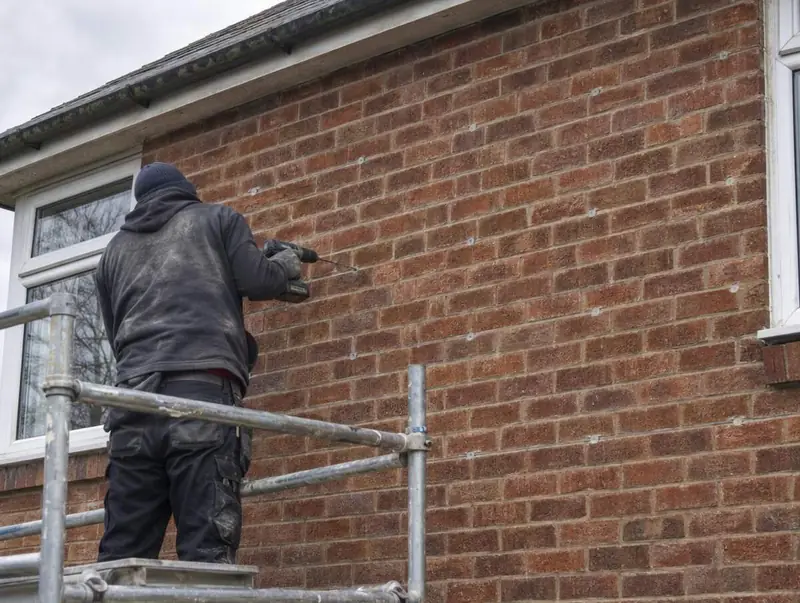
New stainless ties are drilled through the outer leaf into the inner leaf, then fixed by mechanical expansion or resin, depending on the masonry. They are placed to a set grid across each elevation, with extra ties around openings and at the edges. Holes are made good in matching mortar.
Best for: Walls where the original ties have failed or are missing
Isolating the old ties
Where the old ties are swelling and cracking the brickwork, fitting new ties alone may not stop further damage. Each old tie can be isolated, usually by cutting it through within the cavity or sleeving its outer end, so it can no longer lift the outer leaf as it continues to corrode.
Best for: Thick mild steel ties still causing horizontal cracking
What happens during wall tie replacement, step by step?
Access
Ties are fitted across the whole of each affected elevation, so scaffold or a tower is usually needed above ground floor. We plan access around conservatories, extensions, neighbours’ land and any parking that must be suspended.
Install the new ties
New stainless ties are drilled and fixed to the specified grid, with closer spacing around windows, doors and the roofline. Sample ties can be pull-tested to confirm they are holding in your particular brick and block.
Deal with the old ties and make good
Old ties are isolated or removed where the report calls for it, cracked joints are raked out and repointed, and drilled holes are filled in matching mortar. A written note of tie positions and findings goes in your property file.
Do you need approval for wall tie replacement in Scotland?
In Scotland, small repairs often do not need a building warrant, but structural alterations and strengthening generally do. Check with the council’s building standards service if unsure; there is no Party Wall Act in Scotland.
Wall tie replacement near you in Renfrewshire and Inverclyde
Questions about wall tie replacement in Renfrewshire and Inverclyde
Does the ground around Paisley cause cracking?
Renfrewshire has glacial till and Clyde alluvium with coal workings recorded in parts, while Inverclyde's towns climb steep slopes above the Clyde with many retaining walls. Parts of Renfrewshire and Inverclyde lie on a former coalfield, so a coal mining search is worth checking if movement has no obvious cause. Only an investigation on site can say why a particular building has moved.
How much will wall tie replacement cost in Renfrewshire and Inverclyde?
On Scotland rates, wall tie replacement starts from about £1,700 per house, including VAT. The written price depends on the extent of the damage, access and whether an engineer or building control is needed.
Will a mortgage lender accept wall tie replacement?
Lenders generally accept properly carried out tie replacement, but they may want to see the survey, the quote or a record of the completed work. If a valuation has flagged wall ties, a written report and itemised quote are usually what the lender or buyer needs next.
Can wall ties be replaced on a rendered house?
Yes, new ties can be fitted through render, with each drill hole made good afterwards. The repairs can show on painted render, so redecoration of the affected elevation is often worth including. Render can also hide the cracking pattern, so a survey matters more.
How do I know if my wall ties have failed?
The clearest sign is horizontal cracking in the mortar joints repeating every few courses, often with a bulge or a lifted roofline. Wire ties can fail with no cracking at all, so a tie survey with a metal detector and borescope is the only reliable check.