East Riding of Yorkshire · England
Wall tie replacement in East Riding of Yorkshire
Wall tie replacement in East Riding of Yorkshire starts with the ground. Clay soils are found in parts of East Riding of Yorkshire, and the buildings here are mostly Victorian terraces in Hull, so the repair has to suit both.
Guide price from£1,700per house inc VAT
- Area
- East Riding of Yorkshire
- Pricing region
- Yorkshire and the Humber
- Ground
- Clay in parts
- Towns listed
- 4
What should you know about the ground under East Riding of Yorkshire?
The Yorkshire Wolds are chalk, while Holderness and Hull sit on glacial till and estuarine clays and silts. Soft alluvial ground near the Humber can settle, and the Holderness coast is one of the fastest-eroding in Europe.
Ground movement here is more often linked to soils, drains and trees than to mining. Across East Riding of Yorkshire, most homes are Victorian terraces in Hull, market-town houses in Beverley and Driffield, and post-war estates.
Which repair method suits a home in East Riding of Yorkshire?
Partial rebuild of the outer leaf
If a section of the outer leaf has bulged too far to be tied back, it is carefully taken down and rebuilt with new ties built in as the work goes up. This is uncommon, and is usually limited to a gable top, a parapet or a panel under a window.
Best for: Outer leaf too distorted to tie back safely
Remedial tie installation
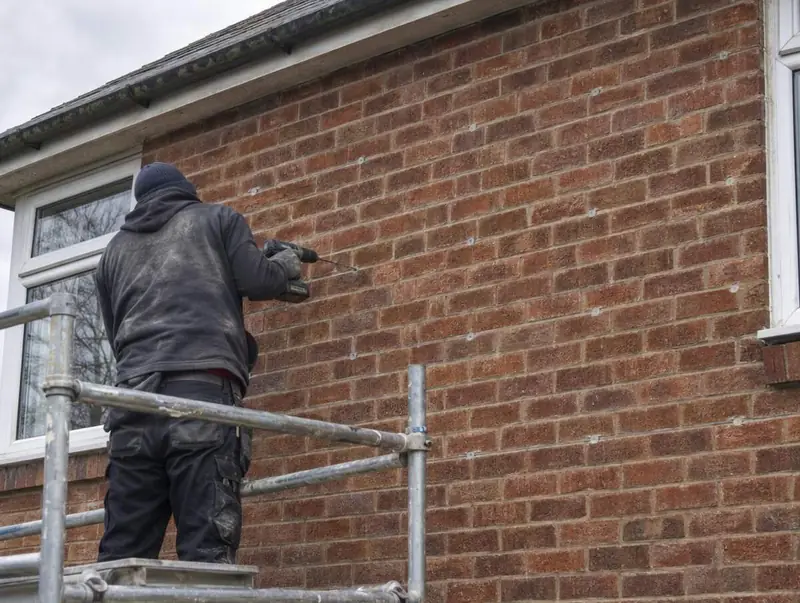
New stainless ties are drilled through the outer leaf into the inner leaf, then fixed by mechanical expansion or resin, depending on the masonry. They are placed to a set grid across each elevation, with extra ties around openings and at the edges. Holes are made good in matching mortar.
Best for: Walls where the original ties have failed or are missing
Removing old ties and rebedding
On badly cracked elevations the old ties are cut out from the outer face, the joints raked and rebedded, and the brickwork repointed. It is more work than isolation but removes the source of expansion entirely. An engineer or the survey report usually specifies where this is needed.
Best for: Elevations with severe cracking or lifting
What happens when we carry out wall tie replacement in East Riding of Yorkshire?
Tie survey
A metal detector locates the existing ties and shows their pattern. Small holes are then drilled at sample points and a borescope passed into the cavity to see the tie condition, type and embedment. The holes are made good afterwards.
Report and quote
You receive a written summary of what the survey found on each elevation, which walls need new ties, whether old ties should be isolated or removed, and a no-obligation written quote with scaffold shown separately.
Deal with the old ties and make good
Old ties are isolated or removed where the report calls for it, cracked joints are raked out and repointed, and drilled holes are filled in matching mortar. A written note of tie positions and findings goes in your property file.
Signs you may need wall tie replacement
- Horizontal cracks along mortar joints, repeating every few brick courses
- Cracked render with a regular horizontal pattern
- The roof edge or verge lifting slightly above the brickwork
- Outer brickwork bowing or bulging, often worst near the top
How much will wall tie replacement cost in East Riding of Yorkshire?
Guide prices below are for homes in East Riding of Yorkshire, on Yorkshire and the Humber rates and including VAT. A survey or good photos let us turn them into a fixed written price.
| Item | Guide price | Per |
|---|---|---|
| Mid-terrace houseest. | £1,700 – £3,300 | per house |
| Semi-detached house | £2,400 – £4,750 | per house |
| Detached houseest. | £3,300 – £6,650 | per house |
| Scaffolding where neededest. | £570 – £1,700 | per elevation |
Do you need approval for wall tie replacement in England?
Like-for-like repairs such as crack stitching and repointing do not usually need building control approval in England, but anything that changes or strengthens the structure, such as underpinning or rebuilding a wall, does. If the work touches a party wall, the Party Wall etc. Act 1996 may apply.
Towns in East Riding of Yorkshire we cover for wall tie replacement
Wall tie replacement in East Riding of Yorkshire: questions and answers
Is the ground in East Riding of Yorkshire prone to subsidence?
The Yorkshire Wolds are chalk, while Holderness and Hull sit on glacial till and estuarine clays and silts. Soft alluvial ground near the Humber can settle, and the Holderness coast is one of the fastest-eroding in Europe. Ground movement here is more often linked to soils, drains and trees than to mining. Only an investigation on site can say why a particular building has moved.
How much will wall tie replacement cost in East Riding of Yorkshire?
On Yorkshire and the Humber rates, wall tie replacement starts from about £1,700 per house, including VAT. The written price depends on the extent of the damage, access and whether an engineer or building control is needed.
Do the old wall ties have to be removed?
Not always, because thin wire ties that cannot swell are usually left in place once new ties are fitted. Thicker ties that are still expanding and cracking the wall are isolated or removed so they stop causing damage. The survey decides which applies.
Is wall tie failure covered by insurance?
Usually not, because insurers treat it as gradual deterioration. Damage caused by a sudden event, such as part of a wall collapsing in a storm, may be treated differently under some policies. Check your policy wording, and tell your insurer if you are unsure.
How do I know if my wall ties have failed?
The clearest sign is horizontal cracking in the mortar joints repeating every few courses, often with a bulge or a lifted roofline. Wire ties can fail with no cracking at all, so a tie survey with a metal detector and borescope is the only reliable check.