Essex · England
Wall tie replacement in Essex
We arrange surveys and price wall tie replacement throughout Essex. Essex is one of the parts of the UK where clay soils are most likely to move with the seasons, and we take that into account before recommending a method.
Guide price from£1,900per house inc VAT
- Area
- Essex
- Pricing region
- East of England
- Ground
- Shrinkable clay widespread
- Towns listed
- 23
What should you know about the ground under Essex?
London Clay covers much of south and central Essex and boulder clay much of the north, making it one of the counties most affected by clay shrinkage in dry summers. Street and garden trees close to houses add to the risk.
Ground movement here is more often linked to soils, drains and trees than to mining. Across Essex, most homes are Victorian terraces, 1930s semis and bungalows, and large post-war new-town estates in Basildon and Harlow.
Guide prices for wall tie replacement in Essex
These are guide prices for Essex, using East of England rates and including VAT. Your written quote follows photos or a survey, and is fixed once the repair is specified.
| Item | Guide price | Per |
|---|---|---|
| Mid-terrace houseest. | £1,900 – £3,700 | per house |
| Semi-detached house | £2,600 – £5,250 | per house |
| Detached houseest. | £3,700 – £7,350 | per house |
| Scaffolding where neededest. | £630 – £1,900 | per elevation |
Methods for wall tie replacement
Partial rebuild of the outer leaf
If a section of the outer leaf has bulged too far to be tied back, it is carefully taken down and rebuilt with new ties built in as the work goes up. This is uncommon, and is usually limited to a gable top, a parapet or a panel under a window.
Best for: Outer leaf too distorted to tie back safely
Isolating the old ties
Where the old ties are swelling and cracking the brickwork, fitting new ties alone may not stop further damage. Each old tie can be isolated, usually by cutting it through within the cavity or sleeving its outer end, so it can no longer lift the outer leaf as it continues to corrode.
Best for: Thick mild steel ties still causing horizontal cracking
Remedial tie installation
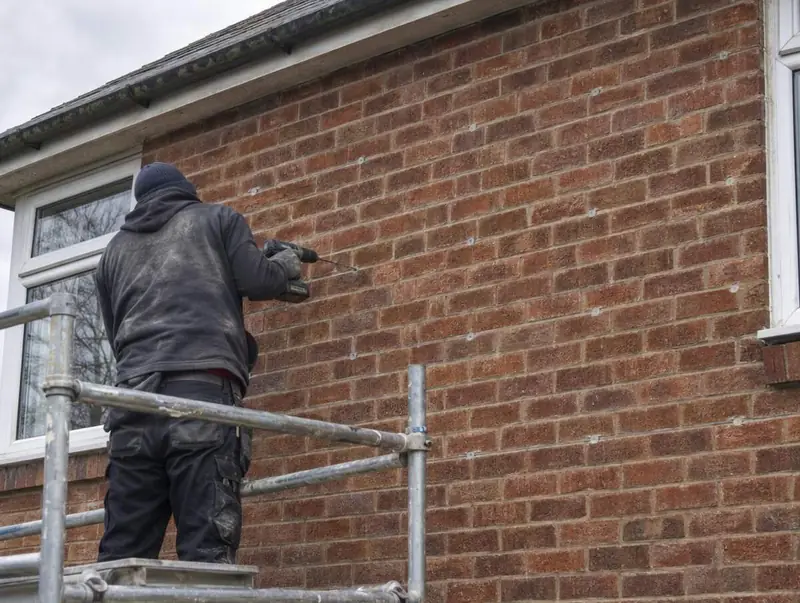
New stainless ties are drilled through the outer leaf into the inner leaf, then fixed by mechanical expansion or resin, depending on the masonry. They are placed to a set grid across each elevation, with extra ties around openings and at the edges. Holes are made good in matching mortar.
Best for: Walls where the original ties have failed or are missing
From first photo to finished repair
Report and quote
You receive a written summary of what the survey found on each elevation, which walls need new ties, whether old ties should be isolated or removed, and a no-obligation written quote with scaffold shown separately.
Access
Ties are fitted across the whole of each affected elevation, so scaffold or a tower is usually needed above ground floor. We plan access around conservatories, extensions, neighbours’ land and any parking that must be suspended.
Install the new ties
New stainless ties are drilled and fixed to the specified grid, with closer spacing around windows, doors and the roofline. Sample ties can be pull-tested to confirm they are holding in your particular brick and block.
Symptoms that point to wall tie replacement
- Mortar joints that look wider or opened up on one elevation
- The roof edge or verge lifting slightly above the brickwork
- A house built before the 1980s on an exposed or coastal site
- Horizontal cracks along mortar joints, repeating every few brick courses
Do you need approval for wall tie replacement in England?
Like-for-like repairs such as crack stitching and repointing do not usually need building control approval in England, but anything that changes or strengthens the structure, such as underpinning or rebuilding a wall, does. If the work touches a party wall, the Party Wall etc. Act 1996 may apply.
Wall tie replacement near you in Essex
- Southend-on-Sea
- Basildon
- Colchester
- Chelmsford
- Harlow
- Grays
- Braintree
- Brentwood
- Clacton-on-Sea
- Benfleet
- Canvey Island
- Billericay
- Rayleigh
- Stanford-le-Hope
- Wickford
- Witham
- Maldon
- South Ockendon
- Harwich
- Hadleigh
- Walton-on-the-Naze
- Rochford
- Saffron Walden
Frequently asked questions
Does the ground around Southend-on-Sea cause cracking?
London Clay covers much of south and central Essex and boulder clay much of the north, making it one of the counties most affected by clay shrinkage in dry summers. Street and garden trees close to houses add to the risk. Ground movement here is more often linked to soils, drains and trees than to mining. Only an investigation on site can say why a particular building has moved.
How much will wall tie replacement cost in Essex?
On East of England rates, wall tie replacement starts from about £1,900 per house, including VAT. The written price depends on the extent of the damage, access and whether an engineer or building control is needed.
Which houses are most at risk of wall tie failure?
Cavity-walled houses built before the 1980s are most at risk, especially those with mild steel ties, black ash mortar or an exposed position. Coastal and hilltop houses, and elevations facing the prevailing weather, tend to fail first.
Will a mortgage lender accept wall tie replacement?
Lenders generally accept properly carried out tie replacement, but they may want to see the survey, the quote or a record of the completed work. If a valuation has flagged wall ties, a written report and itemised quote are usually what the lender or buyer needs next.
How do I know if my wall ties have failed?
The clearest sign is horizontal cracking in the mortar joints repeating every few courses, often with a bulge or a lifted roofline. Wire ties can fail with no cracking at all, so a tie survey with a metal detector and borescope is the only reliable check.