Lancashire · England
Chimney stack repairs in Lancashire
Across Lancashire, requests for chimney stack repairs usually begin with a crack someone has noticed getting wider. Clay soils are found in parts of Lancashire. A repair only lasts if the reason for the movement has stopped.
Guide price from£480per stack inc VAT
- Area
- Lancashire
- Pricing region
- North West
- Ground
- Clay in parts
- Towns listed
- 20
How do local ground conditions affect chimney stack repairs in Lancashire?
Lancashire is mostly glacial till over sandstone and mudstone, with the Burnley and Accrington coalfield in the east and soft coastal and estuarine ground on the Fylde. Old mill and mine sites leave made ground in many towns.
Parts of Lancashire lie on a former coalfield, so a coal mining search is worth checking if movement has no obvious cause. Across Lancashire, most homes are stone and brick mill terraces, seaside villas in Blackpool and Lytham, and inter-war and post-war semis.
What should you budget for chimney stack repairs in Lancashire?
For Lancashire we use North West rates. Treat the table as a budget guide, inc VAT; the price you pay is the one on your written quote.
| Item | Guide price | Per |
|---|---|---|
| Repointing, flaunching and minor brick repairs | £480 – £1,900 | per stack |
| Partial or full stack rebuild | £2,900 – £9,600 | per stack |
| Stack restraint or strappingest. | £385 – £1,150 | per stack |
Repair options we may recommend
Partial or full rebuild
Where the lean is pronounced or the brickwork is badly decayed, the stack is taken down to sound masonry, often to roof level, and rebuilt plumb with new flashings and flaunching. Original bricks are cleaned and reused where possible to keep the appearance.
Best for: Badly leaning or decayed stacks
Repointing and brick repairs
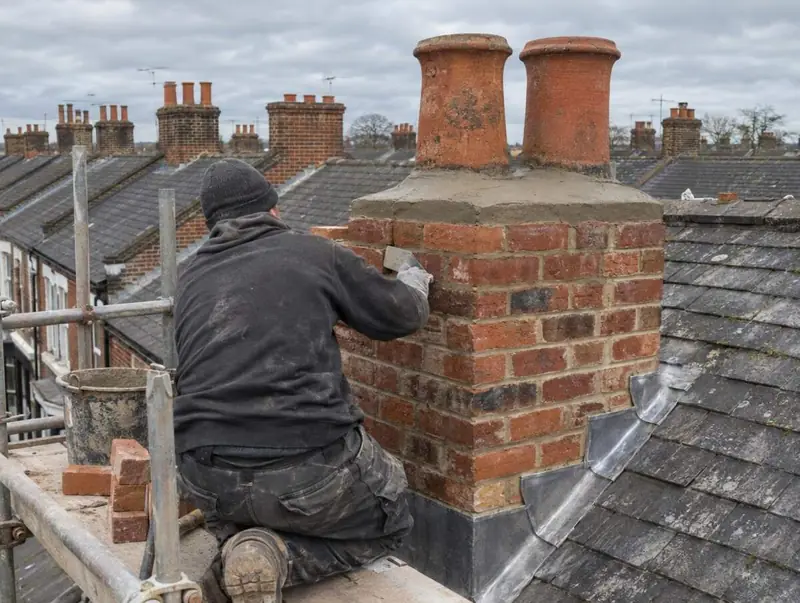
Eroded joints are raked out and repointed in a mortar suited to the brick, often a lime-based mix on older stacks. Spalled or cracked bricks are cut out and replaced with matched reclaimed or new bricks. On many stacks this, with new flaunching, is all that is needed.
Best for: Upright stacks with weathered joints and some damaged bricks
Flaunching and pot resetting
Old cracked flaunching is broken out, pots are lifted and reset or replaced, and new flaunching is formed to a fall so water runs off. Unused flues can be capped with ventilated caps, which keeps rain out while letting the flue breathe.
Best for: Loose pots and cracked mortar at the top of the stack
What to expect when we carry out chimney stack repairs
Check what is below
We ask whether any chimney breasts have been removed, and check the loft and rooms below for cracking. If a breast has gone without proper support, we recommend an independent chartered structural engineer before any stack work.
Repair, restrain or rebuild
The agreed work is carried out: repointing, new flaunching and pots, restraint, or taking the stack down and rebuilding it. Lead flashings where the stack meets the roof are checked and renewed if needed.
Weatherproof and clear
Caps or cowls are fitted where agreed, the roof around the stack is checked for slipped tiles, and debris is cleared from gutters. You receive photos of the finished stack taken from the scaffold, since it is hard to see from the ground.
Is it time for chimney stack repairs? Common signs
- Cracked or missing flaunching around the top of the stack
- Bits of brick, mortar or render landing in the garden or gutter
- Mortar washed out of joints, leaving bricks standing proud
- Damp patches on the chimney breast inside, especially after rain
Do you need approval for chimney stack repairs in England?
In England, underpinning and other work that alters or strengthens a wall or foundation is building work under the Building Regulations (Part A, structure), so building control approves and inspects it. Like-for-like repairs often are not, and we tell you which applies before a price is agreed. Work to a party wall, or excavation close to a neighbour’s foundations, can also need a notice under the Party Wall etc. Act 1996.
Find chimney stack repairs in your Lancashire town
- Preston
- Burnley
- Blackburn
- Blackpool
- Morecambe
- Lancaster
- Lytham St Annes
- Skelmersdale
- Leyland
- Accrington
- Chorley
- Darwen
- Thornton-Cleveleys
- Nelson
- Fleetwood
- Ormskirk
- Rawtenstall
- Colne
- Poulton-le-Fylde
- Heysham
Your chimney stack repairs questions
Why do houses in Lancashire crack?
Lancashire is mostly glacial till over sandstone and mudstone, with the Burnley and Accrington coalfield in the east and soft coastal and estuarine ground on the Fylde. Old mill and mine sites leave made ground in many towns. Parts of Lancashire lie on a former coalfield, so a coal mining search is worth checking if movement has no obvious cause. Only an investigation on site can say why a particular building has moved.
How much will chimney stack repairs cost in Lancashire?
On North West rates, chimney stack repairs starts from about £480 per stack, including VAT. The written price depends on the extent of the damage, access and whether an engineer or building control is needed.
Can a leaning stack be straightened?
Not by pushing it back, because the brickwork would crack. A slight lean on a sound stack can be restrained so it moves no further. A pronounced lean is fixed by taking the stack down to sound masonry and rebuilding it plumb.
Is a leaning chimney dangerous?
A leaning chimney can become dangerous, because stacks are heavy and stand high above the roof. A slight, long-standing lean may be stable for now, but a lean that is worsening, or loose bricks and pots, should be looked at quickly. Keep people away from below if anything looks loose.
Should I remove my chimney stack instead of repairing it?
It depends on whether you use the flue, the stack’s condition and how it relates to the house next door. Taking a stack down below the roofline changes the structure and the roof, and on a terrace it can affect your neighbour. We can price both options.