County Durham · England
Lintel replacement in County Durham
County Durham has its own mix of ground and building types, and that shapes how lintel replacement is done here. Parts of County Durham have clay that can shrink near trees in dry spells.
Guide price from£690per opening inc VAT
- Area
- County Durham
- Pricing region
- North East
- Ground
- Clay in parts
- Towns listed
- 13
Why does the ground in County Durham matter for lintel replacement?
Much of County Durham sits on the Durham Coalfield, worked for centuries, often under a cover of glacial clay. Many former pit villages have recorded mine workings, and coal mining searches are standard for property here.
Historic coal workings are recorded beneath parts of County Durham, and a coal mining search is worth checking where movement is unexplained. What you mostly find across County Durham: colliery terraces, stone and brick villas in Durham and Darlington, and post-war council estates.
Symptoms that point to lintel replacement
- Soft, crumbly timber visible behind the brick face over a bay
- Damp patches on the inside wall just above a window
- Rust stains or flaking steel showing above the frame
- A diagonal crack climbing away from a window head
Guide prices for lintel replacement in County Durham
These are guide prices for County Durham, using North East rates and including VAT. Your written quote follows photos or a survey, and is fixed once the repair is specified.
| Item | Guide price | Per |
|---|---|---|
| Standard window or door opening | £690 – £2,300 | per opening |
| Wide or bay openingest. | £1,850 – £4,150 | per opening |
| Making good inside and outest. | £140 – £550 | per opening |
Methods for lintel replacement
Like-for-like replacement
The failed lintel comes out and one of suitable type and size is bedded on mortar with adequate bearing at each end. Bricks above are relaid to match the original bond and the joints are pointed to blend with the surrounding wall.
Best for: Standard windows and doors with a single failed lintel
Inner and outer lintel replacement
Solid walls and some cavity walls carry separate lintels on the inside and outside faces. Where both have failed, each is replaced in turn, keeping the wall supported throughout. Internal plaster and reveals are then made good and redecorated where included.
Best for: Older solid walls with rotten timber across the inner face
Replacement with a cavity tray
A damp-proof membrane is laid over the new lintel with stop ends and weep holes, so water running down the cavity is directed out rather than into the house. Many older lintels were installed without one, which is often why they failed.
Best for: Cavity walls with damp above windows
From first photo to finished repair
Specify the replacement
We confirm the lintel type, length and bearing needed. For wide openings, bays or walls with unusual loads, an engineer may specify it, and where the repair needs an engineer’s design or sign-off we can arrange one.
Support the wall
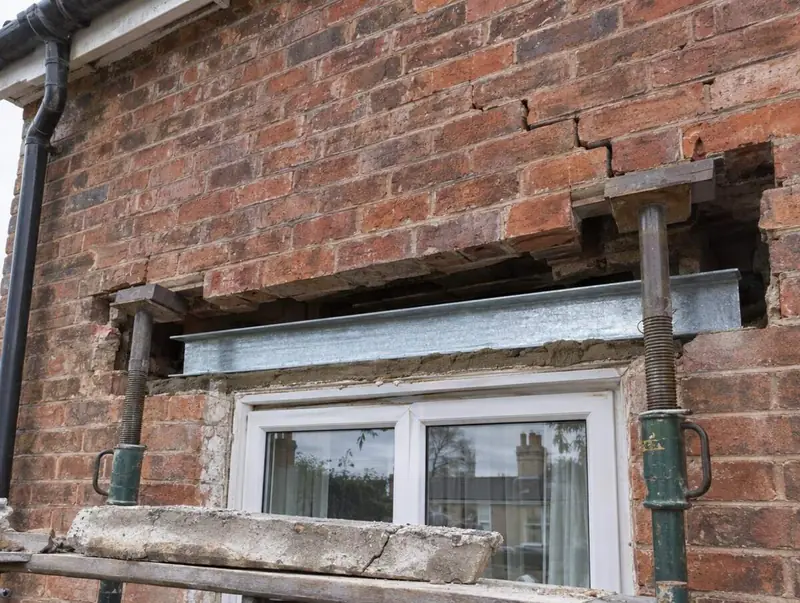
Props or needles are set so the brickwork above carries no load on the old lintel. Windows are protected or temporarily removed where the work demands it, and the room inside is sheeted against dust.
Remove supports and make good
Once the mortar has gained strength, props and needles come out and their holes are made good. Pointing, reveals and plaster are finished, and the window is refitted or checked for smooth operation.
Do you need approval for lintel replacement in England?
In England, underpinning and other work that alters or strengthens a wall or foundation is building work under the Building Regulations (Part A, structure), so building control approves and inspects it. Like-for-like repairs often are not, and we tell you which applies before a price is agreed. Work to a party wall, or excavation close to a neighbour’s foundations, can also need a notice under the Party Wall etc. Act 1996.
Lintel replacement near you in County Durham
- Darlington
- Hartlepool
- Stockton-on-Tees
- Durham
- Chester-le-Street
- Houghton-le-Spring
- Stanley
- Consett
- Newton Aycliffe
- Bishop Auckland
- Seaham
- Peterlee
- Spennymoor
Frequently asked questions
Does the ground around Darlington cause cracking?
Much of County Durham sits on the Durham Coalfield, worked for centuries, often under a cover of glacial clay. Many former pit villages have recorded mine workings, and coal mining searches are standard for property here. Historic coal workings are recorded beneath parts of County Durham, and a coal mining search is worth checking where movement is unexplained. Only an investigation on site can say why a particular building has moved.
How much will lintel replacement cost in County Durham?
On North East rates, lintel replacement starts from about £690 per opening, including VAT. The written price depends on the extent of the damage, access and whether an engineer or building control is needed.
Is it safe to live in the house during lintel replacement?
Yes, in almost all cases. The wall is fully supported before anything is removed, and the work is confined to one opening at a time. The affected room is sheeted against dust and kept clear while props are in place.
How long does it take to replace a lintel?
Most single lintels are replaced in one to two days. The props stay in until the mortar has gained enough strength, and wide bays or openings with both inner and outer lintels can take longer. The window can usually be used again once the supports come out.
What does needling a wall mean?
Needling means passing short steel members through holes cut in the wall just above the opening and supporting them on props on both sides. The needles take the weight of the wall above, so the old lintel can be removed safely without any brickwork dropping.