West Sussex · England
Lintel replacement in West Sussex
West Sussex has its own mix of ground and building types, and that shapes how lintel replacement is done here. Much of West Sussex sits on clay that shrinks in dry summers and swells in wet winters.
Guide price from£840per opening inc VAT
- Area
- West Sussex
- Pricing region
- South East
- Ground
- Shrinkable clay widespread
- Towns listed
- 11
How do local ground conditions affect lintel replacement in West Sussex?
North West Sussex around Crawley and Horsham sits on Weald Clay, the South Downs are chalk, and the coastal plain has brickearth and gravels. The Weald Clay is prone to shrink-swell movement near trees.
Ground movement here is more often linked to soils, drains and trees than to mining. Across West Sussex, most homes are Wealden cottages, 1930s semis and bungalows on the coast, and new-town estates in Crawley.
Symptoms that point to lintel replacement
- Soft, crumbly timber visible behind the brick face over a bay
- A diagonal crack climbing away from a window head
- Rust stains or flaking steel showing above the frame
- Window or door frames that have started to bind or distort
Guide prices for lintel replacement in West Sussex
The ranges below reflect typical South East costs for lintel replacement, including VAT. Scaffold, access and making good can push a job to the top of the range.
| Item | Guide price | Per |
|---|---|---|
| Standard window or door opening | £840 – £2,800 | per opening |
| Wide or bay openingest. | £2,250 – £5,050 | per opening |
| Making good inside and outest. | £170 – £670 | per opening |
Methods for lintel replacement
Inner and outer lintel replacement
Solid walls and some cavity walls carry separate lintels on the inside and outside faces. Where both have failed, each is replaced in turn, keeping the wall supported throughout. Internal plaster and reveals are then made good and redecorated where included.
Best for: Older solid walls with rotten timber across the inner face
Like-for-like replacement
The failed lintel comes out and one of suitable type and size is bedded on mortar with adequate bearing at each end. Bricks above are relaid to match the original bond and the joints are pointed to blend with the surrounding wall.
Best for: Standard windows and doors with a single failed lintel
Propping and needling
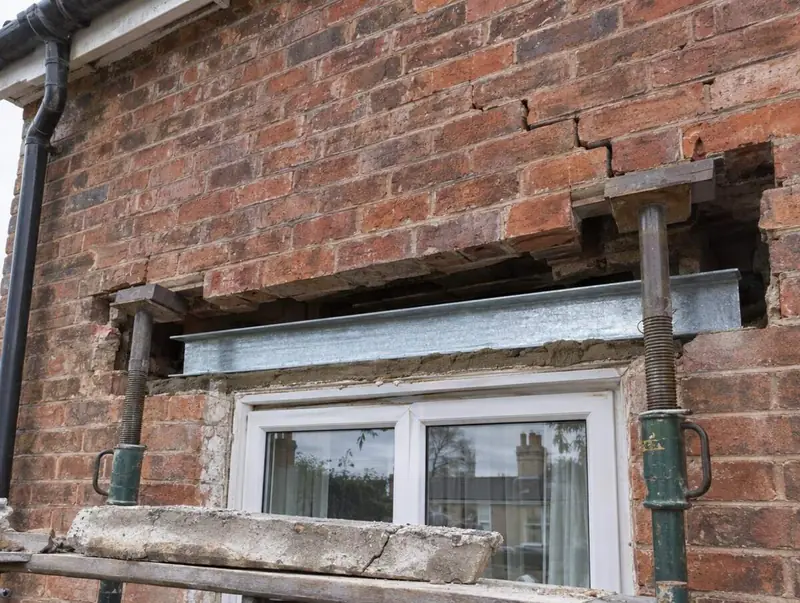
Adjustable props carry the wall above while the old lintel comes out. For heavier walls, short steel needles are passed through holes cut above the opening and propped on both sides, taking the load off the lintel completely. The supports stay until the new work has set.
Best for: Openings with heavy walls, upper floors or bay windows above
From first photo to finished repair
Specify the replacement
We confirm the lintel type, length and bearing needed. For wide openings, bays or walls with unusual loads, an engineer may specify it, and where the repair needs an engineer’s design or sign-off we can arrange one.
Support the wall
Props or needles are set so the brickwork above carries no load on the old lintel. Windows are protected or temporarily removed where the work demands it, and the room inside is sheeted against dust.
Remove supports and make good
Once the mortar has gained strength, props and needles come out and their holes are made good. Pointing, reveals and plaster are finished, and the window is refitted or checked for smooth operation.
Do you need approval for lintel replacement in England?
In England, underpinning and other work that alters or strengthens a wall or foundation is building work under the Building Regulations (Part A, structure), so building control approves and inspects it. Like-for-like repairs often are not, and we tell you which applies before a price is agreed. Work to a party wall, or excavation close to a neighbour’s foundations, can also need a notice under the Party Wall etc. Act 1996.
Lintel replacement near you in West Sussex
- Crawley
- Worthing
- Bognor Regis
- Littlehampton
- Horsham
- Haywards Heath
- Chichester
- Burgess Hill
- East Grinstead
- Shoreham-by-Sea
- Lancing
Frequently asked questions
Does the ground around Crawley cause cracking?
North West Sussex around Crawley and Horsham sits on Weald Clay, the South Downs are chalk, and the coastal plain has brickearth and gravels. The Weald Clay is prone to shrink-swell movement near trees. Ground movement here is more often linked to soils, drains and trees than to mining. Only an investigation on site can say why a particular building has moved.
How much will lintel replacement cost in West Sussex?
On South East rates, lintel replacement starts from about £840 per opening, including VAT. The written price depends on the extent of the damage, access and whether an engineer or building control is needed.
How do I know if a lintel has failed?
The most common sign is a diagonal or stepped crack running up from the top corner of a window or door. Others include a dip in the brickwork above, rust or rot visible at the lintel edge, and windows that start to stick. A crack alone can have other causes, so it is worth checking.
What is a cavity tray and do I need one?
A cavity tray is a damp-proof membrane above a lintel that catches water running down inside a cavity wall and sends it out through weep holes. If your wall is cavity construction and the original lintel had no tray, fitting one with the new lintel is usually sensible.
Do I need building regulations approval to replace a lintel?
In England and Wales, replacing a lintel is structural work and building control will usually need to approve it. Rules differ in Scotland and Northern Ireland. We deal with building control where the work needs it, and include the cost in the quote.