Suffolk · England
Lintel replacement in Suffolk
Across Suffolk, requests for lintel replacement usually begin with a crack someone has noticed getting wider. Shrinkable clay is widespread in Suffolk. A repair only lasts if the reason for the movement has stopped.
Guide price from£790per opening inc VAT
- Area
- Suffolk
- Pricing region
- East of England
- Ground
- Shrinkable clay widespread
- Towns listed
- 8
Why does the ground in Suffolk matter for lintel replacement?
Much of Suffolk is chalky boulder clay, with London Clay around Ipswich and Felixstowe and sandier ground in the Breckland and on the coast. The clay areas are prone to seasonal shrinkage near trees.
Ground movement here is more often linked to soils, drains and trees than to mining. Housing stock in Suffolk: Timber-framed and flint cottages, Victorian terraces in Ipswich and Lowestoft, and post-war estates.
What should you budget for lintel replacement in Suffolk?
Prices in Suffolk are worked out on East of England rates. They include VAT and are a starting point: access, the extent of the damage and whether an engineer or building control is involved all move the figure.
| Item | Guide price | Per |
|---|---|---|
| Standard window or door opening | £790 – £2,600 | per opening |
| Wide or bay openingest. | £2,100 – £4,700 | per opening |
| Making good inside and outest. | £160 – £630 | per opening |
Repair options we may recommend
Replacement with a cavity tray
A damp-proof membrane is laid over the new lintel with stop ends and weep holes, so water running down the cavity is directed out rather than into the house. Many older lintels were installed without one, which is often why they failed.
Best for: Cavity walls with damp above windows
Inner and outer lintel replacement
Solid walls and some cavity walls carry separate lintels on the inside and outside faces. Where both have failed, each is replaced in turn, keeping the wall supported throughout. Internal plaster and reveals are then made good and redecorated where included.
Best for: Older solid walls with rotten timber across the inner face
Propping and needling
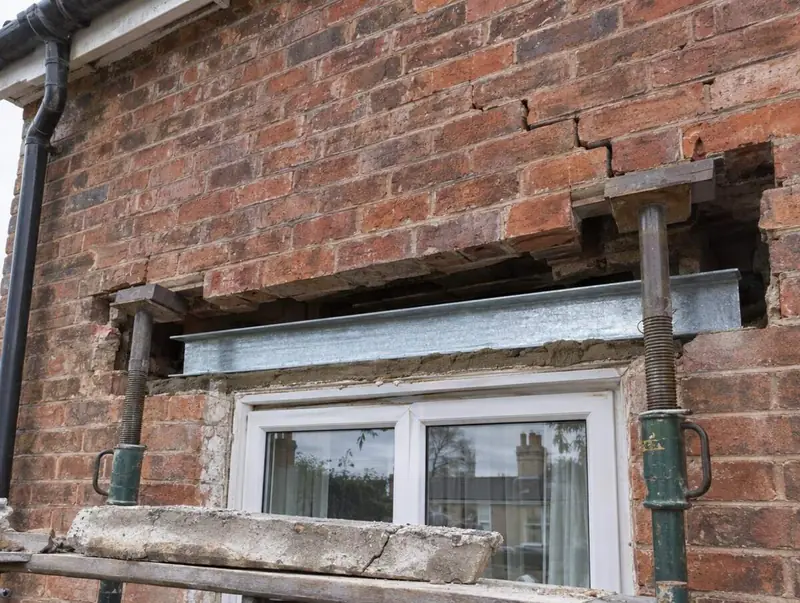
Adjustable props carry the wall above while the old lintel comes out. For heavier walls, short steel needles are passed through holes cut above the opening and propped on both sides, taking the load off the lintel completely. The supports stay until the new work has set.
Best for: Openings with heavy walls, upper floors or bay windows above
What to expect when we carry out lintel replacement
Inspect the opening
We look at the crack pattern, the type of lintel and what sits above it. Pictures of both faces of the window, plus any visible lintel edge, help us judge it before visiting.
Support the wall
Props or needles are set so the brickwork above carries no load on the old lintel. Windows are protected or temporarily removed where the work demands it, and the room inside is sheeted against dust.
Remove and replace
Brickwork is carefully taken out above the lintel, the old lintel removed and the new one bedded level on full bearings. A cavity tray goes in where relevant, then the brickwork above is relaid.
Is it time for lintel replacement? Common signs
- Soft, crumbly timber visible behind the brick face over a bay
- Rust stains or flaking steel showing above the frame
- A diagonal crack climbing away from a window head
- Damp patches on the inside wall just above a window
Do you need approval for lintel replacement in England?
In England, underpinning and other work that alters or strengthens a wall or foundation is building work under the Building Regulations (Part A, structure), so building control approves and inspects it. Like-for-like repairs often are not, and we tell you which applies before a price is agreed. Work to a party wall, or excavation close to a neighbour’s foundations, can also need a notice under the Party Wall etc. Act 1996.
Lintel replacement near you in Suffolk
Your lintel replacement questions
Does the ground around Ipswich cause cracking?
Much of Suffolk is chalky boulder clay, with London Clay around Ipswich and Felixstowe and sandier ground in the Breckland and on the coast. The clay areas are prone to seasonal shrinkage near trees. Ground movement here is more often linked to soils, drains and trees than to mining. Only an investigation on site can say why a particular building has moved.
How much will lintel replacement cost in Suffolk?
On East of England rates, lintel replacement starts from about £790 per opening, including VAT. The written price depends on the extent of the damage, access and whether an engineer or building control is needed.
How do I know if a lintel has failed?
The most common sign is a diagonal or stepped crack running up from the top corner of a window or door. Others include a dip in the brickwork above, rust or rot visible at the lintel edge, and windows that start to stick. A crack alone can have other causes, so it is worth checking.
Is it safe to live in the house during lintel replacement?
Yes, in almost all cases. The wall is fully supported before anything is removed, and the work is confined to one opening at a time. The affected room is sheeted against dust and kept clear while props are in place.
How long does it take to replace a lintel?
Most single lintels are replaced in one to two days. The props stay in until the mortar has gained enough strength, and wide bays or openings with both inner and outer lintels can take longer. The window can usually be used again once the supports come out.