Dunbartonshire · Scotland
Crack stitching in Dunbartonshire
We arrange surveys and price crack stitching throughout Dunbartonshire. Clay shrinkage is less of a concern in Dunbartonshire, so other causes such as drains, poor footings or older walls are checked first, and we take that into account before recommending a method.
Guide price from£75per metre of crack inc VAT
- Area
- Dunbartonshire
- Pricing region
- Scotland
- Ground
- Mostly firmer ground
- Towns listed
- 5
Is Dunbartonshire prone to ground movement?
Dunbartonshire has glacial till over sandstone and volcanic rock, with coal and ironstone workings recorded around Kirkintilloch and Bishopbriggs and soft river ground along the Clyde and Leven.
Parts of Dunbartonshire lie on a former coalfield, so a coal mining search is worth checking if movement has no obvious cause. Housing stock in Dunbartonshire: Tenements, Victorian villas in Bearsden and Milngavie, and post-war estates.
Guide prices for crack stitching in Dunbartonshire
Prices in Dunbartonshire are worked out on Scotland rates. They include VAT and are a starting point: access, the extent of the damage and whether an engineer or building control is involved all move the figure.
| Item | Guide price | Per |
|---|---|---|
| Crack stitching with stainless helical bars | £75 – £170 | per metre of crack |
| Small jobs (minimum visit)est. | £330 – £475 | per visit |
| Repointing over the stitched line in matching mortarest. | £30 – £55 | per metre |
Methods for crack stitching
Stitching with crack injection
Once the bars are in, the crack itself is filled. Fine cracks are pointed in matching mortar, while wider or deeper cracks can be injected with grout so the void inside the wall is filled rather than just the face. On older houses, lime mortar keeps the repair breathable.
Best for: Deep cracks running through the full thickness of the wall
Helical bars in resin grout
A resin grout bonds quickly and strongly to the bar and masonry and suits wet conditions or work that must take load sooner. It is less forgiving of soft or crumbly bricks, so the choice of grout is made wall by wall rather than as a rule.
Best for: Dense bricks, damp walls and repairs needing a fast cure
Helical bars in cementitious grout
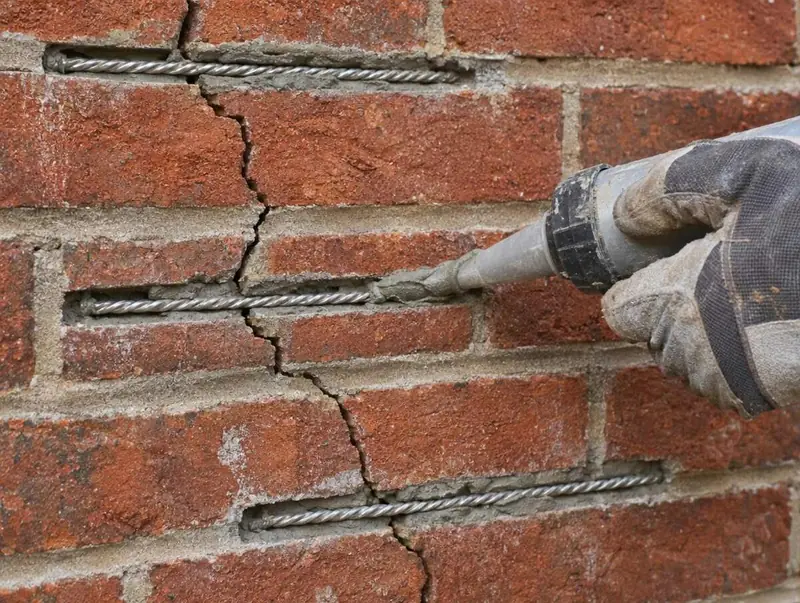
The most common approach. A slot is cut along the bed joint with a twin-blade cutter, flushed out and part filled with a cement-based grout. The helical bar is pushed in, more grout is packed over it, and the joint is pointed to match. The grout cures over a few days.
Best for: Most brick and block walls, including older softer bricks
From first photo to finished repair
Set out the bars
Bar positions are marked across the crack, typically every few courses up its full height, with each bar extending well into sound brickwork on both sides. An engineer’s specification, where there is one, sets the exact spacing and length.
Cut, clean and grout
Slots are cut into the bed joints to the right depth, dust is blown and washed out, and grout is placed. The bars are pressed home and covered, and the crack line is filled or injected.
Make good and record
Internal plaster cracks are cut out and filled where included, and dust is cleared. You receive a short note of where the bars went, which is useful for future buyers, surveyors and any insurance file.
Symptoms that point to crack stitching
- Bricks split clean through where the crack crosses them
- Stepped cracking beside a window, door or corner
- A crack visible on both the inside and outside face of the wall
- Filled cracks that keep reopening along the same line
Do you need approval for crack stitching in Scotland?
In Scotland, small repairs often do not need a building warrant, but structural alterations and strengthening generally do. Check with the council’s building standards service if unsure; there is no Party Wall Act in Scotland.
Crack stitching near you in Dunbartonshire
Frequently asked questions
Does the ground around Bearsden cause cracking?
Dunbartonshire has glacial till over sandstone and volcanic rock, with coal and ironstone workings recorded around Kirkintilloch and Bishopbriggs and soft river ground along the Clyde and Leven. Parts of Dunbartonshire lie on a former coalfield, so a coal mining search is worth checking if movement has no obvious cause. Only an investigation on site can say why a particular building has moved.
How much will crack stitching cost in Dunbartonshire?
On Scotland rates, crack stitching starts from about £75 per metre of crack, including VAT. The written price depends on the extent of the damage, access and whether an engineer or building control is needed.
Does crack stitching stop a wall moving?
No, crack stitching reconnects cracked masonry but does not stop the movement that caused it. If the ground is still shrinking, a drain is still leaking or ties are still rusting, a stitched wall can crack again nearby. The cause has to be identified and dealt with first.
Will crack stitching be visible afterwards?
Usually only slightly, because the bars sit inside the mortar joints and are pointed over. The main giveaway is the colour of new mortar, which can take a few months to weather. Careful mortar matching keeps the line discreet, especially on older brickwork.
Can crack stitching be done from outside only?
Often yes, especially on cavity walls where only the outer leaf has cracked. On solid walls, or where the crack shows clearly inside, bars may be needed on both faces to reconnect the full thickness. We check both sides before quoting.