Stirling, Falkirk and Clackmannanshire · Scotland
Floor joist repairs in Stirling, Falkirk and Clackmannanshire
We carry out floor joist repairs across Stirling, Falkirk and Clackmannanshire, from the larger towns to smaller places nearby. Most of Stirling, Falkirk and Clackmannanshire is on firmer ground than the clay belts of the south-east. Every job starts with the cause, then the repair is specified to match it.
Guide price from£240per joist inc VAT
- Area
- Stirling, Falkirk and Clackmannanshire
- Pricing region
- Scotland
- Ground
- Mostly firmer ground
- Towns listed
- 5
Is Stirling, Falkirk and Clackmannanshire prone to ground movement?
The Forth valley has soft carse clays near the river, which can settle, and coalfields beneath Falkirk, Clackmannanshire and the south of Stirling with recorded historic workings.
Historic coal workings are recorded beneath parts of Stirling, Falkirk and Clackmannanshire, and a coal mining search is worth checking where movement is unexplained. Typical buildings in Stirling, Falkirk and Clackmannanshire: Stone tenements and villas, miners' rows and post-war estates.
What should you budget for floor joist repairs in Stirling, Falkirk and Clackmannanshire?
Guide prices below are for homes in Stirling, Falkirk and Clackmannanshire, on Scotland rates and including VAT. A survey or good photos let us turn them into a fixed written price.
| Item | Guide price | Per |
|---|---|---|
| Splicing or sistering a damaged joist | £240 – £380 | per joist |
| Whole room of joists and boards | £1,900 – £5,700 | per room |
| Sleeper wall rebuild and ventilationest. | £380 – £1,400 | per room |
Repair options we may recommend
Sleeper walls and ventilation
Settled or damp sleeper walls are rebuilt on a sound base with a damp-proof course under new timber plates. Blocked air bricks are cleared, extra ones added where the void has dead spots, and soil or paving heaped against the outside wall is lowered.
Best for: Damp ground floor voids or joists on poor supports
Replacing joists and boards
When rot or woodworm runs through most of a floor, it is usually cheaper to replace the joists, strutting and boards together. Where joists run parallel to an outside wall, restraint straps tie the new floor back to it so the wall keeps its lateral support.
Best for: Widespread rot, or a whole floor that has dropped
Splicing ends and fitting hangers
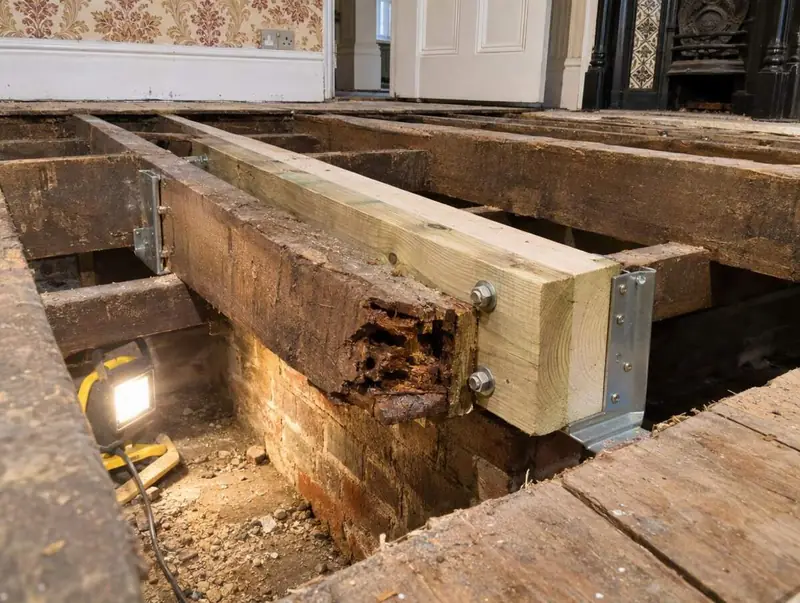
Where only the end has rotted, it is cut back to sound timber and a new piece is fixed alongside, bearing on the wall or on a new joist hanger. Missing or under-nailed hangers elsewhere are replaced at the same time. The damp in the wall must be fixed too.
Best for: Rotten joist ends in damp solid walls
What to expect when we carry out floor joist repairs
Photos and a call
Send photos of the dip or soft area, the outside wall at ground level and any air bricks. A short call about when it started, and any recent plumbing or heating work, tells us whether the problem is local or widespread.
Written quote
You get a no-obligation written quote listing which joists are sistered, spliced or replaced and any sleeper wall or ventilation work. It becomes a fixed price in writing once the repair is specified.
Repair the structure
Boards are lifted and numbered if they are going back, and rotten timber is cut out. New treated timber is fixed and checked with a level before strutting, hangers and any restraint straps go in.
Is it time for floor joist repairs? Common signs
- Floor bouncing, or ornaments rattling, when someone walks across
- A gap opening up between the skirting board and the floor
- A musty smell, or fungal strands showing between the boards
- Soft or spongy boards near outside walls, hearths or the bathroom
Do you need approval for floor joist repairs in Scotland?
In Scotland, small repairs often do not need a building warrant, but structural alterations and strengthening generally do. Check with the council’s building standards service if unsure; there is no Party Wall Act in Scotland.
Find floor joist repairs in your Stirling, Falkirk and Clackmannanshire town
Your floor joist repairs questions
Why do houses in Stirling, Falkirk and Clackmannanshire crack?
The Forth valley has soft carse clays near the river, which can settle, and coalfields beneath Falkirk, Clackmannanshire and the south of Stirling with recorded historic workings. Historic coal workings are recorded beneath parts of Stirling, Falkirk and Clackmannanshire, and a coal mining search is worth checking where movement is unexplained. Only an investigation on site can say why a particular building has moved.
How much will floor joist repairs cost in Stirling, Falkirk and Clackmannanshire?
On Scotland rates, floor joist repairs starts from about £240 per joist, including VAT. The written price depends on the extent of the damage, access and whether an engineer or building control is needed.
What is sistering a floor joist?
Sistering is fixing a new length of timber alongside an existing joist so the two share the load. It strengthens a notched, cracked or sagging joist without removing it, so it is quicker and less disruptive than replacement.
Do I need building control for floor joist repairs?
Usually not for like-for-like repairs to a few joists, but replacing a whole floor structure can be building work. In Scotland that generally needs a building warrant, and in Northern Ireland council building control applies. We deal with building control where the work needs it.
Why is my floor bouncy?
A bouncy floor usually means the joists are deflecting too much, often because they span too far, have lost their strutting or have been weakened by notches. It rarely means imminent failure, but it is worth checking, especially if the bounce appeared after work in the room.