Lincolnshire · England
Floor joist repairs in Lincolnshire
Lincolnshire has its own mix of ground and building types, and that shapes how floor joist repairs is done here. Parts of Lincolnshire have clay that can shrink near trees in dry spells.
Guide price from£245per joist inc VAT
- Area
- Lincolnshire
- Pricing region
- East Midlands
- Ground
- Clay in parts
- Towns listed
- 11
Is Lincolnshire prone to ground movement?
Lincolnshire has Lias, Oxford and Kimmeridge clays on the vales, chalk on the Wolds and soft silts and peat in the fens around Boston and Spalding. Fen ground and clay can both settle or shrink in dry years.
Ground movement here is more often linked to soils, drains and trees than to mining. Housing stock in Lincolnshire: Victorian terraces in Lincoln and Grimsby, fenland brick houses, seaside bungalows and post-war estates.
Symptoms that point to floor joist repairs
- A musty smell, or fungal strands showing between the boards
- A gap opening up between the skirting board and the floor
- Soft or spongy boards near outside walls, hearths or the bathroom
- Ceiling cracks below that follow the line of the joists
Guide prices for floor joist repairs in Lincolnshire
For Lincolnshire we use East Midlands rates. Treat the table as a budget guide, inc VAT; the price you pay is the one on your written quote.
| Item | Guide price | Per |
|---|---|---|
| Splicing or sistering a damaged joist | £245 – £390 | per joist |
| Whole room of joists and boards | £1,950 – £5,900 | per room |
| Sleeper wall rebuild and ventilationest. | £390 – £1,450 | per room |
Methods for floor joist repairs
Replacing joists and boards
When rot or woodworm runs through most of a floor, it is usually cheaper to replace the joists, strutting and boards together. Where joists run parallel to an outside wall, restraint straps tie the new floor back to it so the wall keeps its lateral support.
Best for: Widespread rot, or a whole floor that has dropped
Splicing ends and fitting hangers
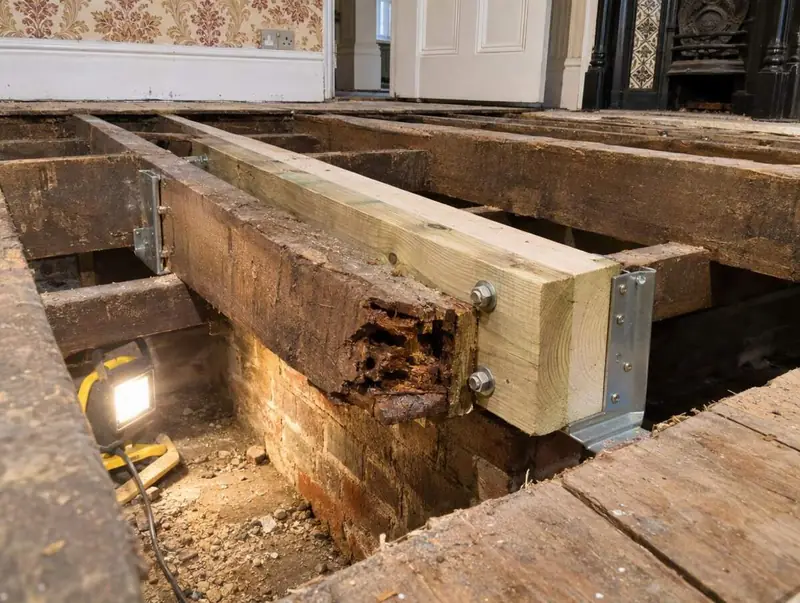
Where only the end has rotted, it is cut back to sound timber and a new piece is fixed alongside, bearing on the wall or on a new joist hanger. Missing or under-nailed hangers elsewhere are replaced at the same time. The damp in the wall must be fixed too.
Best for: Rotten joist ends in damp solid walls
Sleeper walls and ventilation
Settled or damp sleeper walls are rebuilt on a sound base with a damp-proof course under new timber plates. Blocked air bricks are cleared, extra ones added where the void has dead spots, and soil or paving heaped against the outside wall is lowered.
Best for: Damp ground floor voids or joists on poor supports
From first photo to finished repair
Lift boards and inspect
On site we lift a few boards where the floor is worst and check the joist ends, sleeper walls and void with a moisture meter. Outside, we look for high ground, blocked vents and leaks keeping the timber wet.
Repair the structure
Boards are lifted and numbered if they are going back, and rotten timber is cut out. New treated timber is fixed and checked with a level before strutting, hangers and any restraint straps go in.
Relay and ventilate
Boards are relaid or replaced, skirting refitted and air bricks cleared or added outside. We point out anything that would let damp back in, such as soil heaped against the wall, so the repair lasts.
Do you need approval for floor joist repairs in England?
Like-for-like repairs such as crack stitching and repointing do not usually need building control approval in England, but anything that changes or strengthens the structure, such as underpinning or rebuilding a wall, does. If the work touches a party wall, the Party Wall etc. Act 1996 may apply.
Find floor joist repairs in your Lincolnshire town
Frequently asked questions
Why do houses in Lincolnshire crack?
Lincolnshire has Lias, Oxford and Kimmeridge clays on the vales, chalk on the Wolds and soft silts and peat in the fens around Boston and Spalding. Fen ground and clay can both settle or shrink in dry years. Ground movement here is more often linked to soils, drains and trees than to mining. Only an investigation on site can say why a particular building has moved.
How much will floor joist repairs cost in Lincolnshire?
On East Midlands rates, floor joist repairs starts from about £245 per joist, including VAT. The written price depends on the extent of the damage, access and whether an engineer or building control is needed.
What causes rot in floor joists?
Damp causes almost all joist rot. Joist ends in damp walls, voids with blocked air bricks, leaking pipes and high outside ground levels keep timber wet enough for fungi to grow. Replacing timber without fixing the damp usually means the rot returns.
Can floor joists be repaired without taking up the whole floor?
Yes, in most cases only the boards over the affected joists need lifting, and three or four boards are often enough to sister a joist or splice a rotten end. Widespread rot is the exception, because the whole floor must come up to remove the decay.
Will my insurance pay for rotten floor joists?
Usually not, because rot, woodworm and gradual wear are standard exclusions. Damage from a sudden escape of water, or a floor that dropped through subsidence, may be treated differently. Check your policy, and tell your insurer before permanent repairs start if either applies.