Greater London · England
Floor joist repairs in Greater London
Greater London has its own mix of ground and building types, and that shapes how floor joist repairs is done here. Shrinkable clay is widespread in Greater London.
Guide price from£310per joist inc VAT
- Area
- Greater London
- Pricing region
- London
- Ground
- Shrinkable clay widespread
- Towns listed
- 32
Is Greater London prone to ground movement?
Most of Greater London sits on London Clay, among the most shrinkage-prone ground in the UK, with river gravels along the Thames. Subsidence claims here are among the most frequent in the country, especially after dry summers and near street and garden trees.
Ground movement here is more often linked to soils, drains and trees than to mining. Across Greater London, most homes are Victorian and Edwardian terraces with shallow footings, inter-war semis in the outer boroughs, and converted flats and mansion blocks.
Symptoms that point to floor joist repairs
- Floor bouncing, or ornaments rattling, when someone walks across
- Ceiling cracks below that follow the line of the joists
- Floor dipping towards an outside wall or in the middle of the room
- A gap opening up between the skirting board and the floor
Guide prices for floor joist repairs in Greater London
For Greater London we use London rates. Treat the table as a budget guide, inc VAT; the price you pay is the one on your written quote.
| Item | Guide price | Per |
|---|---|---|
| Splicing or sistering a damaged joist | £310 – £500 | per joist |
| Whole room of joists and boards | £2,500 – £7,500 | per room |
| Sleeper wall rebuild and ventilationest. | £500 – £1,900 | per room |
Methods for floor joist repairs
Sleeper walls and ventilation
Settled or damp sleeper walls are rebuilt on a sound base with a damp-proof course under new timber plates. Blocked air bricks are cleared, extra ones added where the void has dead spots, and soil or paving heaped against the outside wall is lowered.
Best for: Damp ground floor voids or joists on poor supports
Replacing joists and boards
When rot or woodworm runs through most of a floor, it is usually cheaper to replace the joists, strutting and boards together. Where joists run parallel to an outside wall, restraint straps tie the new floor back to it so the wall keeps its lateral support.
Best for: Widespread rot, or a whole floor that has dropped
Sistering a joist
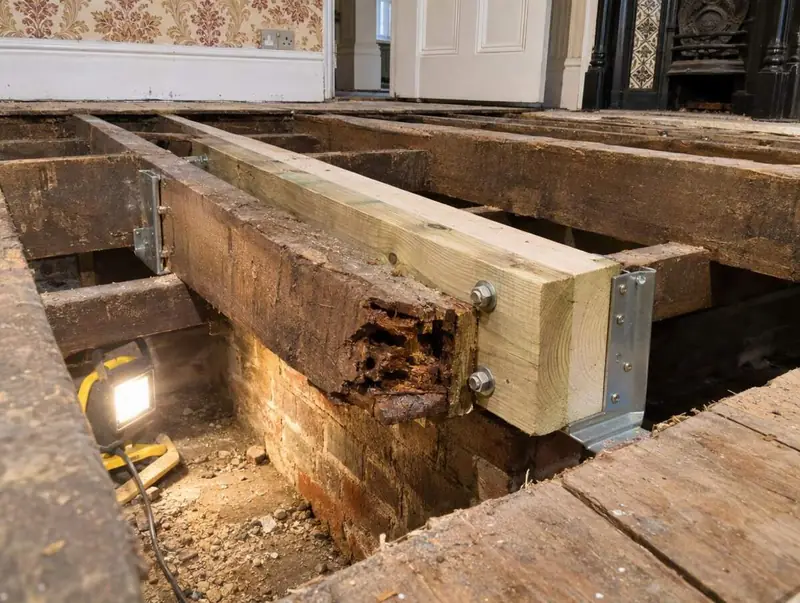
A new length of treated timber, the same depth as the original, is bolted or screwed alongside the damaged joist so the two share the load. It is the quickest fix for a notched, cracked or sagging joist that is otherwise sound, usually after lifting a few boards.
Best for: Cut, cracked or sagging joists with sound ends
From first photo to finished repair
Photos and a call
Send photos of the dip or soft area, the outside wall at ground level and any air bricks. A short call about when it started, and any recent plumbing or heating work, tells us whether the problem is local or widespread.
Repair the structure
Boards are lifted and numbered if they are going back, and rotten timber is cut out. New treated timber is fixed and checked with a level before strutting, hangers and any restraint straps go in.
Relay and ventilate
Boards are relaid or replaced, skirting refitted and air bricks cleared or added outside. We point out anything that would let damp back in, such as soil heaped against the wall, so the repair lasts.
Do you need approval for floor joist repairs in England?
Like-for-like repairs such as crack stitching and repointing do not usually need building control approval in England, but anything that changes or strengthens the structure, such as underpinning or rebuilding a wall, does. If the work touches a party wall, the Party Wall etc. Act 1996 may apply.
Towns in Greater London we cover for floor joist repairs
- Croydon
- Barnet
- Ealing
- Newham
- Brent
- Bromley
- Enfield
- Wandsworth
- Lambeth
- Tower Hamlets
- Redbridge
- Southwark
- Hillingdon
- Lewisham
- Greenwich
- Hounslow
- Waltham Forest
- Haringey
- Havering
- Harrow
- Hackney
- Bexley
- Barking and Dagenham
- Islington
- Merton
- Camden
- Sutton
- Westminster
- Richmond upon Thames
- Hammersmith and Fulham
- Kingston upon Thames
- Kensington and Chelsea
Frequently asked questions
Is the ground in Greater London prone to subsidence?
Most of Greater London sits on London Clay, among the most shrinkage-prone ground in the UK, with river gravels along the Thames. Subsidence claims here are among the most frequent in the country, especially after dry summers and near street and garden trees. Ground movement here is more often linked to soils, drains and trees than to mining. Only an investigation on site can say why a particular building has moved.
How much will floor joist repairs cost in Greater London?
On London rates, floor joist repairs starts from about £310 per joist, including VAT. The written price depends on the extent of the damage, access and whether an engineer or building control is needed.
Is a sagging floor dangerous?
A gentle, long-standing sag is usually not dangerous, and many older floors have moved slightly over a century. A sag that is getting worse, soft boards or a floor dropping near a wall needs checking soon, because rotten joist ends can lose their bearing.
What causes rot in floor joists?
Damp causes almost all joist rot. Joist ends in damp walls, voids with blocked air bricks, leaking pipes and high outside ground levels keep timber wet enough for fungi to grow. Replacing timber without fixing the damp usually means the rot returns.
Why is my floor bouncy?
A bouncy floor usually means the joists are deflecting too much, often because they span too far, have lost their strutting or have been weakened by notches. It rarely means imminent failure, but it is worth checking, especially if the bounce appeared after work in the room.