Edinburgh and the Lothians · Scotland
Floor joist repairs in Edinburgh and the Lothians
If you live in Edinburgh and the Lothians and are looking at floor joist repairs, the first question is why the wall moved. Shrinkable clay is less common in Edinburgh and the Lothians than in south-east England; parts of Edinburgh and the Lothians lie on a former coalfield, so a coal mining search is worth checking if movement has no obvious cause.
Guide price from£240per joist inc VAT
- Area
- Edinburgh and the Lothians
- Pricing region
- Scotland
- Ground
- Mostly firmer ground
- Towns listed
- 12
How do local ground conditions affect floor joist repairs in Edinburgh and the Lothians?
Edinburgh is volcanic and sedimentary rock with glacial till, while the Midlothian and East Lothian coalfields and oil-shale workings in West Lothian have left recorded mine workings and bings.
Parts of Edinburgh and the Lothians lie on a former coalfield, so a coal mining search is worth checking if movement has no obvious cause. Housing stock in Edinburgh and the Lothians: Sandstone tenements and Georgian terraces, miners' rows, bungalows and post-war estates.
What happens during floor joist repairs, step by step?
Written quote
You get a no-obligation written quote listing which joists are sistered, spliced or replaced and any sleeper wall or ventilation work. It becomes a fixed price in writing once the repair is specified.
Repair the structure
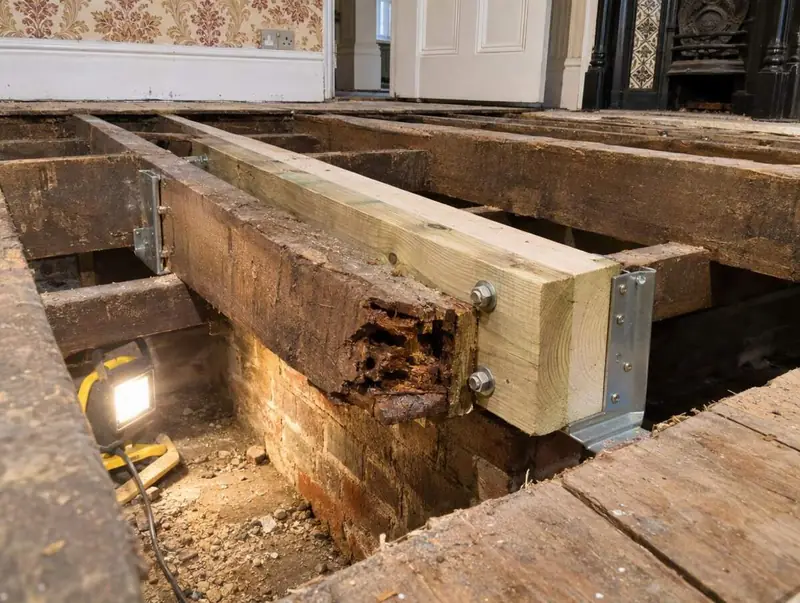
Boards are lifted and numbered if they are going back, and rotten timber is cut out. New treated timber is fixed and checked with a level before strutting, hangers and any restraint straps go in.
Relay and ventilate
Boards are relaid or replaced, skirting refitted and air bricks cleared or added outside. We point out anything that would let damp back in, such as soil heaped against the wall, so the repair lasts.
What to look for before calling about floor joist repairs
- A gap opening up between the skirting board and the floor
- Ceiling cracks below that follow the line of the joists
- Soft or spongy boards near outside walls, hearths or the bathroom
- A musty smell, or fungal strands showing between the boards
Floor joist repairs prices in Edinburgh and the Lothians
Prices in Edinburgh and the Lothians are worked out on Scotland rates. They include VAT and are a starting point: access, the extent of the damage and whether an engineer or building control is involved all move the figure.
| Item | Guide price | Per |
|---|---|---|
| Splicing or sistering a damaged joist | £240 – £380 | per joist |
| Whole room of joists and boards | £1,900 – £5,700 | per room |
| Sleeper wall rebuild and ventilationest. | £380 – £1,400 | per room |
How we usually approach floor joist repairs
Replacing joists and boards
When rot or woodworm runs through most of a floor, it is usually cheaper to replace the joists, strutting and boards together. Where joists run parallel to an outside wall, restraint straps tie the new floor back to it so the wall keeps its lateral support.
Best for: Widespread rot, or a whole floor that has dropped
Sleeper walls and ventilation
Settled or damp sleeper walls are rebuilt on a sound base with a damp-proof course under new timber plates. Blocked air bricks are cleared, extra ones added where the void has dead spots, and soil or paving heaped against the outside wall is lowered.
Best for: Damp ground floor voids or joists on poor supports
Sistering a joist
A new length of treated timber, the same depth as the original, is bolted or screwed alongside the damaged joist so the two share the load. It is the quickest fix for a notched, cracked or sagging joist that is otherwise sound, usually after lifting a few boards.
Best for: Cut, cracked or sagging joists with sound ends
Do you need approval for floor joist repairs in Scotland?
In Scotland, small repairs often do not need a building warrant, but structural alterations and strengthening generally do. Check with the council’s building standards service if unsure; there is no Party Wall Act in Scotland.
Towns in Edinburgh and the Lothians we cover for floor joist repairs
- Edinburgh
- Livingston
- Musselburgh
- Bathgate
- Bonnyrigg
- Penicuik
- Broxburn
- Mayfield
- Linlithgow
- Armadale
- Tranent
- Dunbar
Questions about floor joist repairs in Edinburgh and the Lothians
Is the ground in Edinburgh and the Lothians prone to subsidence?
Edinburgh is volcanic and sedimentary rock with glacial till, while the Midlothian and East Lothian coalfields and oil-shale workings in West Lothian have left recorded mine workings and bings. Parts of Edinburgh and the Lothians lie on a former coalfield, so a coal mining search is worth checking if movement has no obvious cause. Only an investigation on site can say why a particular building has moved.
How much will floor joist repairs cost in Edinburgh and the Lothians?
On Scotland rates, floor joist repairs starts from about £240 per joist, including VAT. The written price depends on the extent of the damage, access and whether an engineer or building control is needed.
Can floor joists be repaired without taking up the whole floor?
Yes, in most cases only the boards over the affected joists need lifting, and three or four boards are often enough to sister a joist or splice a rotten end. Widespread rot is the exception, because the whole floor must come up to remove the decay.
Is a sagging floor dangerous?
A gentle, long-standing sag is usually not dangerous, and many older floors have moved slightly over a century. A sag that is getting worse, soft boards or a floor dropping near a wall needs checking soon, because rotten joist ends can lose their bearing.
Why is my floor bouncy?
A bouncy floor usually means the joists are deflecting too much, often because they span too far, have lost their strutting or have been weakened by notches. It rarely means imminent failure, but it is worth checking, especially if the bounce appeared after work in the room.