North Yorkshire · England
Brick arch repairs in North Yorkshire
If you live in North Yorkshire and are looking at brick arch repairs, the first question is why the wall moved. North Yorkshire has a mix of ground, with clay in some places and firmer rock in others; parts of North Yorkshire lie on a former coalfield, so a coal mining search is worth checking if movement has no obvious cause.
Guide price from£380per arch inc VAT
- Area
- North Yorkshire
- Pricing region
- Yorkshire and the Humber
- Ground
- Clay in parts
- Towns listed
- 11
Is North Yorkshire prone to ground movement?
North Yorkshire ranges from limestone dales and moors to clays and glacial deposits in the Vale of York, with the Selby coalfield in the south and ironstone workings in Cleveland. Teesside has areas of soft and made ground.
Parts of North Yorkshire lie on a former coalfield, so a coal mining search is worth checking if movement has no obvious cause. Housing stock in North Yorkshire: Stone cottages, Georgian and Victorian houses in York and Harrogate, and brick terraces on Teesside.
Brick arch repairs prices in North Yorkshire
The ranges below reflect typical Yorkshire and the Humber costs for brick arch repairs, including VAT. Scaffold, access and making good can push a job to the top of the range.
| Item | Guide price | Per |
|---|---|---|
| Stitching and reinforcing a sound archest. | £380 – £1,150 | per arch |
| Rebuilding an arch (one side) | £855 – £1,250 | per opening |
| Rebuilding an arch (both sides) | £1,700 – £2,450 | per opening |
How we usually approach brick arch repairs
Rebuilding both faces
Where the arch shows inside as well as outside, or a rotten timber behind it has also failed, both faces are rebuilt. The inner timber is replaced with a suitable lintel, and the outer arch is reformed in front. The two are worked in sequence so the wall is supported throughout.
Best for: Arches with a failed timber or inner face
Lime mortar repairs
On older houses built in soft brick and lime, the arch is rebuilt or repointed in a lime mortar matched to the original. Lime lets moisture escape and moves slightly with the wall, so it protects the bricks rather than forcing damage into them, as hard cement mortar can.
Best for: Pre-1919 houses and soft historic brick
Rebuilding over a former
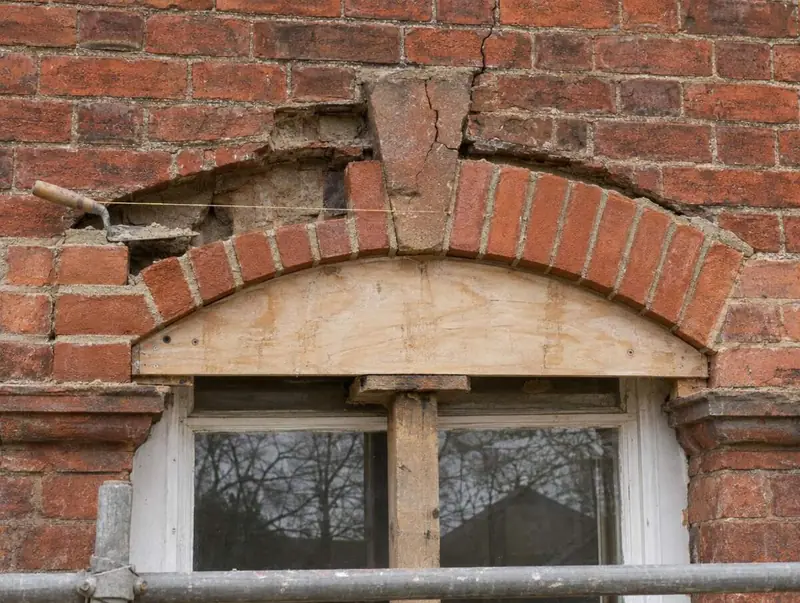
A timber former is cut to the arch profile and propped under the opening. The old arch is carefully taken down, bricks cleaned for reuse, and the arch rebuilt over the former with tight joints and a properly set keystone. The former stays until the mortar is strong enough to carry the load.
Best for: Badly dropped arches or ones with loose voussoirs
What happens during brick arch repairs, step by step?
Look at the arch closely
Straight-on photos of the arch and the wall either side show us how far it has dropped, whether the bricks are sound and whether the cause seems to be the arch itself or the wall around it.
Support the opening
Props carry the brickwork above, and for a rebuild a former is made to the exact profile of the arch. The window or door frame is protected so it is not asked to carry any load.
Repair the arch
Bars are bonded into the joints above a sound arch, or the arch is taken down and relaid over the former using the original bricks where possible, with matched replacements for any that are damaged.
What to look for before calling about brick arch repairs
- Gaps opening between arch bricks at the top or bottom edge
- Cracks stepping out from the arch ends into the wall
- A flat arch that has started to sag into a shallow curve
- The centre bricks of an arch sitting lower than the rest
Do you need approval for brick arch repairs in England?
Like-for-like repairs such as crack stitching and repointing do not usually need building control approval in England, but anything that changes or strengthens the structure, such as underpinning or rebuilding a wall, does. If the work touches a party wall, the Party Wall etc. Act 1996 may apply.
Find brick arch repairs in your North Yorkshire town
Questions about brick arch repairs in North Yorkshire
Why do houses in North Yorkshire crack?
North Yorkshire ranges from limestone dales and moors to clays and glacial deposits in the Vale of York, with the Selby coalfield in the south and ironstone workings in Cleveland. Teesside has areas of soft and made ground. Parts of North Yorkshire lie on a former coalfield, so a coal mining search is worth checking if movement has no obvious cause. Only an investigation on site can say why a particular building has moved.
How much will brick arch repairs cost in North Yorkshire?
On Yorkshire and the Humber rates, brick arch repairs starts from about £380 per arch, including VAT. The written price depends on the extent of the damage, access and whether an engineer or building control is needed.
What is a former in arch building?
A former, sometimes called a centre, is a temporary timber frame cut to the exact shape of the arch. It supports the bricks while the arch is laid and the mortar cures, and is removed once the arch can carry itself.
Can you match the original bricks?
Usually, because most arches are rebuilt with their own cleaned bricks, which is the best match of all. Damaged bricks are replaced with reclaimed or new bricks chosen for size, colour and texture, and the mortar is matched to the surrounding joints.
Why has the middle of my brick arch dropped?
The centre of an arch usually drops because the bricks have lost their wedge, either because the wall at the sides has moved or the mortar has worn away. A rotting timber hidden behind the arch is another common cause. The keystone slipping is the visible result.