Kent · England
Brick arch repairs in Kent
Across Kent, requests for brick arch repairs usually begin with a crack someone has noticed getting wider. Shrinkable clay is widespread in Kent. A repair only lasts if the reason for the movement has stopped.
Guide price from£450per arch inc VAT
- Area
- Kent
- Pricing region
- South East
- Ground
- Shrinkable clay widespread
- Towns listed
- 22
Is Kent prone to ground movement?
North Kent sits on London Clay, central Kent on Gault and Weald Clays and the Downs on chalk, so shrinkable clay is widespread. East Kent around Deal and Dover had a small deep coalfield, worked until the late 1980s.
Parts of Kent lie on a former coalfield, so a coal mining search is worth checking if movement has no obvious cause. Across Kent, most homes are Victorian terraces in the Medway towns, weatherboarded and Wealden houses, 1930s semis and seaside bungalows.
Is it time for brick arch repairs? Common signs
- Gaps opening between arch bricks at the top or bottom edge
- Mortar falling out of the arch joints after frosty weather
- A flat arch that has started to sag into a shallow curve
- Cracks stepping out from the arch ends into the wall
What should you budget for brick arch repairs in Kent?
Prices in Kent are worked out on South East rates. They include VAT and are a starting point: access, the extent of the damage and whether an engineer or building control is involved all move the figure.
| Item | Guide price | Per |
|---|---|---|
| Stitching and reinforcing a sound archest. | £450 – £1,350 | per arch |
| Rebuilding an arch (one side) | £1,000 – £1,450 | per opening |
| Rebuilding an arch (both sides) | £2,000 – £2,900 | per opening |
Repair options we may recommend
Lime mortar repairs
On older houses built in soft brick and lime, the arch is rebuilt or repointed in a lime mortar matched to the original. Lime lets moisture escape and moves slightly with the wall, so it protects the bricks rather than forcing damage into them, as hard cement mortar can.
Best for: Pre-1919 houses and soft historic brick
Reinforcing a sound arch
Where the arch has only dropped slightly and the bricks are sound, stainless helical bars are bonded into the bed joints just above it, extending well into the wall on each side. The bars turn the courses above into a reinforced band of masonry, so the arch no longer has to carry the full load. Joints are repointed to match.
Best for: Slightly dropped or cracked arches with sound bricks
Rebuilding over a former
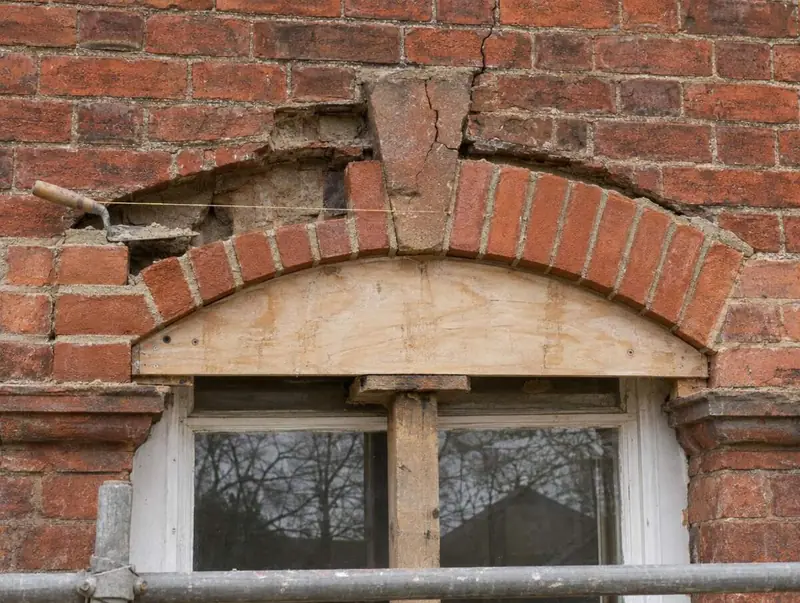
A timber former is cut to the arch profile and propped under the opening. The old arch is carefully taken down, bricks cleaned for reuse, and the arch rebuilt over the former with tight joints and a properly set keystone. The former stays until the mortar is strong enough to carry the load.
Best for: Badly dropped arches or ones with loose voussoirs
What to expect when we carry out brick arch repairs
Choose reinforce or rebuild
We recommend reinforcement where the arch is sound and only slightly displaced, and a rebuild where it has dropped badly or bricks are loose. If the wall beside the opening is moving, that is dealt with first.
Support the opening
Props carry the brickwork above, and for a rebuild a former is made to the exact profile of the arch. The window or door frame is protected so it is not asked to carry any load.
Repair the arch
Bars are bonded into the joints above a sound arch, or the arch is taken down and relaid over the former using the original bricks where possible, with matched replacements for any that are damaged.
Do you need approval for brick arch repairs in England?
Like-for-like repairs such as crack stitching and repointing do not usually need building control approval in England, but anything that changes or strengthens the structure, such as underpinning or rebuilding a wall, does. If the work touches a party wall, the Party Wall etc. Act 1996 may apply.
Find brick arch repairs in your Kent town
- Maidstone
- Gillingham
- Tunbridge Wells
- Folkestone
- Margate
- Ashford
- Canterbury
- Sittingbourne
- Gravesend
- Dartford
- Ramsgate
- Dover
- Tonbridge
- Strood
- Whitstable
- Deal
- Sevenoaks
- Herne Bay
- Faversham
- Swanley
- Longfield
- Swanscombe
Your brick arch repairs questions
Why do houses in Kent crack?
North Kent sits on London Clay, central Kent on Gault and Weald Clays and the Downs on chalk, so shrinkable clay is widespread. East Kent around Deal and Dover had a small deep coalfield, worked until the late 1980s. Parts of Kent lie on a former coalfield, so a coal mining search is worth checking if movement has no obvious cause. Only an investigation on site can say why a particular building has moved.
How much will brick arch repairs cost in Kent?
On South East rates, brick arch repairs starts from about £450 per arch, including VAT. The written price depends on the extent of the damage, access and whether an engineer or building control is needed.
Should a brick arch be repaired with lime mortar?
On older houses built with soft bricks and lime, yes, in most cases. Lime mortar lets the wall breathe and is weaker than the brick, so any movement or frost damage happens in the joints rather than the bricks. Modern hard brickwork can take a cement-based mortar.
Can a dropped arch be repaired without rebuilding it?
Yes, if the drop is small and the brickwork is in good condition. Bars bonded into the joints above can take the load off the arch and hold it in place. If the bricks are loose or the arch has dropped badly, rebuilding is the more reliable repair.
Why has the middle of my brick arch dropped?
The centre of an arch usually drops because the bricks have lost their wedge, either because the wall at the sides has moved or the mortar has worn away. A rotting timber hidden behind the arch is another common cause. The keystone slipping is the visible result.