Dunbartonshire · Scotland
Concrete repairs in Dunbartonshire
If you live in Dunbartonshire and are looking at concrete repairs, the first question is why the wall moved. Clay shrinkage is less of a concern in Dunbartonshire, so other causes such as drains, poor footings or older walls are checked first; parts of Dunbartonshire lie on a former coalfield, so a coal mining search is worth checking if movement has no obvious cause.
Guide price from£80per m² inc VAT
- Area
- Dunbartonshire
- Pricing region
- Scotland
- Ground
- Mostly firmer ground
- Towns listed
- 5
What should you know about the ground under Dunbartonshire?
Dunbartonshire has glacial till over sandstone and volcanic rock, with coal and ironstone workings recorded around Kirkintilloch and Bishopbriggs and soft river ground along the Clyde and Leven.
Parts of Dunbartonshire lie on a former coalfield, so a coal mining search is worth checking if movement has no obvious cause. Across Dunbartonshire, most homes are tenements, Victorian villas in Bearsden and Milngavie, and post-war estates.
What to look for before calling about concrete repairs
- Fine cracks running in straight lines along the line of the reinforcement
- Damp patches, white deposits or drips on a balcony or canopy underside
- Chunks or flakes of concrete breaking away from edges and soffits
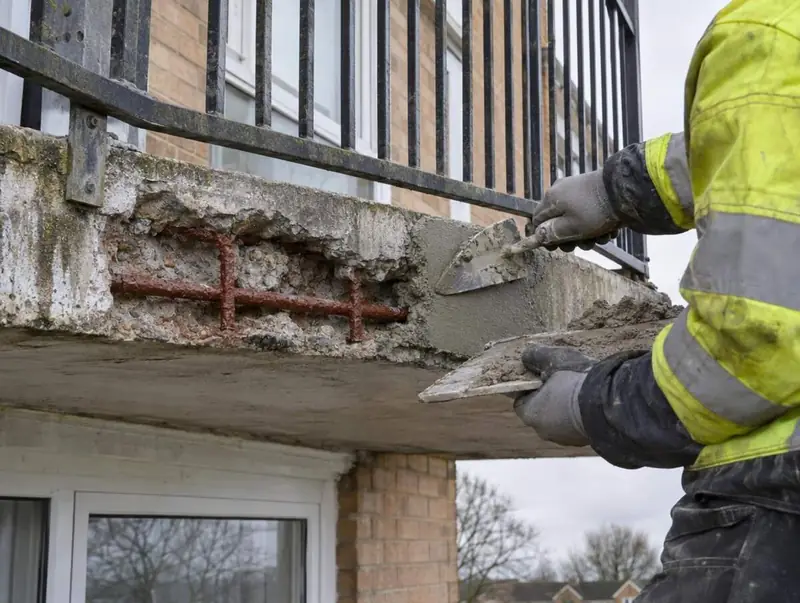
- Exposed steel bars showing where concrete has fallen away
Concrete repairs prices in Dunbartonshire
These are guide prices for Dunbartonshire, using Scotland rates and including VAT. Your written quote follows photos or a survey, and is fixed once the repair is specified.
| Item | Guide price | Per |
|---|---|---|
| Concrete patch repair | £80 – £170 | per m² |
| Crack injection | £170 – £455 | per metre |
| Small jobs (minimum visit)est. | £430 – £855 | per visit |
How we usually approach concrete repairs
Patch repair
Loose and contaminated concrete is broken out behind the bar, the steel is cleaned of rust and primed, and the section is rebuilt with a repair mortar. The edges are cut square so the patch does not feather out and fail. A protective coating may be applied over the whole surface afterwards.
Best for: Localised spalling around rusting bars
Crack injection
Cracks are sealed at the surface, then a low-viscosity resin is injected under pressure through ports until it fills the crack. A rigid resin bonds the two faces back together, while a flexible one seals live cracks against water. The choice depends on whether the crack is still moving.
Best for: Cracks letting water in, or splitting a slab or beam
Protective coatings and sealing
After repair, an anti-carbonation coating, a waterproof deck membrane on a balcony, or a penetrating sealer slows the return of moisture and carbon dioxide. Restoring drips, upstands and falls so water drains away is as important as the coating itself.
Best for: Extending the life of repaired balconies and canopies
What happens during concrete repairs, step by step?
Photos and a description
Send photos of the damage close up and from a distance, plus the whole balcony, canopy or elevation. Tell us roughly how old the building is and whether anything has fallen, so we can judge whether to make it safe first.
Survey and tapping test
On site we tap the surface to find hollow areas, check the steel where it is exposed and note drainage. Where the extent is unclear, a cover meter, carbonation test or chloride test may be advised before repair.
Engineer where needed
If the steel has lost significant section, or the element carries a balcony, stair or wall, an independent chartered structural engineer is appointed to assess and specify. We can arrange this, and the repair follows their scope.
Do you need approval for concrete repairs in Scotland?
In Scotland, small repairs often do not need a building warrant, but structural alterations and strengthening generally do. Check with the council’s building standards service if unsure; there is no Party Wall Act in Scotland.
Towns in Dunbartonshire we cover for concrete repairs
Questions about concrete repairs in Dunbartonshire
Is the ground in Dunbartonshire prone to subsidence?
Dunbartonshire has glacial till over sandstone and volcanic rock, with coal and ironstone workings recorded around Kirkintilloch and Bishopbriggs and soft river ground along the Clyde and Leven. Parts of Dunbartonshire lie on a former coalfield, so a coal mining search is worth checking if movement has no obvious cause. Only an investigation on site can say why a particular building has moved.
How much will concrete repairs cost in Dunbartonshire?
On Scotland rates, concrete repairs starts from about £80 per m², including VAT. The written price depends on the extent of the damage, access and whether an engineer or building control is needed.
Why does concrete crack and rust?
Concrete cracks as it shrinks, moves with temperature or carries more load than intended. Steel inside it rusts when carbonation or salts reach it and moisture gets in. The two feed each other: cracks let water in, and rusting steel expands and cracks the concrete further.
What is spalling concrete?
Spalling is concrete breaking away from the surface in flakes or chunks. In reinforced concrete it is usually caused by the steel inside rusting and expanding, which pushes the cover off. It often follows a straight line where a bar sits close to the surface, with rust staining nearby.
What is carbonation in concrete?
Carbonation is the gradual reaction between carbon dioxide in the air and concrete, which lowers its alkalinity from the surface inward. Alkaline concrete protects the steel inside, so when carbonation reaches the bars, they can start to rust. A simple test on a freshly broken surface shows how deep it has gone.