Devon · England
Concrete repairs in Devon
Across Devon, requests for concrete repairs usually begin with a crack someone has noticed getting wider. Clay shrinkage is less of a concern in Devon, so other causes such as drains, poor footings or older walls are checked first. A repair only lasts if the reason for the movement has stopped.
Guide price from£90per m² inc VAT
- Area
- Devon
- Pricing region
- South West
- Ground
- Mostly firmer ground
- Towns listed
- 10
How do local ground conditions affect concrete repairs in Devon?
Devon's ground is mostly older mudstones, sandstones and granite, so shrinkable-clay subsidence is less widespread than further east. Older solid-walled and cob buildings, steep sites and retaining walls are the more common structural concerns.
Old metal-mine shafts and workings are recorded in places, so mining searches are routine for some properties. Typical buildings in Devon: Cob and stone cottages, Victorian terraces in Exeter, Plymouth and Torbay, and post-war estates.
Repair options we may recommend
Crack injection
Cracks are sealed at the surface, then a low-viscosity resin is injected under pressure through ports until it fills the crack. A rigid resin bonds the two faces back together, while a flexible one seals live cracks against water. The choice depends on whether the crack is still moving.
Best for: Cracks letting water in, or splitting a slab or beam
Patch repair
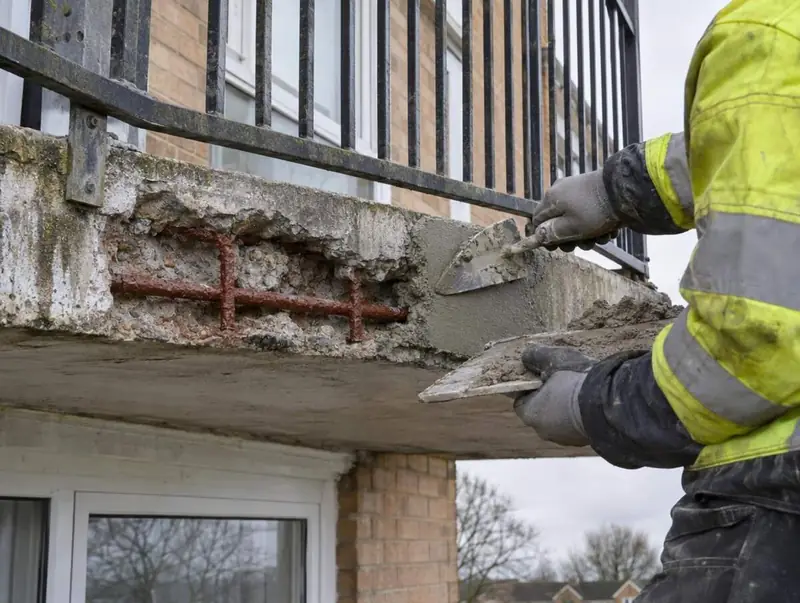
Loose and contaminated concrete is broken out behind the bar, the steel is cleaned of rust and primed, and the section is rebuilt with a repair mortar. The edges are cut square so the patch does not feather out and fail. A protective coating may be applied over the whole surface afterwards.
Best for: Localised spalling around rusting bars
Recasting or strengthening
Where steel has lost much of its section, or a lintel or canopy is too far gone to patch, the element is propped and rebuilt, replaced or strengthened to an engineer’s design. It is less common, but sometimes the more lasting option for small canopies and old precast lintels.
Best for: Badly corroded lintels, canopies and balcony edges
What to expect when we carry out concrete repairs
Survey and tapping test
On site we tap the surface to find hollow areas, check the steel where it is exposed and note drainage. Where the extent is unclear, a cover meter, carbonation test or chloride test may be advised before repair.
Engineer where needed
If the steel has lost significant section, or the element carries a balcony, stair or wall, an independent chartered structural engineer is appointed to assess and specify. We can arrange this, and the repair follows their scope.
Written quote
You receive a no-obligation written quote setting out the estimated area of patching, the length of crack injection, coatings and access. It becomes a fixed price in writing once the repair is specified, with any re-measure terms stated clearly.
Is it time for concrete repairs? Common signs
- Fine cracks running in straight lines along the line of the reinforcement
- Hollow sound when the surface is tapped with a hammer
- Damp patches, white deposits or drips on a balcony or canopy underside
- Chunks or flakes of concrete breaking away from edges and soffits
What should you budget for concrete repairs in Devon?
Prices in Devon are worked out on South West rates. They include VAT and are a starting point: access, the extent of the damage and whether an engineer or building control is involved all move the figure.
| Item | Guide price | Per |
|---|---|---|
| Concrete patch repair | £90 – £185 | per m² |
| Crack injection | £185 – £495 | per metre |
| Small jobs (minimum visit)est. | £465 – £925 | per visit |
Do you need approval for concrete repairs in England?
Like-for-like repairs such as crack stitching and repointing do not usually need building control approval in England, but anything that changes or strengthens the structure, such as underpinning or rebuilding a wall, does. If the work touches a party wall, the Party Wall etc. Act 1996 may apply.
Towns in Devon we cover for concrete repairs
Your concrete repairs questions
Is the ground in Devon prone to subsidence?
Devon's ground is mostly older mudstones, sandstones and granite, so shrinkable-clay subsidence is less widespread than further east. Older solid-walled and cob buildings, steep sites and retaining walls are the more common structural concerns. Old metal-mine shafts and workings are recorded in places, so mining searches are routine for some properties. Only an investigation on site can say why a particular building has moved.
How much will concrete repairs cost in Devon?
On South West rates, concrete repairs starts from about £90 per m², including VAT. The written price depends on the extent of the damage, access and whether an engineer or building control is needed.
What is spalling concrete?
Spalling is concrete breaking away from the surface in flakes or chunks. In reinforced concrete it is usually caused by the steel inside rusting and expanding, which pushes the cover off. It often follows a straight line where a bar sits close to the surface, with rust staining nearby.
Can a concrete balcony be repaired rather than replaced?
In most cases, yes. Patch repairs, crack injection, a new waterproof deck and restored drips usually extend a balcony’s life considerably. Replacement is generally only needed where the steel has lost a lot of section or the balcony’s fixing to the building is compromised.
Why does concrete crack and rust?
Concrete cracks as it shrinks, moves with temperature or carries more load than intended. Steel inside it rusts when carbonation or salts reach it and moisture gets in. The two feed each other: cracks let water in, and rusting steel expands and cracks the concrete further.