Greater London · England
Concrete repairs in Greater London
Concrete repairs in Greater London starts with the ground. Greater London is one of the parts of the UK where clay soils are most likely to move with the seasons, and the buildings here are mostly Victorian and Edwardian terraces with shallow footings, so the repair has to suit both.
Guide price from£105per m² inc VAT
- Area
- Greater London
- Pricing region
- London
- Ground
- Shrinkable clay widespread
- Towns listed
- 32
How do local ground conditions affect concrete repairs in Greater London?
Most of Greater London sits on London Clay, among the most shrinkage-prone ground in the UK, with river gravels along the Thames. Subsidence claims here are among the most frequent in the country, especially after dry summers and near street and garden trees.
Ground movement here is more often linked to soils, drains and trees than to mining. Across Greater London, most homes are Victorian and Edwardian terraces with shallow footings, inter-war semis in the outer boroughs, and converted flats and mansion blocks.
How much will concrete repairs cost in Greater London?
For Greater London we use London rates. Treat the table as a budget guide, inc VAT; the price you pay is the one on your written quote.
| Item | Guide price | Per |
|---|---|---|
| Concrete patch repair | £105 – £225 | per m² |
| Crack injection | £225 – £600 | per metre |
| Small jobs (minimum visit)est. | £560 – £1,100 | per visit |
Which repair method suits a home in Greater London?
Crack injection
Cracks are sealed at the surface, then a low-viscosity resin is injected under pressure through ports until it fills the crack. A rigid resin bonds the two faces back together, while a flexible one seals live cracks against water. The choice depends on whether the crack is still moving.
Best for: Cracks letting water in, or splitting a slab or beam
Protective coatings and sealing
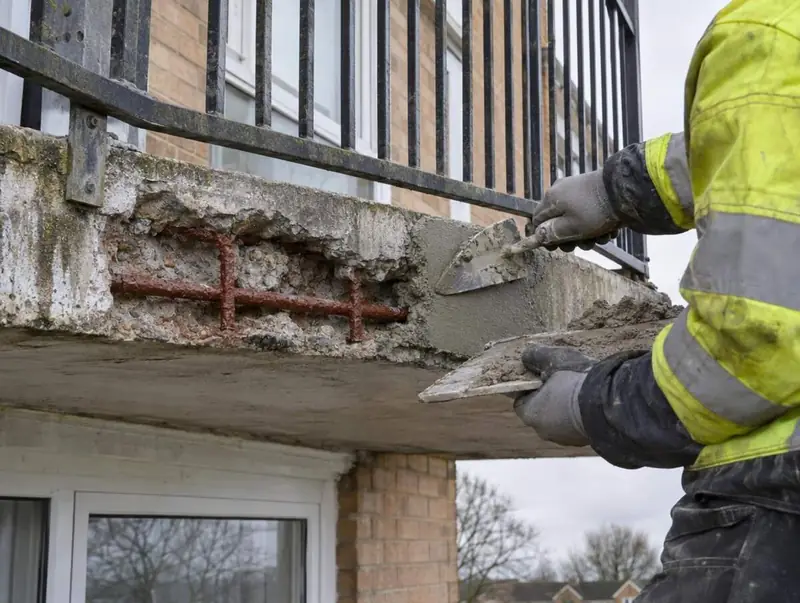
After repair, an anti-carbonation coating, a waterproof deck membrane on a balcony, or a penetrating sealer slows the return of moisture and carbon dioxide. Restoring drips, upstands and falls so water drains away is as important as the coating itself.
Best for: Extending the life of repaired balconies and canopies
Recasting or strengthening
Where steel has lost much of its section, or a lintel or canopy is too far gone to patch, the element is propped and rebuilt, replaced or strengthened to an engineer’s design. It is less common, but sometimes the more lasting option for small canopies and old precast lintels.
Best for: Badly corroded lintels, canopies and balcony edges
What happens when we carry out concrete repairs in Greater London?
Survey and tapping test
On site we tap the surface to find hollow areas, check the steel where it is exposed and note drainage. Where the extent is unclear, a cover meter, carbonation test or chloride test may be advised before repair.
Engineer where needed
If the steel has lost significant section, or the element carries a balcony, stair or wall, an independent chartered structural engineer is appointed to assess and specify. We can arrange this, and the repair follows their scope.
Written quote
You receive a no-obligation written quote setting out the estimated area of patching, the length of crack injection, coatings and access. It becomes a fixed price in writing once the repair is specified, with any re-measure terms stated clearly.
Signs you may need concrete repairs
- Rust-coloured stains or streaks running down the concrete surface
- Fine cracks running in straight lines along the line of the reinforcement
- Hollow sound when the surface is tapped with a hammer
- Chunks or flakes of concrete breaking away from edges and soffits
Do you need approval for concrete repairs in England?
Like-for-like repairs such as crack stitching and repointing do not usually need building control approval in England, but anything that changes or strengthens the structure, such as underpinning or rebuilding a wall, does. If the work touches a party wall, the Party Wall etc. Act 1996 may apply.
Concrete repairs near you in Greater London
- Croydon
- Barnet
- Ealing
- Newham
- Brent
- Bromley
- Enfield
- Wandsworth
- Lambeth
- Tower Hamlets
- Redbridge
- Southwark
- Hillingdon
- Lewisham
- Greenwich
- Hounslow
- Waltham Forest
- Haringey
- Havering
- Harrow
- Hackney
- Bexley
- Barking and Dagenham
- Islington
- Merton
- Camden
- Sutton
- Westminster
- Richmond upon Thames
- Hammersmith and Fulham
- Kingston upon Thames
- Kensington and Chelsea
Concrete repairs in Greater London: questions and answers
Does the ground around Croydon cause cracking?
Most of Greater London sits on London Clay, among the most shrinkage-prone ground in the UK, with river gravels along the Thames. Subsidence claims here are among the most frequent in the country, especially after dry summers and near street and garden trees. Ground movement here is more often linked to soils, drains and trees than to mining. Only an investigation on site can say why a particular building has moved.
How much will concrete repairs cost in Greater London?
On London rates, concrete repairs starts from about £105 per m², including VAT. The written price depends on the extent of the damage, access and whether an engineer or building control is needed.
Can you repair a cracked concrete lintel?
Often, yes. Spalling and small cracks in a concrete lintel can be patch repaired and the steel treated. If the lintel is badly cracked, sagging or the bars have lost much of their section, replacement is usually better, and the opening is propped while it is done.
Do you repair concrete on blocks of flats?
Yes, we repair concrete on houses, flats and small commercial buildings, including balconies, walkway edges, canopies and lintels. For flats, the freeholder, managing agent or owners’ association normally instructs the work. We can price to an engineer’s schedule where one has been prepared.
Is spalling concrete dangerous?
It can be, mainly because pieces may fall from balconies, canopies and soffits above doors or paths. It also means the steel is losing strength over time. Fence off the area below any loose concrete, keep people off a balcony that is badly affected, and have it assessed soon.