Staffordshire · England
Retaining wall repairs in Staffordshire
We arrange surveys and price retaining wall repairs throughout Staffordshire. Staffordshire has a mix of ground, with clay in some places and firmer rock in others, and we take that into account before recommending a method.
Guide price from£500per wall inc VAT
- Area
- Staffordshire
- Pricing region
- West Midlands
- Ground
- Clay in parts
- Towns listed
- 13
What should you know about the ground under Staffordshire?
North Staffordshire around Stoke-on-Trent, Newcastle-under-Lyme and Kidsgrove, and the Cannock Chase area, lie on coalfields with recorded workings. Much of the rest of the county is Mercia Mudstone and glacial clay.
Parts of Staffordshire lie on a former coalfield, so a coal mining search is worth checking if movement has no obvious cause. Across Staffordshire, most homes are Potteries terraces, brick villas, inter-war semis and post-war estates.
Guide prices for retaining wall repairs in Staffordshire
Prices in Staffordshire are worked out on West Midlands rates. They include VAT and are a starting point: access, the extent of the damage and whether an engineer or building control is involved all move the figure.
| Item | Guide price | Per |
|---|---|---|
| Minor repairs and drainage | £500 – £2,000 | per wall |
| Structural repair or partial rebuild | £3,000 – £15,000 | per wall |
| New retaining wall | £200 – £450 | per m² of wall face |
Methods for retaining wall repairs
Rebuilding on new footings
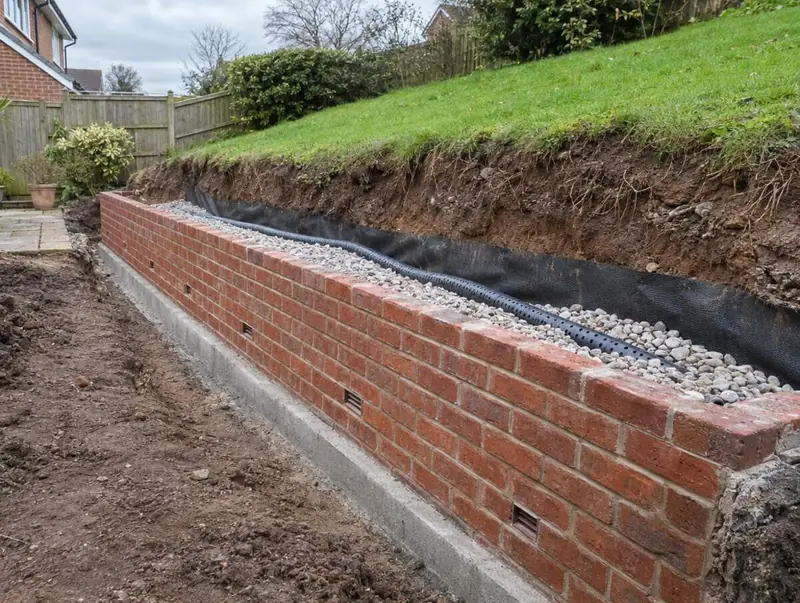
Where the whole wall is failing, it is replaced with a new retaining wall on a properly sized footing, with free-draining backfill, a membrane, weep holes and a drain at the base. Reinforced blockwork faced in brick or stone is common, so the wall matches its surroundings.
Best for: Walls failing along their length, or retaining significant height
Drainage and minor repairs
Blocked weep holes are cleared or new ones drilled, and where practical a drainage layer is formed behind the wall with an outlet at its base. Loose copings are rebedded, open joints repointed and a few damaged bricks replaced. For a low wall that has not moved much, this can be enough.
Best for: Low walls that are damp or slightly weathered but still upright
Temporary support and reducing load
While a repair is designed and programmed, a dangerous wall may be propped, or soil and loads near the top removed to reduce the push. Moving parked cars or a shed back from the wall is sometimes the simplest first step.
Best for: Walls that are moving now and need making safe
From first photo to finished repair
Photos and measurements
Send photos of the whole wall from the front and the end, so any lean shows, plus close-ups of cracks and weep holes. Tell us roughly how tall it is and what sits at the top, such as lawn, patio, drive or a building.
Written quote
You receive a no-obligation written quote covering demolition, excavation, temporary support, the footing, the new or repaired wall, drainage and spoil removal. It becomes a fixed price in writing once the repair is specified.
Build and drain
The failing section is taken down, the soil supported in short lengths, and the footing cast. The wall is rebuilt with drainage behind it, backfilled with free-draining material, and building control inspects where the work needs it.
Symptoms that point to retaining wall repairs
- Bricks or blocks pushed out of line, or coping stones sliding off
- No weep holes, or weep holes that never seem to drain
- Ground cracking or sinking along the top of the wall
- Water seeping through joints, or white salt staining, after rain
Do you need approval for retaining wall repairs in England?
In England, underpinning and other work that alters or strengthens a wall or foundation is building work under the Building Regulations (Part A, structure), so building control approves and inspects it. Like-for-like repairs often are not, and we tell you which applies before a price is agreed. Work to a party wall, or excavation close to a neighbour’s foundations, can also need a notice under the Party Wall etc. Act 1996.
Find retaining wall repairs in your Staffordshire town
- Stoke-on-Trent
- Newcastle-under-Lyme
- Burton upon Trent
- Cannock
- Tamworth
- Stafford
- Lichfield
- Kidsgrove
- Burntwood
- Rugeley
- Leek
- Great Wyrley
- Biddulph
Frequently asked questions
Why do houses in Staffordshire crack?
North Staffordshire around Stoke-on-Trent, Newcastle-under-Lyme and Kidsgrove, and the Cannock Chase area, lie on coalfields with recorded workings. Much of the rest of the county is Mercia Mudstone and glacial clay. Parts of Staffordshire lie on a former coalfield, so a coal mining search is worth checking if movement has no obvious cause. Only an investigation on site can say why a particular building has moved.
How much will retaining wall repairs cost in Staffordshire?
On West Midlands rates, retaining wall repairs starts from about £500 per wall, including VAT. The written price depends on the extent of the damage, access and whether an engineer or building control is needed.
Can a bulging retaining wall be saved?
Sometimes, if the bulge is small, the wall is low and the cause is mainly poor drainage. Improving drainage and repairing the face may stop further movement. A wall that has bulged a lot, cracked through or moved at its base usually needs that section rebuilding on a proper footing.
How long does a retaining wall rebuild take?
Drainage and minor repairs usually take a day or two. Rebuilding a garden retaining wall on new footings typically takes one to three weeks, depending on its length, height, access for digging and any wait for the engineer’s design or inspections.
What are weep holes in a retaining wall?
Weep holes are small openings near the base of a retaining wall that let water drain out from the soil behind it. Without them, water builds up and adds hydrostatic pressure that can push the wall over. They work best with a drainage layer behind the wall, and they need to be kept clear.