Staffordshire · England
Mining subsidence repairs in Staffordshire
Looking for mining subsidence repairs in Staffordshire? Send us photos for a free initial view. Clay soils are found in parts of Staffordshire, so we look at the ground, drains and nearby trees before recommending anything.
Guide price from£80per metre of crack inc VAT
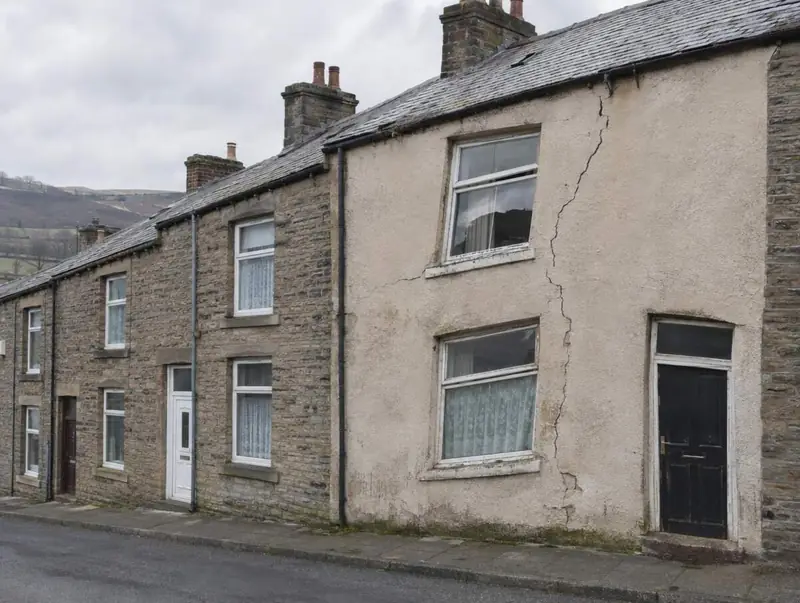
- Area
- Staffordshire
- Pricing region
- West Midlands
- Ground
- Clay in parts
- Towns listed
- 13
How do local ground conditions affect mining subsidence repairs in Staffordshire?
North Staffordshire around Stoke-on-Trent, Newcastle-under-Lyme and Kidsgrove, and the Cannock Chase area, lie on coalfields with recorded workings. Much of the rest of the county is Mercia Mudstone and glacial clay.
Parts of Staffordshire lie on a former coalfield, so a coal mining search is worth checking if movement has no obvious cause. Across Staffordshire, most homes are Potteries terraces, brick villas, inter-war semis and post-war estates.
What to look for before calling about mining subsidence repairs
- Damage that does not change with the seasons
- Steps or ridges forming in paths, kerbs or garden walls
- Cracks appearing suddenly across several walls at once
- Cracks running through the foundations and up both faces of a wall
Mining subsidence repairs prices in Staffordshire
Prices in Staffordshire are worked out on West Midlands rates. They include VAT and are a starting point: access, the extent of the damage and whether an engineer or building control is involved all move the figure.
| Item | Guide price | Per |
|---|---|---|
| Crack stitching and making good | £80 – £180 | per metre of crack |
| Re-levelling or ground stabilisation by resin injection | £800 – £1,500 | per metre of wall |
| Underpinning where the engineer specifies it | £1,000 – £3,500 | per metre of wall |
| Repair schedule for a claim (pricing an engineer's scope)est. | Free to request | — |
How we usually approach mining subsidence repairs
Ground stabilisation by resin injection
For localised settlement in the upper soil layers, expanding resin can be injected beneath the footings to firm the ground and sometimes reduce a small tilt. It is not suitable for large voids deep below, which need grouting or other specialist treatment first.
Best for: Shallow settlement once deeper voids are ruled out or treated
Underpinning to sound ground
Where the engineer specifies it, foundations are taken down by mass concrete, beam-and-base or mini-piles to ground that will not move further. On mining sites the design often follows grouting of old workings so the new foundation sits above a stable mass.
Best for: Ongoing movement or damage beyond what crack repairs can hold
Crack stitching and making good
Where the ground has stopped moving and the damage is cracking, the walls are stitched with stainless helical bars, repointed and replastered. This covers a large share of mining damage, especially legacy movement that settled years ago and left cracks behind.
Best for: Cracking after movement that has now stopped
What happens during mining subsidence repairs, step by step?
Report and photograph
Photograph every crack with a scale and note the date it appeared. Report suspected coal-mining damage to the Mining Remediation Authority, or the operator of a working mine, and notify your home insurer. Time limits can apply, so report promptly.
Engineer’s assessment
An independent chartered structural engineer inspects the damage and, if needed, recommends drilling or ground investigation to locate voids. We can arrange the engineer. Their report sets out the cause, whether movement has stopped and what repair is needed.
Repairs and records
Work proceeds once any ground treatment is complete and the engineer is satisfied. We stitch, stabilise or underpin as specified, make good inside and out, deal with building control where needed, and hand over records for your file.
Do you need approval for mining subsidence repairs in England?
In England, underpinning and other work that alters or strengthens a wall or foundation is building work under the Building Regulations (Part A, structure), so building control approves and inspects it. Like-for-like repairs often are not, and we tell you which applies before a price is agreed. Work to a party wall, or excavation close to a neighbour’s foundations, can also need a notice under the Party Wall etc. Act 1996.
Mining subsidence repairs near you in Staffordshire
- Stoke-on-Trent
- Newcastle-under-Lyme
- Burton upon Trent
- Cannock
- Tamworth
- Stafford
- Lichfield
- Kidsgrove
- Burntwood
- Rugeley
- Leek
- Great Wyrley
- Biddulph
Questions about mining subsidence repairs in Staffordshire
Does the ground around Stoke-on-Trent cause cracking?
North Staffordshire around Stoke-on-Trent, Newcastle-under-Lyme and Kidsgrove, and the Cannock Chase area, lie on coalfields with recorded workings. Much of the rest of the county is Mercia Mudstone and glacial clay. Parts of Staffordshire lie on a former coalfield, so a coal mining search is worth checking if movement has no obvious cause. Only an investigation on site can say why a particular building has moved.
How much will mining subsidence repairs cost in Staffordshire?
On West Midlands rates, mining subsidence repairs starts from about £80 per metre of crack, including VAT. The written price depends on the extent of the damage, access and whether an engineer or building control is needed.
What should I do if a hole opens in my garden?
Keep everyone away from it and do not try to fill it yourself. Report it straight away to the Mining Remediation Authority if coal mining may be involved, or to your council and insurer otherwise. Old shafts can be deeper and wider than the visible hole suggests.
Can you repair mining damage that is not part of a claim?
Yes. If the damage is old and settled, or a claim has been closed, we can repair it privately. Send photos for a free initial assessment and you will receive a no-obligation written quote. If the cause is unclear, an engineer’s inspection first is sensible.
Who pays for coal-mining subsidence damage?
Liability for damage from past coal mining usually rests with the Mining Remediation Authority, or with the operator of a working mine. They investigate whether coal mining caused the damage before agreeing any repair. Tell your home insurer as well, because policy cover and the mining claim can overlap.