Staffordshire · England
Underpinning in Staffordshire
Homes in Staffordshire are mostly Potteries terraces. That matters for underpinning: footings, wall construction and mortar all vary with the age of the building. Clay soils are found in parts of Staffordshire.
Guide price from£1,000per metre of wall inc VAT
- Area
- Staffordshire
- Pricing region
- West Midlands
- Ground
- Clay in parts
- Towns listed
- 13
What is the ground like in Staffordshire?
North Staffordshire around Stoke-on-Trent, Newcastle-under-Lyme and Kidsgrove, and the Cannock Chase area, lie on coalfields with recorded workings. Much of the rest of the county is Mercia Mudstone and glacial clay.
Parts of Staffordshire lie on a former coalfield, so a coal mining search is worth checking if movement has no obvious cause. What you mostly find across Staffordshire: Potteries terraces, brick villas, inter-war semis and post-war estates.
How much will underpinning cost in Staffordshire?
These are guide prices for Staffordshire, using West Midlands rates and including VAT. Your written quote follows photos or a survey, and is fixed once the repair is specified.
| Item | Guide price | Per |
|---|---|---|
| Mass-concrete underpinning | £1,000 – £1,500 | per metre of wall |
| Beam-and-base underpinning | £1,500 – £2,500 | per metre of wall |
| Mini-piled underpinning | £2,000 – £3,500 | per metre of wall |
| Engineer's design and building control feesest. | £800 – £2,500 | per scheme |
Which repair method suits a home in Staffordshire?
Mass concrete underpinning
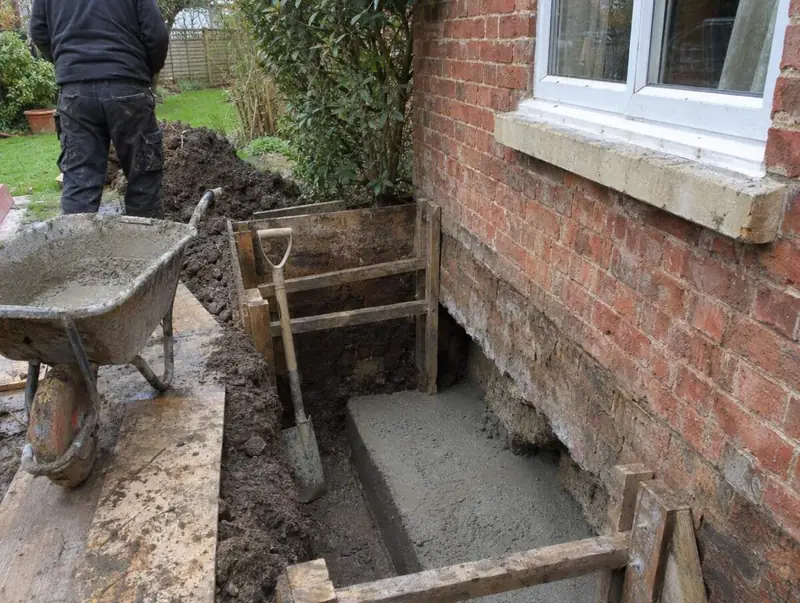
The traditional method. Short sections under the wall are dug out in a set sequence, usually about a metre at a time, and filled with concrete before the next section is opened. It suits moderate depths and good access, and it needs little specialist plant.
Best for: Shallow failures on firm ground found at moderate depth
Beam-and-base underpinning
A reinforced concrete beam is cast beneath or alongside the existing footing and carries the wall onto mass concrete bases at intervals. It spreads load well across variable ground and can mean less digging than continuous underpinning along the whole wall.
Best for: Longer runs of wall or heavier loads over variable ground
Mini-piled underpinning
Small-diameter piles are driven or bored down to firm ground and linked by a reinforced beam or needles that pick up the wall. Compact rigs fit through narrow access, and the method reaches depths that would be impractical to excavate by hand.
Best for: Deep soft ground, tree roots, or restricted access
What happens when we carry out underpinning in Staffordshire?
Engineer’s investigation
An independent chartered structural engineer studies the monitoring results, trial pits and soil tests, then decides whether underpinning is needed and which method suits. We can arrange the engineer if you do not already have one.
Fixed written price
With the design in hand we confirm a fixed price in writing, setting out the method, the length of wall, access arrangements and the making good. For insurance work we can price to the loss adjuster’s or engineer’s schedule.
Excavation and concrete
Work runs in the sequence the engineer sets so the wall is never left unsupported over a long length. Building control inspects the excavations before concrete goes in, and each section is dry-packed tight to the footing above.
Signs you may need underpinning
- Floors sloping noticeably towards one external wall
- Movement continuing through more than one winter of monitoring
- A large tree nearby that cannot be removed or reduced
- Footings found to be very shallow during a trial pit
Do you need approval for underpinning in England?
In England, underpinning and other work that alters or strengthens a wall or foundation is building work under the Building Regulations (Part A, structure), so building control approves and inspects it. Like-for-like repairs often are not, and we tell you which applies before a price is agreed. Work to a party wall, or excavation close to a neighbour’s foundations, can also need a notice under the Party Wall etc. Act 1996.
Towns in Staffordshire we cover for underpinning
- Stoke-on-Trent
- Newcastle-under-Lyme
- Burton upon Trent
- Cannock
- Tamworth
- Stafford
- Lichfield
- Kidsgrove
- Burntwood
- Rugeley
- Leek
- Great Wyrley
- Biddulph
Underpinning in Staffordshire: questions and answers
Is the ground in Staffordshire prone to subsidence?
North Staffordshire around Stoke-on-Trent, Newcastle-under-Lyme and Kidsgrove, and the Cannock Chase area, lie on coalfields with recorded workings. Much of the rest of the county is Mercia Mudstone and glacial clay. Parts of Staffordshire lie on a former coalfield, so a coal mining search is worth checking if movement has no obvious cause. Only an investigation on site can say why a particular building has moved.
How much will underpinning cost in Staffordshire?
On West Midlands rates, underpinning starts from about £1,000 per metre of wall, including VAT. The written price depends on the extent of the damage, access and whether an engineer or building control is needed.
Does my house really need underpinning?
Often not, because most subsidence is fixed by repairing drains or managing trees and then repairing the cracks. Underpinning is justified when monitoring shows movement continuing after the cause has been dealt with, or when the ground itself is unsuitable. An independent engineer should make that call.
Will underpinning affect selling my house?
It needs explaining to buyers, but a properly documented scheme is far better than unresolved movement. Keep the engineer’s design, the building control completion certificate and any insurance paperwork. Lenders and surveyors will usually ask for these before agreeing a sale.
Do I need to tell my neighbours about underpinning?
In England and Wales you usually do. Underpinning a party wall normally needs two months’ notice, and excavating near a neighbour’s foundations needs one month’s notice under the Party Wall etc. Act 1996. Scotland and Northern Ireland have no equivalent Act, but agreeing the work in writing still helps.