Stirling, Falkirk and Clackmannanshire · Scotland
Underpinning in Stirling, Falkirk and Clackmannanshire
Underpinning in Stirling, Falkirk and Clackmannanshire starts with the ground. Most of Stirling, Falkirk and Clackmannanshire is on firmer ground than the clay belts of the south-east, and the buildings here are mostly stone tenements and villas, so the repair has to suit both.
Guide price from£950per metre of wall inc VAT
- Area
- Stirling, Falkirk and Clackmannanshire
- Pricing region
- Scotland
- Ground
- Mostly firmer ground
- Towns listed
- 5
Why does the ground in Stirling, Falkirk and Clackmannanshire matter for underpinning?
The Forth valley has soft carse clays near the river, which can settle, and coalfields beneath Falkirk, Clackmannanshire and the south of Stirling with recorded historic workings.
Historic coal workings are recorded beneath parts of Stirling, Falkirk and Clackmannanshire, and a coal mining search is worth checking where movement is unexplained. What you mostly find across Stirling, Falkirk and Clackmannanshire: stone tenements and villas, miners' rows and post-war estates.
Which repair method suits a home in Stirling, Falkirk and Clackmannanshire?
Mini-piled underpinning
Small-diameter piles are driven or bored down to firm ground and linked by a reinforced beam or needles that pick up the wall. Compact rigs fit through narrow access, and the method reaches depths that would be impractical to excavate by hand.
Best for: Deep soft ground, tree roots, or restricted access
Beam-and-base underpinning
A reinforced concrete beam is cast beneath or alongside the existing footing and carries the wall onto mass concrete bases at intervals. It spreads load well across variable ground and can mean less digging than continuous underpinning along the whole wall.
Best for: Longer runs of wall or heavier loads over variable ground
Mass concrete underpinning
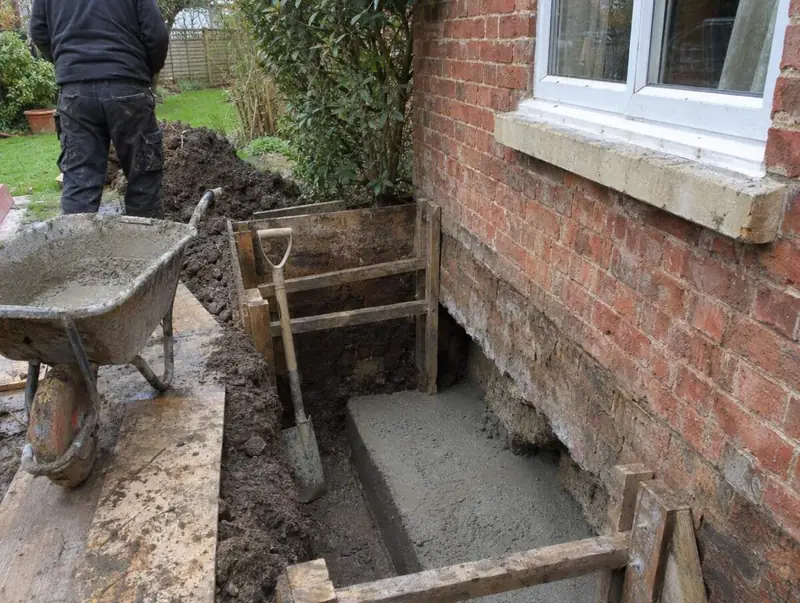
The traditional method. Short sections under the wall are dug out in a set sequence, usually about a metre at a time, and filled with concrete before the next section is opened. It suits moderate depths and good access, and it needs little specialist plant.
Best for: Shallow failures on firm ground found at moderate depth
What happens when we carry out underpinning in Stirling, Falkirk and Clackmannanshire?
Engineer’s investigation
An independent chartered structural engineer studies the monitoring results, trial pits and soil tests, then decides whether underpinning is needed and which method suits. We can arrange the engineer if you do not already have one.
Design and approvals
The engineer produces drawings and calculations. We make the building control or building warrant application, and party wall notices are served where the law requires them, before any digging starts.
Crack repairs and handover
Once the new foundation has cured, cracks are stitched and repointed, inside walls are made good, and paths or patios disturbed by the dig are reinstated. You receive the building control completion paperwork for your records.
Signs you may need underpinning
- One corner of the house visibly lower than the others
- Movement continuing through more than one winter of monitoring
- Floors sloping noticeably towards one external wall
- Footings found to be very shallow during a trial pit
How much will underpinning cost in Stirling, Falkirk and Clackmannanshire?
Guide prices below are for homes in Stirling, Falkirk and Clackmannanshire, on Scotland rates and including VAT. A survey or good photos let us turn them into a fixed written price.
| Item | Guide price | Per |
|---|---|---|
| Mass-concrete underpinning | £950 – £1,400 | per metre of wall |
| Beam-and-base underpinning | £1,400 – £2,400 | per metre of wall |
| Mini-piled underpinning | £1,900 – £3,300 | per metre of wall |
| Engineer's design and building control feesest. | £760 – £2,400 | per scheme |
Do you need approval for underpinning in Scotland?
In Scotland, underpinning and other structural alterations generally need a building warrant from the council’s building standards service before work starts, and a completion certificate at the end; small like-for-like repairs often do not. There is no Party Wall Act in Scotland; shared walls are covered by title deeds and, for flats, the Tenements (Scotland) Act 2004.
Underpinning near you in Stirling, Falkirk and Clackmannanshire
Underpinning in Stirling, Falkirk and Clackmannanshire: questions and answers
Does the ground around Stirling cause cracking?
The Forth valley has soft carse clays near the river, which can settle, and coalfields beneath Falkirk, Clackmannanshire and the south of Stirling with recorded historic workings. Historic coal workings are recorded beneath parts of Stirling, Falkirk and Clackmannanshire, and a coal mining search is worth checking where movement is unexplained. Only an investigation on site can say why a particular building has moved.
How much will underpinning cost in Stirling, Falkirk and Clackmannanshire?
On Scotland rates, underpinning starts from about £950 per metre of wall, including VAT. The written price depends on the extent of the damage, access and whether an engineer or building control is needed.
Which underpinning method is best?
The right method depends on how deep firm ground lies, the load on the wall and the access. Mass concrete suits moderate depths, beam-and-base spreads heavier loads, and mini-piles reach deep soft ground or work through tight access. The engineer chooses the method from the site investigation.
Do I need to tell my neighbours about underpinning?
In England and Wales you usually do. Underpinning a party wall normally needs two months’ notice, and excavating near a neighbour’s foundations needs one month’s notice under the Party Wall etc. Act 1996. Scotland and Northern Ireland have no equivalent Act, but agreeing the work in writing still helps.
Will underpinning affect selling my house?
It needs explaining to buyers, but a properly documented scheme is far better than unresolved movement. Keep the engineer’s design, the building control completion certificate and any insurance paperwork. Lenders and surveyors will usually ask for these before agreeing a sale.