Havering · Greater London
Floor joist repairs in Havering
Whether it is one soft patch by the bathroom or a whole room dropping towards the wall, floor joist repairs in Havering are priced only after the timber has been seen. Rot, notches and failed supports each need a different fix, and the quote says which.
Guide price from£310per joist inc VAT
- Postcodes
- RM1, RM2, RM3, RM11, RM12
- Population
- about 260,000
- Area
- Greater London
- Pricing region
- London
What should you know about the ground under Havering?
Havering takes in postcode districts including RM1, RM2, RM3, RM11, RM12, with about 260,000 residents. We also take enquiries from nearby South Ockendon (4 miles), Barking and Dagenham (4 miles) and Brentwood (5 miles).
Much of Greater London sits on clay that shrinks in dry summers and swells in wet winters. Ground movement here is more often linked to soils, drains and trees than to mining. Typical buildings in Greater London: Victorian and Edwardian terraces with shallow footings, inter-war semis in the outer boroughs, and converted flats and mansion blocks.
Symptoms that point to floor joist repairs
- Ceiling cracks below that follow the line of the joists
- Floor dipping towards an outside wall or in the middle of the room
- Soft or spongy boards near outside walls, hearths or the bathroom
Guide prices for floor joist repairs in Havering
The ranges below reflect typical London costs for floor joist repairs, including VAT. Scaffold, access and making good can push a job to the top of the range.
| Item | Guide price | Per |
|---|---|---|
| Splicing or sistering a damaged joist | £310 – £500 | per joist |
| Whole room of joists and boards | £2,500 – £7,500 | per room |
| Sleeper wall rebuild and ventilationest. | £500 – £1,900 | per room |
Methods for floor joist repairs
Splicing ends and fitting hangers
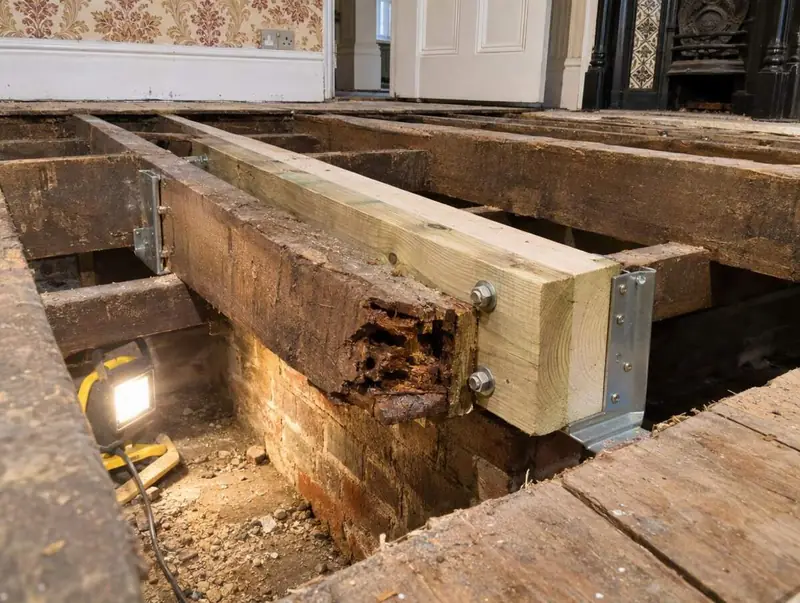
Where only the end has rotted, it is cut back to sound timber and a new piece is fixed alongside, bearing on the wall or on a new joist hanger. Missing or under-nailed hangers elsewhere are replaced at the same time. The damp in the wall must be fixed too.
Best for: Rotten joist ends in damp solid walls
Sistering a joist
A new length of treated timber, the same depth as the original, is bolted or screwed alongside the damaged joist so the two share the load. It is the quickest fix for a notched, cracked or sagging joist that is otherwise sound, usually after lifting a few boards.
Best for: Cut, cracked or sagging joists with sound ends
From first photo to finished repair
Lift boards and inspect
On site we lift a few boards where the floor is worst and check the joist ends, sleeper walls and void with a moisture meter. Outside, we look for high ground, blocked vents and leaks keeping the timber wet.
Written quote
You get a no-obligation written quote listing which joists are sistered, spliced or replaced and any sleeper wall or ventilation work. It becomes a fixed price in writing once the repair is specified.
Repair the structure
Boards are lifted and numbered if they are going back, and rotten timber is cut out. New treated timber is fixed and checked with a level before strutting, hangers and any restraint straps go in.
Rules for floor joist repairs in England
Like-for-like repairs such as crack stitching and repointing do not usually need building control approval in England, but anything that changes or strengthens the structure, such as underpinning or rebuilding a wall, does. If the work touches a party wall, the Party Wall etc. Act 1996 may apply.
Frequently asked questions
How much should I budget for floor joist repairs in Havering?
Guide prices for floor joist repairs in Havering start from about £310 per joist, including VAT, on London rates. Your fixed written price follows photos or a survey and depends on the extent of the work and access.
Can you survey a property in Havering?
Yes. We take enquiries from across Havering, including RM1, RM2, RM3, RM11, and from nearby places such as South Ockendon and Barking and Dagenham. Send photos for a free initial view and we will tell you what happens next.
Why do houses in Greater London crack?
Most of Greater London sits on London Clay, among the most shrinkage-prone ground in the UK, with river gravels along the Thames. Subsidence claims here are among the most frequent in the country, especially after dry summers and near street and garden trees. Only an investigation can say why a particular building has moved.
Why is my floor bouncy?
A bouncy floor usually means the joists are deflecting too much, often because they span too far, have lost their strutting or have been weakened by notches. It rarely means imminent failure, but it is worth checking, especially if the bounce appeared after work in the room.
Is a sagging floor dangerous?
A gentle, long-standing sag is usually not dangerous, and many older floors have moved slightly over a century. A sag that is getting worse, soft boards or a floor dropping near a wall needs checking soon, because rotten joist ends can lose their bearing.
Related work in Havering
- Bowing wall repairs
- Subsidence insurance claim repairs
- Roof structure repairs
- Boundary and garden wall repairs
- Chimney stack repairs
Floor joist repairs near Havering
If a floor in Havering has dropped after plumbing or heating work, send photos of any lifted boards and notches, and we will price the strengthening.