Greater Manchester · England
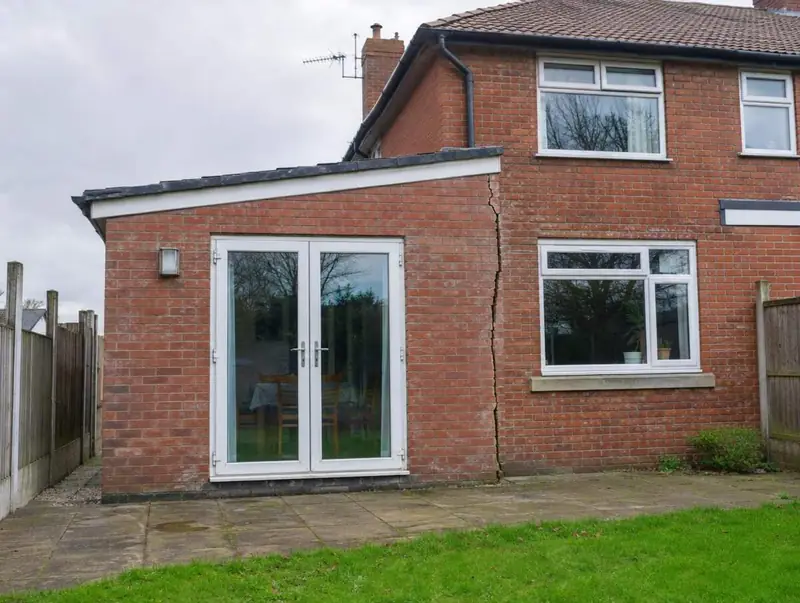
Extension pulling away repairs in Greater Manchester
If you live in Greater Manchester and are looking at extension pulling away repairs, the first question is why the wall moved. Clay soils are found in parts of Greater Manchester; parts of Greater Manchester lie on a former coalfield, so a coal mining search is worth checking if movement has no obvious cause.
Guide price from£575per junction inc VAT
- Area
- Greater Manchester
- Pricing region
- North West
- Ground
- Clay in parts
- Towns listed
- 23
Is Greater Manchester prone to ground movement?
Greater Manchester is mostly glacial till over sandstone and mudstone, with the Lancashire coalfield beneath much of Wigan, Bolton, Salford and parts of the east. Historic mine workings, made ground and old mill sites are common.
Parts of Greater Manchester lie on a former coalfield, so a coal mining search is worth checking if movement has no obvious cause. Typical buildings in Greater Manchester: Red-brick terraces, mill-town stone terraces, inter-war semis and post-war estates.
How we usually approach extension pulling away repairs
Underpinning the extension
If the extension is still dropping because its footings are too shallow or on poor ground, they are taken deeper by mass concrete, beam-and-base or mini-piles. The engineer designs the scheme, and the junction is repaired once the new foundation is in.
Best for: Active movement from shallow footings, roots or soft ground
Junction crack repair with stainless ties
The open joint is cut out, stainless ties or helical bars are fixed across it into both the old and new masonry, and the joint is repointed or rendered to match. Inside, the corner is replastered. This suits extensions that moved once and have since stopped.
Best for: Settled extensions with a stable gap at the junction
Movement joint and making good
Where some seasonal movement is expected to continue, the junction is formed into a proper flexible movement joint with a compressible filler and sealant, so the two parts can move without cracking. Flashings and internal finishes are detailed to suit.
Best for: Minor ongoing movement that does not threaten the structure
What happens during extension pulling away repairs, step by step?
Find what is moving
An independent chartered structural engineer can inspect, and we can arrange one. A drain survey under the extension, a trial pit at its footing and tell-tale monitoring across the joint are common checks before choosing the repair.
Choose the fix
The engineer decides between ties, a movement joint or underpinning. We confirm a fixed price in writing once the repair is specified, covering the junction, flashings, internal finishes and any foundation work.
Finish and hand over
Internal corners are replastered, skirtings and coving refixed, and doors or windows in the extension eased where the movement affected them. Records of the repair and any approvals are passed to you.
What to look for before calling about extension pulling away repairs
- A vertical crack or gap where the extension meets the house
- Floor level dropping where the extension and house floors meet
- Mastic or render at the joint repeatedly splitting open
- Patio doors or windows in the extension starting to bind
Extension pulling away repairs prices in Greater Manchester
For Greater Manchester we use North West rates. Treat the table as a budget guide, inc VAT; the price you pay is the one on your written quote.
| Item | Guide price | Per |
|---|---|---|
| Junction crack repair with stainless tiesest. | £575 – £1,900 | per junction |
| Movement joint and making goodest. | £385 – £1,150 | per junction |
| Underpinning the extension where needed | £960 – £2,400 | per metre of wall |
Do you need approval for extension pulling away repairs in England?
In England, underpinning and other work that alters or strengthens a wall or foundation is building work under the Building Regulations (Part A, structure), so building control approves and inspects it. Like-for-like repairs often are not, and we tell you which applies before a price is agreed. Work to a party wall, or excavation close to a neighbour’s foundations, can also need a notice under the Party Wall etc. Act 1996.
Towns in Greater Manchester we cover for extension pulling away repairs
- Manchester
- Oldham
- Wigan
- Bolton
- Stockport
- Salford
- Rochdale
- Sale
- Bury
- Altrincham
- Middleton
- Ashton-under-Lyne
- Leigh
- Tyldesley
- Hyde
- Radcliffe
- Cheadle Hulme
- Ashton-in-Makerfield
- Westhoughton
- Hindley
- Irlam
- Horwich
- Ramsbottom
Questions about extension pulling away repairs in Greater Manchester
Is the ground in Greater Manchester prone to subsidence?
Greater Manchester is mostly glacial till over sandstone and mudstone, with the Lancashire coalfield beneath much of Wigan, Bolton, Salford and parts of the east. Historic mine workings, made ground and old mill sites are common. Parts of Greater Manchester lie on a former coalfield, so a coal mining search is worth checking if movement has no obvious cause. Only an investigation on site can say why a particular building has moved.
How much will extension pulling away repairs cost in Greater Manchester?
On North West rates, extension pulling away repairs starts from about £575 per junction, including VAT. The written price depends on the extent of the damage, access and whether an engineer or building control is needed.
Can I just fill the gap with mastic?
Mastic can keep water out short term, but it does not stop movement or reconnect the walls. If the gap reopens after filling, something is still moving. Photograph and measure it over a few months first, so an engineer can see the trend.
What is a movement joint?
A movement joint is a deliberate, flexible break in a wall that lets two parts of a building move slightly without cracking. It is filled with a compressible material and sealed. At an extension junction it can replace a rigid joint that keeps cracking.
Who is responsible if a recent extension is moving?
If the extension is recent, the original builder, the designer or building control records may be relevant, and you may have rights against the builder. Gather the plans, completion certificate and contract. Insurance often excludes defects in new construction, so check your policy.