Buckinghamshire · England
Boundary and garden wall repairs in Buckinghamshire
We arrange surveys and price boundary and garden wall repairs throughout Buckinghamshire. Much of Buckinghamshire sits on clay that shrinks in dry summers and swells in wet winters, and we take that into account before recommending a method.
Guide price from£335per wall inc VAT
- Area
- Buckinghamshire
- Pricing region
- South East
- Ground
- Shrinkable clay widespread
- Towns listed
- 9
What should you know about the ground under Buckinghamshire?
The Chilterns are chalk with clay-with-flints on the tops, while the Vale of Aylesbury and Milton Keynes sit on Gault, Kimmeridge and Oxford Clays and glacial till. The vale clays are prone to seasonal shrinkage near trees.
Ground movement here is more often linked to soils, drains and trees than to mining. Across Buckinghamshire, most homes are market-town terraces, 1930s semis in the south, and large late-20th-century estates in Milton Keynes and Aylesbury.
Guide prices for boundary and garden wall repairs in Buckinghamshire
These are guide prices for Buckinghamshire, using South East rates and including VAT. Your written quote follows photos or a survey, and is fixed once the repair is specified.
| Item | Guide price | Per |
|---|---|---|
| Repointing and minor repairsest. | £335 – £1,350 | per wall |
| Rebuilding a leaning sectionest. | £170 – £390 | per m² of wall face |
| New brick piersest. | £280 – £670 | per pier |
Methods for boundary and garden wall repairs
Dealing with roots and soil loading
Soil banked against the wall is dug back. Where roots are the cause, the wall can be rebuilt with a lintel bridging the root zone, or realigned to give the tree room. Decisions about the tree are made with its owner and, where needed, a tree specialist.
Best for: Walls lifted by roots or pushed over by banked soil
New piers and movement joints
Brick piers are built at intervals along the wall, bonded in or tied with stainless fixings, to stiffen it against wind and lean. Vertical movement joints are cut where a long run keeps cracking. Gate piers are rebuilt larger and on deeper footings where they carry heavy gates.
Best for: Long walls with regular cracks, or weak gate piers
Rebuilding a leaning section
The leaning or badly cracked section is taken down, sound bricks cleaned for reuse, and the wall rebuilt on a new footing at a suitable depth. A damp-proof course and a proper coping are added, and the new work is jointed to the sound wall either side.
Best for: Sections that lean, rock or have cracked right through
From first photo to finished repair
Photos and ownership
Send photos of the whole wall and close-ups of cracks, the lean and the coping, plus any nearby trees. Tell us whether the wall is yours, shared or your neighbour’s, as that affects who can instruct the work.
Written quote
You receive a no-obligation written quote that separates repointing, rebuilt sections, new piers and copings, so you or your neighbour can see each part. It becomes a fixed price in writing once the repair is specified.
Repair and rebuild
Sections are taken down, footings dug, and the wall rebuilt or repointed with a damp-proof course and coping. Reclaimed or matched bricks keep the wall consistent, and spoil and old materials are removed at the end.
Symptoms that point to boundary and garden wall repairs
- A tree close to the wall, with the base lifted or cracked
- Vertical cracks at regular intervals along a long run of wall
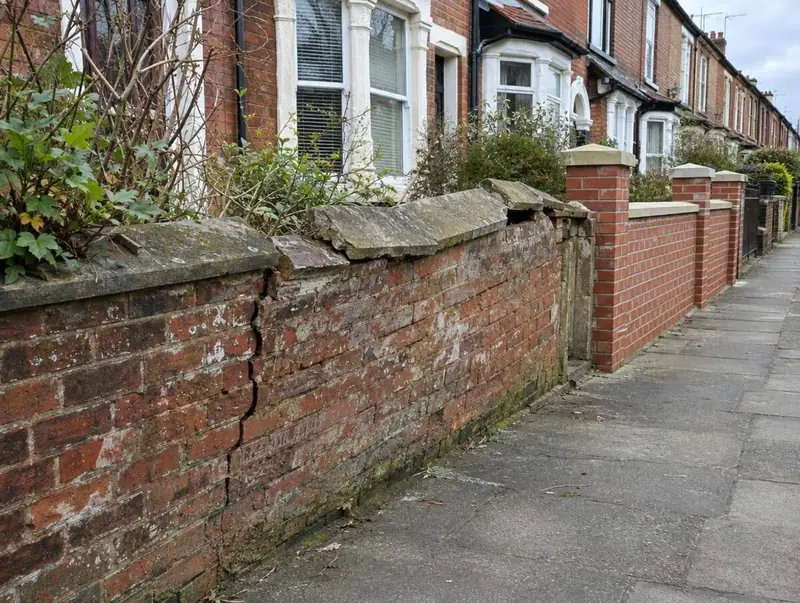
- Wall leaning towards the pavement, drive or neighbour’s garden
- Coping stones or brick-on-edge tops loose, cracked or missing
Do you need approval for boundary and garden wall repairs in England?
Like-for-like repairs such as crack stitching and repointing do not usually need building control approval in England, but anything that changes or strengthens the structure, such as underpinning or rebuilding a wall, does. If the work touches a party wall, the Party Wall etc. Act 1996 may apply.
Boundary and garden wall repairs near you in Buckinghamshire
Frequently asked questions
Does the ground around Milton Keynes cause cracking?
The Chilterns are chalk with clay-with-flints on the tops, while the Vale of Aylesbury and Milton Keynes sit on Gault, Kimmeridge and Oxford Clays and glacial till. The vale clays are prone to seasonal shrinkage near trees. Ground movement here is more often linked to soils, drains and trees than to mining. Only an investigation on site can say why a particular building has moved.
How much will boundary and garden wall repairs cost in Buckinghamshire?
On South East rates, boundary and garden wall repairs starts from about £335 per wall, including VAT. The written price depends on the extent of the damage, access and whether an engineer or building control is needed.
Does home insurance cover a fallen garden wall?
Sometimes, but many policies exclude garden walls or cover them only for certain events, such as vehicle impact or storm. Frost, wear and tree root damage are usually excluded. If a vehicle caused the damage, the driver’s insurer may pay. Check your policy and tell your insurer before permanent repairs start.
Who is responsible for a boundary wall?
Responsibility depends on who owns the wall, which is shown in your title deeds and plans, or may be shared. A wall built on the line between two properties is often jointly owned. Check the deeds first and agree repairs with your neighbour, and in England and Wales check whether the Party Wall Act applies.
Can a leaning wall be pushed back upright?
Usually not in a way that lasts. Masonry does not bend back, and forcing a wall upright tends to crack it further. The normal repair is to rebuild the leaning section on a proper footing, reusing sound bricks, and add piers to stop it happening again.