Bristol · England
Boundary and garden wall repairs in Bristol
We carry out boundary and garden wall repairs across Bristol, from the larger towns to smaller places nearby. Parts of Bristol have clay that can shrink near trees in dry spells. Every job starts with the cause, then the repair is specified to match it.
Guide price from£310per wall inc VAT
- Area
- Bristol
- Pricing region
- South West
- Ground
- Clay in parts
- Towns listed
- 0
Why does the ground in Bristol matter for boundary and garden wall repairs?
Bristol has mixed ground: Mercia Mudstone, limestone and alluvium along the Avon, and Coal Measures under parts of the north and east of the city, where historic shallow workings are recorded. Made ground on old quarry and dock land is also common.
Parts of Bristol lie on a former coalfield, so a coal mining search is worth checking if movement has no obvious cause. Across Bristol, most homes are Georgian and Victorian terraces on steep streets, inter-war council estates and post-war system-built homes.
Is it time for boundary and garden wall repairs? Common signs
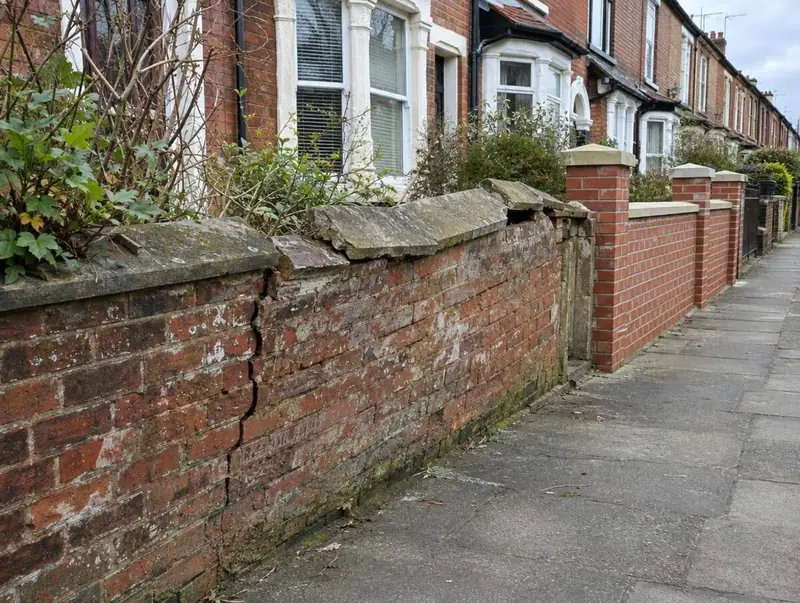
- Vertical cracks at regular intervals along a long run of wall
- Wall leaning towards the pavement, drive or neighbour’s garden
- Coping stones or brick-on-edge tops loose, cracked or missing
- Crumbling mortar, or bricks with faces flaking away
What should you budget for boundary and garden wall repairs in Bristol?
For Bristol we use South West rates. Treat the table as a budget guide, inc VAT; the price you pay is the one on your written quote.
| Item | Guide price | Per |
|---|---|---|
| Repointing and minor repairsest. | £310 – £1,250 | per wall |
| Rebuilding a leaning sectionest. | £155 – £360 | per m² of wall face |
| New brick piersest. | £260 – £620 | per pier |
Repair options we may recommend
Dealing with roots and soil loading
Soil banked against the wall is dug back. Where roots are the cause, the wall can be rebuilt with a lintel bridging the root zone, or realigned to give the tree room. Decisions about the tree are made with its owner and, where needed, a tree specialist.
Best for: Walls lifted by roots or pushed over by banked soil
Rebuilding a leaning section
The leaning or badly cracked section is taken down, sound bricks cleaned for reuse, and the wall rebuilt on a new footing at a suitable depth. A damp-proof course and a proper coping are added, and the new work is jointed to the sound wall either side.
Best for: Sections that lean, rock or have cracked right through
New piers and movement joints
Brick piers are built at intervals along the wall, bonded in or tied with stainless fixings, to stiffen it against wind and lean. Vertical movement joints are cut where a long run keeps cracking. Gate piers are rebuilt larger and on deeper footings where they carry heavy gates.
Best for: Long walls with regular cracks, or weak gate piers
What to expect when we carry out boundary and garden wall repairs
Site assessment
On site we check the lean with a level, look at the footing where it can be seen, note the bricks and mortar, and check for trees, soil loading and gate loads. If the wall turns out to be retaining soil, we treat it as a retaining wall.
Neighbour and notices
Where the wall is shared or on the line of junction in England and Wales, the Party Wall etc. Act 1996 may require notice before work starts. We can explain what is likely to be needed, and work is agreed with neighbours first.
Repair and rebuild
Sections are taken down, footings dug, and the wall rebuilt or repointed with a damp-proof course and coping. Reclaimed or matched bricks keep the wall consistent, and spoil and old materials are removed at the end.
Do you need approval for boundary and garden wall repairs in England?
Like-for-like repairs such as crack stitching and repointing do not usually need building control approval in England, but anything that changes or strengthens the structure, such as underpinning or rebuilding a wall, does. If the work touches a party wall, the Party Wall etc. Act 1996 may apply.
Your boundary and garden wall repairs questions
Does the ground around Bristol cause cracking?
Bristol has mixed ground: Mercia Mudstone, limestone and alluvium along the Avon, and Coal Measures under parts of the north and east of the city, where historic shallow workings are recorded. Made ground on old quarry and dock land is also common. Parts of Bristol lie on a former coalfield, so a coal mining search is worth checking if movement has no obvious cause. Only an investigation on site can say why a particular building has moved.
How much will boundary and garden wall repairs cost in Bristol?
On South West rates, boundary and garden wall repairs starts from about £310 per wall, including VAT. The written price depends on the extent of the damage, access and whether an engineer or building control is needed.
Can a leaning wall be pushed back upright?
Usually not in a way that lasts. Masonry does not bend back, and forcing a wall upright tends to crack it further. The normal repair is to rebuild the leaning section on a proper footing, reusing sound bricks, and add piers to stop it happening again.
Who is responsible for a boundary wall?
Responsibility depends on who owns the wall, which is shown in your title deeds and plans, or may be shared. A wall built on the line between two properties is often jointly owned. Check the deeds first and agree repairs with your neighbour, and in England and Wales check whether the Party Wall Act applies.
Can tree roots damage a garden wall?
Yes, they often do. Roots can lift footings, push walls sideways and, on clay soils, dry the ground so it shrinks under the wall. A wall can sometimes be rebuilt to bridge roots. Take advice before removing a large tree, as it may be protected and removal on clay can cause heave.