Kent · England
Underpinning in Kent
We carry out underpinning across Kent, from the larger towns to smaller places nearby. Much of Kent sits on clay that shrinks in dry summers and swells in wet winters. Every job starts with the cause, then the repair is specified to match it.
Guide price from£1,100per metre of wall inc VAT
- Area
- Kent
- Pricing region
- South East
- Ground
- Shrinkable clay widespread
- Towns listed
- 22
Is Kent prone to ground movement?
North Kent sits on London Clay, central Kent on Gault and Weald Clays and the Downs on chalk, so shrinkable clay is widespread. East Kent around Deal and Dover had a small deep coalfield, worked until the late 1980s.
Parts of Kent lie on a former coalfield, so a coal mining search is worth checking if movement has no obvious cause. Across Kent, most homes are Victorian terraces in the Medway towns, weatherboarded and Wealden houses, 1930s semis and seaside bungalows.
What to expect when we carry out underpinning
Design and approvals
The engineer produces drawings and calculations. We make the building control or building warrant application, and party wall notices are served where the law requires them, before any digging starts.
Fixed written price
With the design in hand we confirm a fixed price in writing, setting out the method, the length of wall, access arrangements and the making good. For insurance work we can price to the loss adjuster’s or engineer’s schedule.
Crack repairs and handover
Once the new foundation has cured, cracks are stitched and repointed, inside walls are made good, and paths or patios disturbed by the dig are reinstated. You receive the building control completion paperwork for your records.
Is it time for underpinning? Common signs
- Footings found to be very shallow during a trial pit
- Cracks that keep widening after the drains have been repaired
- A large tree nearby that cannot be removed or reduced
- Floors sloping noticeably towards one external wall
What should you budget for underpinning in Kent?
Prices in Kent are worked out on South East rates. They include VAT and are a starting point: access, the extent of the damage and whether an engineer or building control is involved all move the figure.
| Item | Guide price | Per |
|---|---|---|
| Mass-concrete underpinning | £1,100 – £1,700 | per metre of wall |
| Beam-and-base underpinning | £1,700 – £2,800 | per metre of wall |
| Mini-piled underpinning | £2,250 – £3,900 | per metre of wall |
| Engineer's design and building control feesest. | £895 – £2,800 | per scheme |
Repair options we may recommend
Mass concrete underpinning
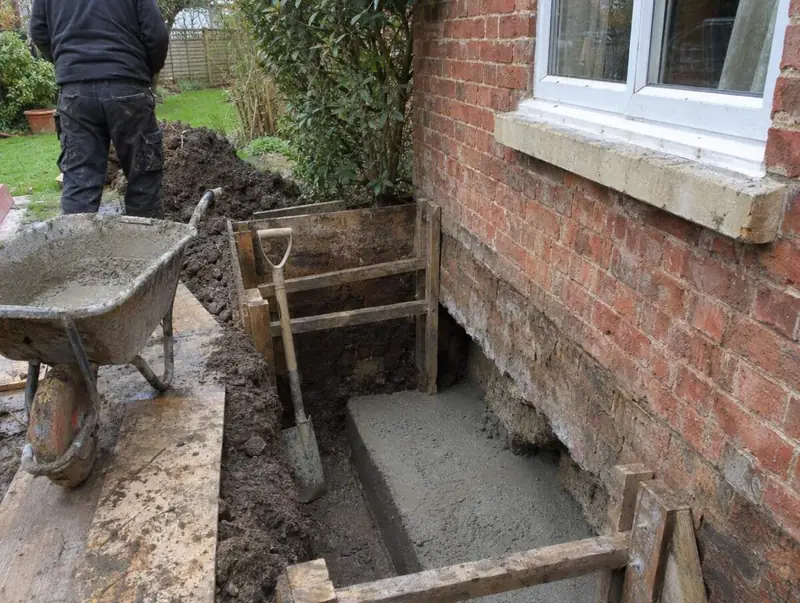
The traditional method. Short sections under the wall are dug out in a set sequence, usually about a metre at a time, and filled with concrete before the next section is opened. It suits moderate depths and good access, and it needs little specialist plant.
Best for: Shallow failures on firm ground found at moderate depth
Mini-piled underpinning
Small-diameter piles are driven or bored down to firm ground and linked by a reinforced beam or needles that pick up the wall. Compact rigs fit through narrow access, and the method reaches depths that would be impractical to excavate by hand.
Best for: Deep soft ground, tree roots, or restricted access
Beam-and-base underpinning
A reinforced concrete beam is cast beneath or alongside the existing footing and carries the wall onto mass concrete bases at intervals. It spreads load well across variable ground and can mean less digging than continuous underpinning along the whole wall.
Best for: Longer runs of wall or heavier loads over variable ground
Do you need approval for underpinning in England?
In England, underpinning and other work that alters or strengthens a wall or foundation is building work under the Building Regulations (Part A, structure), so building control approves and inspects it. Like-for-like repairs often are not, and we tell you which applies before a price is agreed. Work to a party wall, or excavation close to a neighbour’s foundations, can also need a notice under the Party Wall etc. Act 1996.
Find underpinning in your Kent town
- Maidstone
- Gillingham
- Tunbridge Wells
- Folkestone
- Margate
- Ashford
- Canterbury
- Sittingbourne
- Gravesend
- Dartford
- Ramsgate
- Dover
- Tonbridge
- Strood
- Whitstable
- Deal
- Sevenoaks
- Herne Bay
- Faversham
- Swanley
- Longfield
- Swanscombe
Your underpinning questions
Why do houses in Kent crack?
North Kent sits on London Clay, central Kent on Gault and Weald Clays and the Downs on chalk, so shrinkable clay is widespread. East Kent around Deal and Dover had a small deep coalfield, worked until the late 1980s. Parts of Kent lie on a former coalfield, so a coal mining search is worth checking if movement has no obvious cause. Only an investigation on site can say why a particular building has moved.
How much will underpinning cost in Kent?
On South East rates, underpinning starts from about £1,100 per metre of wall, including VAT. The written price depends on the extent of the damage, access and whether an engineer or building control is needed.
Does my house really need underpinning?
Often not, because most subsidence is fixed by repairing drains or managing trees and then repairing the cracks. Underpinning is justified when monitoring shows movement continuing after the cause has been dealt with, or when the ground itself is unsuitable. An independent engineer should make that call.
Does underpinning need building control approval?
Yes, underpinning is building work and needs approval and inspections in England and Wales, a building warrant in Scotland, and council building control in Northern Ireland. Inspectors usually check the excavations before concrete is poured. We deal with building control as part of the job.
Can you underpin only part of a house?
Yes, partial underpinning of one corner or one wall is common, though the engineer must think about the junction with the unstrengthened part. A sudden change in foundation depth can cause new cracking, so the scheme may step down gradually or include a movement joint.