Tyne and Wear · England
Retaining wall repairs in Tyne and Wear
Tyne and Wear has its own mix of ground and building types, and that shapes how retaining wall repairs is done here. Parts of Tyne and Wear have clay that can shrink near trees in dry spells.
Guide price from£460per wall inc VAT
- Area
- Tyne and Wear
- Pricing region
- North East
- Ground
- Clay in parts
- Towns listed
- 9
How do local ground conditions affect retaining wall repairs in Tyne and Wear?
Tyne and Wear lies on the Durham and Northumberland coalfield, with old shallow workings recorded beneath parts of Newcastle, Gateshead and Sunderland, mostly under a cover of glacial clay.
Historic coal workings are recorded beneath parts of Tyne and Wear, and a coal mining search is worth checking where movement is unexplained. Housing stock in Tyne and Wear: Tyneside flats and terraces, Victorian villas, inter-war council estates and post-war semis.
Guide prices for retaining wall repairs in Tyne and Wear
These are guide prices for Tyne and Wear, using North East rates and including VAT. Your written quote follows photos or a survey, and is fixed once the repair is specified.
| Item | Guide price | Per |
|---|---|---|
| Minor repairs and drainage | £460 – £1,850 | per wall |
| Structural repair or partial rebuild | £2,750 – £13,800 | per wall |
| New retaining wall | £185 – £415 | per m² of wall face |
Methods for retaining wall repairs
Rebuilding on new footings
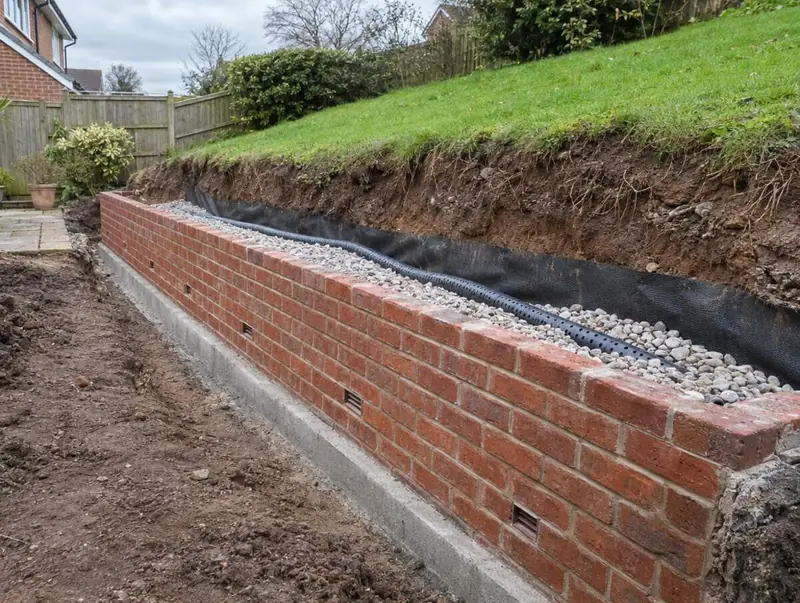
Where the whole wall is failing, it is replaced with a new retaining wall on a properly sized footing, with free-draining backfill, a membrane, weep holes and a drain at the base. Reinforced blockwork faced in brick or stone is common, so the wall matches its surroundings.
Best for: Walls failing along their length, or retaining significant height
Structural repair and partial rebuild
A leaning or bulging section is taken down, the soil behind dug out and supported, and the wall rebuilt on a new footing with drainage and, where specified, reinforcement tied into the sound wall either side. The engineer’s design sets footing size and wall thickness.
Best for: A section that has moved while the rest stays sound
Temporary support and reducing load
While a repair is designed and programmed, a dangerous wall may be propped, or soil and loads near the top removed to reduce the push. Moving parked cars or a shed back from the wall is sometimes the simplest first step.
Best for: Walls that are moving now and need making safe
From first photo to finished repair
Photos and measurements
Send photos of the whole wall from the front and the end, so any lean shows, plus close-ups of cracks and weep holes. Tell us roughly how tall it is and what sits at the top, such as lawn, patio, drive or a building.
Site assessment
On site we measure height and lean, check the drainage and the ground at the top and bottom, and look at access for digging out. Walls that support a drive, path or building, or retain more than a modest height, are referred to an engineer.
Written quote
You receive a no-obligation written quote covering demolition, excavation, temporary support, the footing, the new or repaired wall, drainage and spoil removal. It becomes a fixed price in writing once the repair is specified.
Symptoms that point to retaining wall repairs
- No weep holes, or weep holes that never seem to drain
- Water seeping through joints, or white salt staining, after rain
- Wall leaning forward, or bulging out in the middle of its length
- Horizontal or stepped cracks running along the face of the wall
Do you need approval for retaining wall repairs in England?
In England, underpinning and other work that alters or strengthens a wall or foundation is building work under the Building Regulations (Part A, structure), so building control approves and inspects it. Like-for-like repairs often are not, and we tell you which applies before a price is agreed. Work to a party wall, or excavation close to a neighbour’s foundations, can also need a notice under the Party Wall etc. Act 1996.
Find retaining wall repairs in your Tyne and Wear town
- Newcastle upon Tyne
- Sunderland
- South Shields
- Washington
- Wallsend
- Whitley Bay
- Jarrow
- Whickham
- Blaydon-on-Tyne
Frequently asked questions
Why do houses in Tyne and Wear crack?
Tyne and Wear lies on the Durham and Northumberland coalfield, with old shallow workings recorded beneath parts of Newcastle, Gateshead and Sunderland, mostly under a cover of glacial clay. Historic coal workings are recorded beneath parts of Tyne and Wear, and a coal mining search is worth checking where movement is unexplained. Only an investigation on site can say why a particular building has moved.
How much will retaining wall repairs cost in Tyne and Wear?
On North East rates, retaining wall repairs starts from about £460 per wall, including VAT. The written price depends on the extent of the damage, access and whether an engineer or building control is needed.
Who is responsible for a retaining wall between two properties?
Usually the owner of the higher ground, because the wall holds up their land, but it depends on your title deeds and how the wall came to be built. Check the deeds first, take advice if it is unclear, and agree the repair with your neighbour before work starts.
Do I need an engineer for a retaining wall?
For low walls holding back a planting bed, often not. Walls retaining more than a modest height, often taken as more than about a metre, or supporting a drive, path, building or neighbour’s land, generally need an engineer’s design. An independent chartered structural engineer is appointed where needed, and we can arrange this.
Does home insurance cover a collapsed garden retaining wall?
Often not, because many policies exclude garden walls unless the house is damaged by the same event, and gradual failure is usually excluded. A collapse caused by landslip or a sudden escape of water may be treated differently. Check your schedule and tell your insurer before permanent repairs start.