Isle of Wight · England
Gable end wall repairs in Isle of Wight
Looking for gable end wall repairs in Isle of Wight? Send us photos for a free initial view. Isle of Wight is one of the parts of the UK where clay soils are most likely to move with the seasons, so we look at the ground, drains and nearby trees before recommending anything.
Guide price from£1,100per gable inc VAT
- Area
- Isle of Wight
- Pricing region
- South East
- Ground
- Shrinkable clay widespread
- Towns listed
- 4
Is Isle of Wight prone to ground movement?
The island has clays, sands and chalk, and the south coast around Ventnor sits on one of the largest urban landslide complexes in Europe. Ground movement there is a landslip question as much as a clay one.
Ground movement here is more often linked to soils, drains and trees than to mining. What you mostly find across Isle of Wight: Victorian seaside villas, terraces in Ryde and Newport, and post-war bungalows.
What to look for before calling about gable end wall repairs
- Daylight visible between the gable wall and the roof timbers in the loft
- The gable leaning outward when viewed from the side
- Gable cracks that open after storms or very windy spells
- The verge or bargeboard pulling away from the gable brickwork
Gable end wall repairs prices in Isle of Wight
Prices in Isle of Wight are worked out on South East rates. They include VAT and are a starting point: access, the extent of the damage and whether an engineer or building control is involved all move the figure.
| Item | Guide price | Per |
|---|---|---|
| Gable restraint straps and ties | £1,100 – £3,350 | per gable |
| Rebuilding the top of a gableest. | £3,350 – £10,100 | per gable |
| Scaffolding for a two-storey gableest. | £785 – £2,000 | per gable |
How we usually approach gable end wall repairs
Remedial ties through the gable
Where loft access is poor or the timbers sit away from the wall, stainless ties are drilled in from outside and fixed into the roof structure or the inner leaf. This suits gables where boarding, insulation or a converted loft makes internal strapping awkward.
Best for: Converted lofts or gables with difficult internal access
Gable restraint straps
Steel straps are fixed across at least three rafters or ceiling joists, with blocking packed tight between the last timber and the wall, then turned down and fixed into the gable masonry. They are fitted from inside the loft, so the outside of the house is usually untouched.
Best for: Sound gables with no connection to the roof
Rebuilding the top of the gable
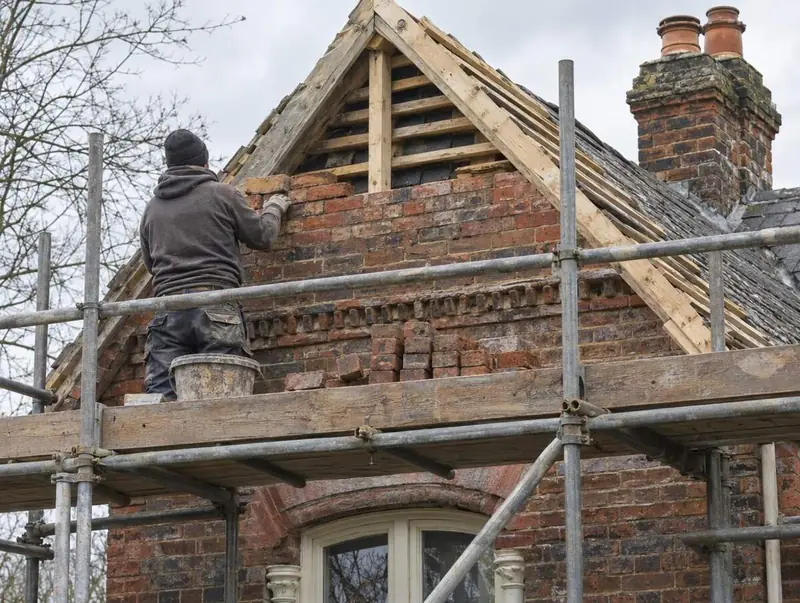
If the apex has leaned, cracked right through or lost its bond, the roof covering is stripped back along the verge, the upper courses are taken down to sound brickwork and the gable is rebuilt with straps and ties built in. Original bricks are reused where they are in good condition.
Best for: Gables leaning or cracked beyond tying back
What happens during gable end wall repairs, step by step?
Check from the loft
Much of the diagnosis happens in the roof space. Photos of where the rafters, purlins and joists meet the gable, plus outside shots of the verge, tell us a great deal before we visit.
Measure the lean
On site we plumb the gable, look for cracks at ceiling line and apex, and check the chimney and verge. Large movement or an unclear cause is a job for an engineer, whom we can bring in for you.
Strap, tie or rebuild
Straps and blocking are fitted at the spacing required, ties drilled and fixed, or the upper gable rebuilt course by course with restraint built in. Roofing along the verge is relaid and bedded or dry-fixed.
Do you need approval for gable end wall repairs in England?
In England, underpinning and other work that alters or strengthens a wall or foundation is building work under the Building Regulations (Part A, structure), so building control approves and inspects it. Like-for-like repairs often are not, and we tell you which applies before a price is agreed. Work to a party wall, or excavation close to a neighbour’s foundations, can also need a notice under the Party Wall etc. Act 1996.
Survey visits in parts of Isle of Wight are by arrangement because of travel and access. We can still give a free initial view from photos, and we tell you any travel cost before a visit is booked.
Towns in Isle of Wight we cover for gable end wall repairs
Questions about gable end wall repairs in Isle of Wight
Is the ground in Isle of Wight prone to subsidence?
The island has clays, sands and chalk, and the south coast around Ventnor sits on one of the largest urban landslide complexes in Europe. Ground movement there is a landslip question as much as a clay one. Ground movement here is more often linked to soils, drains and trees than to mining. Only an investigation on site can say why a particular building has moved.
How much will gable end wall repairs cost in Isle of Wight?
On South East rates, gable end wall repairs starts from about £1,100 per gable, including VAT. The written price depends on the extent of the damage, access and whether an engineer or building control is needed.
Does a gable rebuild affect the roof?
Yes, usually along the verge. Tiles or slates next to the gable are stripped back so the brickwork can be rebuilt, then relaid with new verge bedding or dry-fix verge. The rest of the roof is normally left undisturbed.
Can a gable be repaired without scaffolding?
Often yes, if straps can be fitted from inside the loft and the outside brickwork is sound. Rebuilding the top of a gable, repointing high up or fixing ties from outside usually needs scaffold. We confirm the access needed when we quote.
How long does gable restraint last?
Properly fixed galvanised or stainless straps should last for the life of the roof in a dry loft. What matters is that they are fixed into sound masonry and solid timber with tight blocking. A strapped gable can still be weakened by failed wall ties or poor pointing, so those are checked too.