Devon · England
Bay window subsidence repairs in Devon
Bay window subsidence repairs in Devon starts with the ground. Shrinkable clay is less common in Devon than in south-east England, and the buildings here are mostly cob and stone cottages, so the repair has to suit both.
Guide price from£620per bay inc VAT
- Area
- Devon
- Pricing region
- South West
- Ground
- Mostly firmer ground
- Towns listed
- 10
What should you know about the ground under Devon?
Devon's ground is mostly older mudstones, sandstones and granite, so shrinkable-clay subsidence is less widespread than further east. Older solid-walled and cob buildings, steep sites and retaining walls are the more common structural concerns.
Old metal-mine shafts and workings are recorded in places, so mining searches are routine for some properties. What you mostly find across Devon: cob and stone cottages, Victorian terraces in Exeter, Plymouth and Torbay, and post-war estates.
How much will bay window subsidence repairs cost in Devon?
Prices in Devon are worked out on South West rates. They include VAT and are a starting point: access, the extent of the damage and whether an engineer or building control is involved all move the figure.
| Item | Guide price | Per |
|---|---|---|
| Bay junction crack repair and tie-inest. | £620 – £1,850 | per bay |
| Traditional underpinning of a bay | £3,100 – £7,200 | per bay |
| Mini-piled bay underpinning | £5,150 – £12,400 | per bay |
Which repair method suits a home in Devon?
Traditional underpinning of the bay
The bay footing is excavated in short sections and new mass concrete is placed down to firmer ground below the zone affected by roots and seasons. Because a bay is a short length of wall, the work is compact, but it needs building control approval.
Best for: Active bay movement on firm ground at moderate depth
Mini-piled bay underpinning
Small piles are installed to depth around or beneath the bay and linked by a reinforced beam or needles that pick up its weight. It suits deeper soft ground and heavy root activity, and the compact rigs fit into a front garden.
Best for: Deep clay, nearby trees, or poor ground below the bay
Junction crack repair and tie-in
Where movement has stopped, the open joint between bay and house is raked out, stainless ties or helical bars are fixed across it, and the joint is repointed to match. Internal plaster along the crack is cut back and renewed before redecoration.
Best for: Old, stable cracks where the bay is no longer moving
What happens when we carry out bay window subsidence repairs in Devon?
Engineer and checks
Where the cause is unclear, an independent chartered structural engineer inspects, sometimes with a trial pit at the bay and a drain survey. We can arrange the engineer. Monitoring may be suggested if the movement could be seasonal.
Agree the repair
The engineer decides between tie-in repairs and underpinning. We confirm a fixed price in writing once the repair is specified, including scaffolding if needed, the bay window, roof flashing and internal making good.
Make good inside
Plaster around the bay and along the junction is renewed, the window board is refixed and the room is ready for decoration. Building control paperwork, where it applies, is passed to you for your records.
Signs you may need bay window subsidence repairs
- A step or slope in the bay floor towards the window
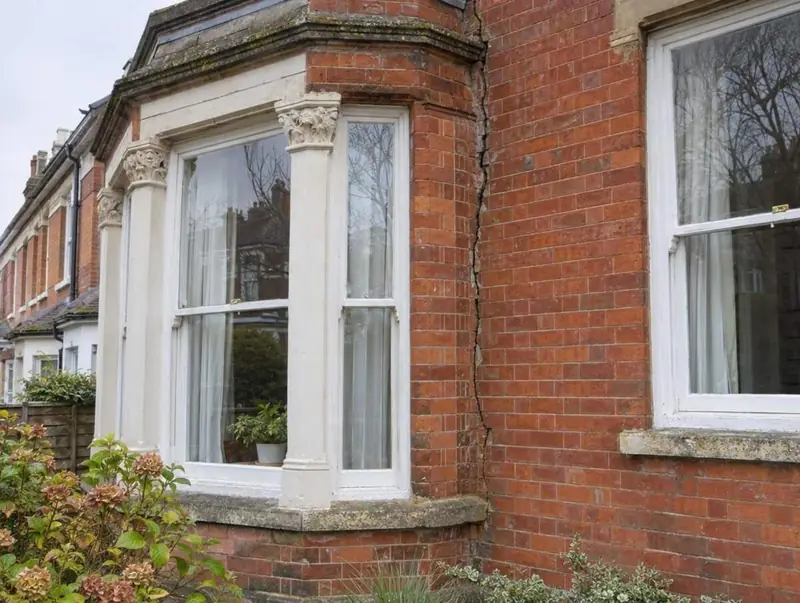
- A vertical crack where the bay meets the front wall
- Gaps opening around the internal bay window board
- Bay window sash or casement sticking or binding
Do you need approval for bay window subsidence repairs in England?
In England, underpinning and other work that alters or strengthens a wall or foundation is building work under the Building Regulations (Part A, structure), so building control approves and inspects it. Like-for-like repairs often are not, and we tell you which applies before a price is agreed. Work to a party wall, or excavation close to a neighbour’s foundations, can also need a notice under the Party Wall etc. Act 1996.
Find bay window subsidence repairs in your Devon town
Bay window subsidence repairs in Devon: questions and answers
Why do houses in Devon crack?
Devon's ground is mostly older mudstones, sandstones and granite, so shrinkable-clay subsidence is less widespread than further east. Older solid-walled and cob buildings, steep sites and retaining walls are the more common structural concerns. Old metal-mine shafts and workings are recorded in places, so mining searches are routine for some properties. Only an investigation on site can say why a particular building has moved.
How much will bay window subsidence repairs cost in Devon?
On South West rates, bay window subsidence repairs starts from about £620 per bay, including VAT. The written price depends on the extent of the damage, access and whether an engineer or building control is needed.
Will the bay window need replacing?
Usually not. Most windows can be eased, packed or resealed once the bay is stable. If the frame has twisted badly or the glass has cracked, replacement may be worth considering. Under a claim, upgrades beyond like-for-like are normally priced separately.
How long does bay underpinning take?
Traditional underpinning of a bay usually takes about a week on site, and mini-piling a little longer depending on depth. A junction tie-in without underpinning normally takes one to two days. Approvals and any monitoring beforehand add to the overall timeline.
Is a crack between my bay and the house serious?
It is often not serious, especially if it is old, fine and unchanged for years. A crack that is widening, tapering or matched by sticking windows and a sloping bay floor needs looking at. An engineer’s inspection, sometimes with monitoring, will confirm whether the bay is still moving.