Hampshire · England
Bay window subsidence repairs in Hampshire
If you live in Hampshire and are looking at bay window subsidence repairs, the first question is why the wall moved. Shrinkable clay is widespread in Hampshire; ground movement here is more often linked to soils, drains and trees than to mining.
Guide price from£670per bay inc VAT
- Area
- Hampshire
- Pricing region
- South East
- Ground
- Shrinkable clay widespread
- Towns listed
- 22
What should you know about the ground under Hampshire?
Central Hampshire is chalk, while the south around Portsmouth, Southampton and the New Forest fringe and the north-east around Farnborough sit on London Clay, Reading Beds and other clays and sands. The clay areas see seasonal movement near trees.
Ground movement here is more often linked to soils, drains and trees than to mining. Housing stock in Hampshire: Victorian terraces in Portsmouth and Southampton, 1930s semis, and large post-war and new-build estates.
What to look for before calling about bay window subsidence repairs
- Bay window sash or casement sticking or binding
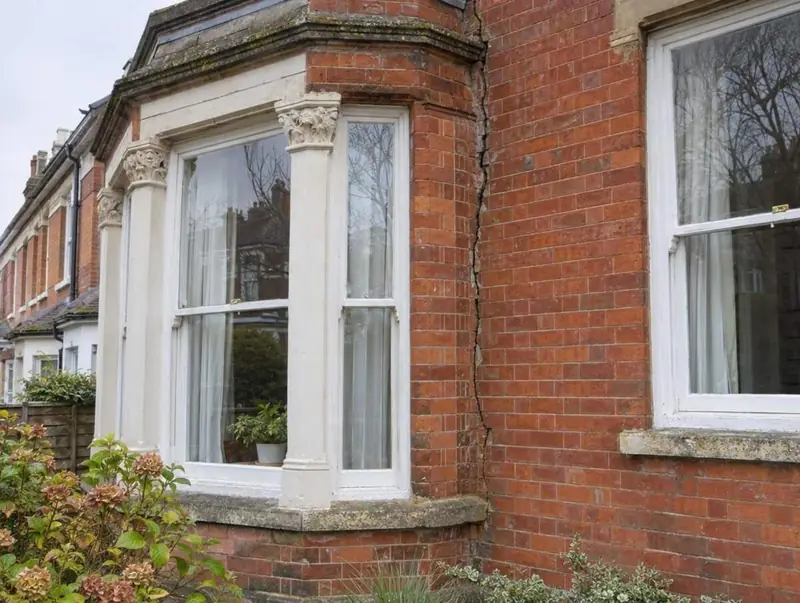
- A vertical crack where the bay meets the front wall
- Gaps opening around the internal bay window board
- Bay roof or lead flashing pulling away from the main wall
Bay window subsidence repairs prices in Hampshire
Prices in Hampshire are worked out on South East rates. They include VAT and are a starting point: access, the extent of the damage and whether an engineer or building control is involved all move the figure.
| Item | Guide price | Per |
|---|---|---|
| Bay junction crack repair and tie-inest. | £670 – £2,000 | per bay |
| Traditional underpinning of a bay | £3,350 – £7,850 | per bay |
| Mini-piled bay underpinning | £5,600 – £13,400 | per bay |
How we usually approach bay window subsidence repairs
Junction crack repair and tie-in
Where movement has stopped, the open joint between bay and house is raked out, stainless ties or helical bars are fixed across it, and the joint is repointed to match. Internal plaster along the crack is cut back and renewed before redecoration.
Best for: Old, stable cracks where the bay is no longer moving
Traditional underpinning of the bay
The bay footing is excavated in short sections and new mass concrete is placed down to firmer ground below the zone affected by roots and seasons. Because a bay is a short length of wall, the work is compact, but it needs building control approval.
Best for: Active bay movement on firm ground at moderate depth
Mini-piled bay underpinning
Small piles are installed to depth around or beneath the bay and linked by a reinforced beam or needles that pick up its weight. It suits deeper soft ground and heavy root activity, and the compact rigs fit into a front garden.
Best for: Deep clay, nearby trees, or poor ground below the bay
What happens during bay window subsidence repairs, step by step?
Photos and first view
Send photos of the outside junction, the inside corners and the window, with a scale. We give a free initial assessment and tell you whether the crack looks old and stable or whether an engineer should inspect first.
Agree the repair
The engineer decides between tie-in repairs and underpinning. We confirm a fixed price in writing once the repair is specified, including scaffolding if needed, the bay window, roof flashing and internal making good.
Make good inside
Plaster around the bay and along the junction is renewed, the window board is refixed and the room is ready for decoration. Building control paperwork, where it applies, is passed to you for your records.
Do you need approval for bay window subsidence repairs in England?
In England, underpinning and other work that alters or strengthens a wall or foundation is building work under the Building Regulations (Part A, structure), so building control approves and inspects it. Like-for-like repairs often are not, and we tell you which applies before a price is agreed. Work to a party wall, or excavation close to a neighbour’s foundations, can also need a notice under the Party Wall etc. Act 1996.
Bay window subsidence repairs near you in Hampshire
- Southampton
- Portsmouth
- Basingstoke
- Waterlooville
- Farnborough
- Eastleigh
- Winchester
- Havant
- Andover
- Fareham
- Aldershot
- Fleet
- Totton
- New Milton
- Bordon
- Hythe
- Alton
- Emsworth
- Hedge End
- Romsey
- Hayling Island
- Tadley
Questions about bay window subsidence repairs in Hampshire
Does the ground around Southampton cause cracking?
Central Hampshire is chalk, while the south around Portsmouth, Southampton and the New Forest fringe and the north-east around Farnborough sit on London Clay, Reading Beds and other clays and sands. The clay areas see seasonal movement near trees. Ground movement here is more often linked to soils, drains and trees than to mining. Only an investigation on site can say why a particular building has moved.
How much will bay window subsidence repairs cost in Hampshire?
On South East rates, bay window subsidence repairs starts from about £670 per bay, including VAT. The written price depends on the extent of the damage, access and whether an engineer or building control is needed.
Can I just fill the crack myself?
Filling it hides the evidence without dealing with the cause, and if the bay is still moving the crack will reopen. Photograph it with a scale and date first. If you plan to claim on insurance, tell your insurer before any repair, including filling.
How long does bay underpinning take?
Traditional underpinning of a bay usually takes about a week on site, and mini-piling a little longer depending on depth. A junction tie-in without underpinning normally takes one to two days. Approvals and any monitoring beforehand add to the overall timeline.
Is a crack between my bay and the house serious?
It is often not serious, especially if it is old, fine and unchanged for years. A crack that is widening, tapering or matched by sticking windows and a sloping bay floor needs looking at. An engineer’s inspection, sometimes with monitoring, will confirm whether the bay is still moving.