Cambridgeshire · England
Structural crack repairs in Cambridgeshire
Homes in Cambridgeshire are mostly Victorian terraces in Cambridge and Peterborough. That matters for structural crack repairs: footings, wall construction and mortar all vary with the age of the building. Cambridgeshire is one of the parts of the UK where clay soils are most likely to move with the seasons.
Guide price from£85per metre of crack inc VAT
- Area
- Cambridgeshire
- Pricing region
- East of England
- Ground
- Shrinkable clay widespread
- Towns listed
- 8
How do local ground conditions affect structural crack repairs in Cambridgeshire?
Gault Clay underlies much of the Cambridge area and Oxford Clay the west of the county around Peterborough and Huntingdon, while the northern fens are peat and silt that can shrink as they dry. Both clay and peat ground can move with the seasons.
Ground movement here is more often linked to soils, drains and trees than to mining. Typical buildings in Cambridgeshire: Victorian terraces in Cambridge and Peterborough, fen-edge cottages, and extensive post-war and new-build estates.
Signs you may need structural crack repairs
- Doors or windows that have started sticking or no longer latch
- Daylight or a draught coming through a crack in an outside wall
- Diagonal cracks running from the corners of windows and doors
- A crack noticeably wider at the top than the bottom, or the reverse
How much will structural crack repairs cost in Cambridgeshire?
Guide prices below are for homes in Cambridgeshire, on East of England rates and including VAT. A survey or good photos let us turn them into a fixed written price.
| Item | Guide price | Per |
|---|---|---|
| Crack stitching with helical bars | £85 – £190 | per metre of crack |
| Single crack, outside only (up to about 2 m)est. | £420 – £945 | per crack |
| Internal making good and redecoration of the crack lineest. | £160 – £525 | per room |
Which repair method suits a home in Cambridgeshire?
Filling and repointing
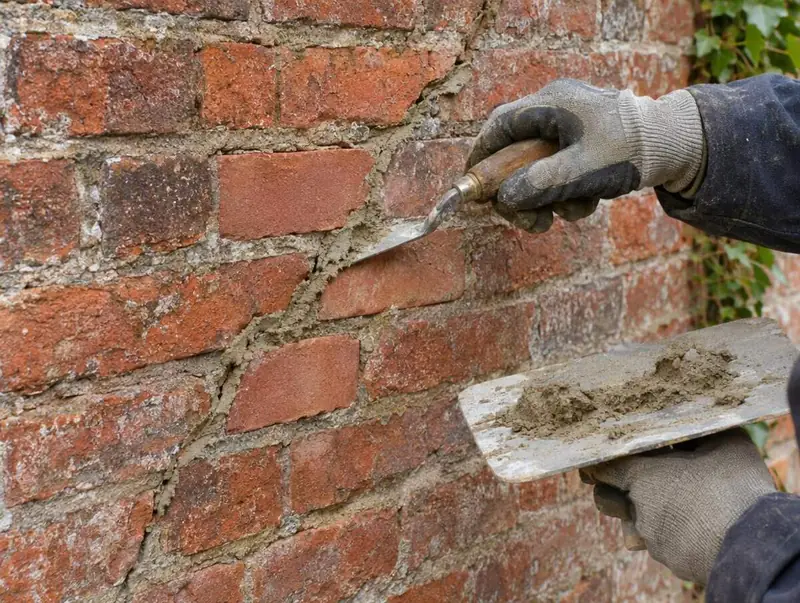
For hairline and narrow cracks that have stopped moving, the crack line is raked out and repointed in mortar matched to the original for strength, colour and texture. Inside, plaster cracks are cut out, filled with a flexible filler and redecorated.
Best for: Cracks up to about 5 mm that are no longer moving
Crack stitching with helical bars
Stainless steel helical bars are grouted into slots cut along the bed joints, bridging the crack so the masonry works as one piece again. It is the standard repair for wider stepped and vertical cracks once whatever caused them has stopped.
Best for: Stable cracks wider than about 5 mm, or ones that keep reopening
Rebuilding a cracked section
Where bricks have split or the wall has moved out of line, the damaged area is taken down and rebuilt, bonded into sound masonry on either side. Reclaimed or matched bricks keep the repair discreet, with temporary support used where needed.
Best for: Badly displaced or broken brickwork
What happens when we carry out structural crack repairs in Cambridgeshire?
Survey and record
On site we measure the width along the crack, note its pattern and check nearby drains, trees and openings. If the cause is unclear, gauges can be fixed across it and read over several months.
Deal with the cause
Leaking drains, failed ties, a sagging lintel or ground movement are put right first, sometimes through an insurance claim. Repairing a crack before its cause is fixed usually means paying for the same job twice.
Repair and make good
Cracks are stitched, repointed or rebuilt as specified, with mortar matched to the existing wall. Internal crack lines are filled and redecorated where included, and you get a written note of what was done.
Do you need approval for structural crack repairs in England?
Like-for-like repairs such as crack stitching and repointing do not usually need building control approval in England, but anything that changes or strengthens the structure, such as underpinning or rebuilding a wall, does. If the work touches a party wall, the Party Wall etc. Act 1996 may apply.
Structural crack repairs near you in Cambridgeshire
Structural crack repairs in Cambridgeshire: questions and answers
Does the ground around Peterborough cause cracking?
Gault Clay underlies much of the Cambridge area and Oxford Clay the west of the county around Peterborough and Huntingdon, while the northern fens are peat and silt that can shrink as they dry. Both clay and peat ground can move with the seasons. Ground movement here is more often linked to soils, drains and trees than to mining. Only an investigation on site can say why a particular building has moved.
How much will structural crack repairs cost in Cambridgeshire?
On East of England rates, structural crack repairs starts from about £85 per metre of crack, including VAT. The written price depends on the extent of the damage, access and whether an engineer or building control is needed.
Should I tell my insurer about cracks in my house?
Yes, if you think the cracks could come from subsidence or heave, tell your insurer before any permanent repair, because repairing first can make a claim harder to prove. Cracks from normal shrinkage or ageing are not usually covered, and the insurer decides which applies.
When is a crack in a wall structural?
A crack is more likely to be structural when it is wider than about 5 mm, tapers, passes through the whole wall or keeps growing. BRE Digest 251 treats damage up to about 5 mm as aesthetic and over 25 mm as a stability concern. Width is a guide, not a diagnosis.
Are horizontal cracks in a wall serious?
Horizontal cracks are often more serious than vertical ones, because they suggest the wall is being pushed or lifted. Cracks repeating every few courses point to rusting wall ties, while one long crack with a bulge may mean lost restraint.