Northumberland · England
Roof structure repairs in Northumberland
We carry out roof structure repairs across Northumberland, from the larger towns to smaller places nearby. Northumberland has a mix of ground, with clay in some places and firmer rock in others. Every job starts with the cause, then the repair is specified to match it.
Guide price from£275per rafter inc VAT
- Area
- Northumberland
- Pricing region
- North East
- Ground
- Clay in parts
- Towns listed
- 6
Why does the ground in Northumberland matter for roof structure repairs?
South-east Northumberland around Blyth, Ashington and Cramlington lies on the Northumberland coalfield, worked extensively in the past, under a cover of glacial clay. The north and west are hard rock and moorland.
Parts of Northumberland lie on a former coalfield, so a coal mining search is worth checking if movement has no obvious cause. What you mostly find across Northumberland: colliery terraces, stone farmhouses and villages, and post-war estates.
Is it time for roof structure repairs? Common signs
- Roof slope looking hollow or wavy between the ridge and the gutter
- Horizontal cracks in the wall just below the eaves or ceiling line
- Top of an outside wall leaning out at eaves level
- Ridge line dipping in the middle when seen from the street
What should you budget for roof structure repairs in Northumberland?
The ranges below reflect typical North East costs for roof structure repairs, including VAT. Scaffold, access and making good can push a job to the top of the range.
| Item | Guide price | Per |
|---|---|---|
| Repairing or doubling a rafter | £275 – £550 | per rafter |
| Purlin and strut strengthening | £1,100 – £2,750 | per roof |
| Tying in roof spread (straps and ties)est. | £735 – £2,300 | per roof |
Repair options we may recommend
Tying in roof spread
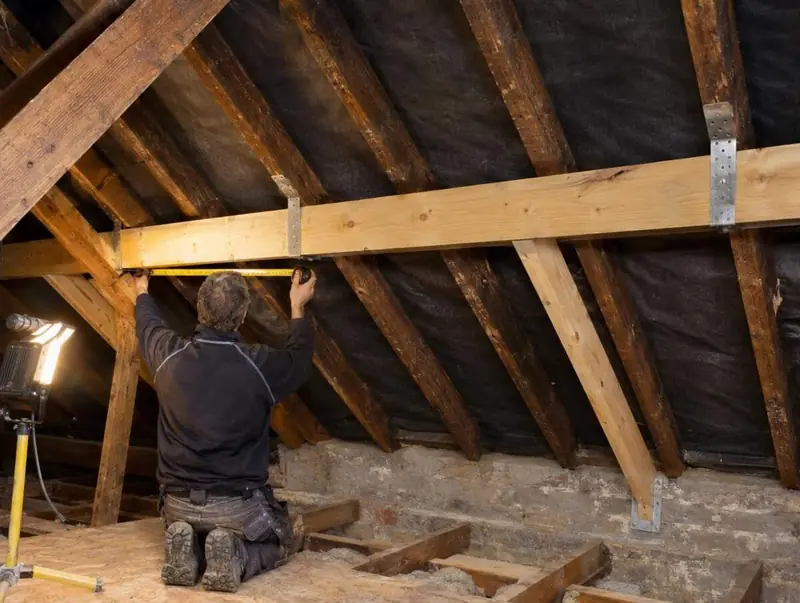
New ties, collars or steel straps connect opposite rafters, or fix the rafter feet and wall plate firmly to the ceiling joists, so the outward thrust is resisted. Leaning wall heads are strapped back to the roof, and a badly spread roof may need partly rebuilding first.
Best for: Walls pushed out at eaves level by spreading rafters
Purlin and strut strengthening
Undersized purlins are strengthened with extra timber or replaced, and new struts are taken down to a load-bearing wall. Where there is no suitable wall, an engineer designs the load path. Temporary props hold the roof while members are changed.
Best for: Sagging slopes, slim purlins and struts removed from the loft
Wall plate replacement
Rotten or crushed wall plates are replaced in short lengths while the rafters above are propped, and bedded on the wall in mortar. The plate is then strapped down to the masonry. It is often combined with rafter foot splices along the same run.
Best for: Rot along the eaves where rafters bear on the wall
What to expect when we carry out roof structure repairs
Send photos
Photograph the roof from across the street, both slopes if you can, and the loft timbers with a torch. Include the eaves and any cracks just below them. From these we can usually tell sag from spread and whether an engineer is needed.
Loft and outside survey
On site we check rafter sizes and spacing, purlins, struts, ties and wall plates, look for rot and past alterations, and measure any lean at the wall head. The covering is noted too, because its weight affects the repair.
Prop, strengthen and tie
The roof is propped where members are being changed, then rafters, purlins, struts and ties are repaired or added as specified. Coverings disturbed by the work are relaid, and building control inspects where the work needs it.
Do you need approval for roof structure repairs in England?
In England, underpinning and other work that alters or strengthens a wall or foundation is building work under the Building Regulations (Part A, structure), so building control approves and inspects it. Like-for-like repairs often are not, and we tell you which applies before a price is agreed. Work to a party wall, or excavation close to a neighbour’s foundations, can also need a notice under the Party Wall etc. Act 1996.
Find roof structure repairs in your Northumberland town
Your roof structure repairs questions
Why do houses in Northumberland crack?
South-east Northumberland around Blyth, Ashington and Cramlington lies on the Northumberland coalfield, worked extensively in the past, under a cover of glacial clay. The north and west are hard rock and moorland. Parts of Northumberland lie on a former coalfield, so a coal mining search is worth checking if movement has no obvious cause. Only an investigation on site can say why a particular building has moved.
How much will roof structure repairs cost in Northumberland?
On North East rates, roof structure repairs starts from about £275 per rafter, including VAT. The written price depends on the extent of the damage, access and whether an engineer or building control is needed.
What is roof spread?
Roof spread is when the feet of the rafters move outward because nothing is tying them together firmly enough. As they spread, the ridge drops and the tops of the walls are pushed out, often with a horizontal crack below the eaves. It is fixed by adding ties, collars or straps, sometimes with rebuilding.
Why are there cracks just below the eaves?
A horizontal crack just below the eaves, along the front or back wall, is a common sign of roof spread. The rafters push the top of the wall outward and the masonry cracks where it hinges. Corroded wall ties can cause similar cracks, so the cause needs checking.
Do roof structure repairs need building control?
Usually yes, where the structure is strengthened or altered, or the covering becomes significantly heavier. In England and Wales that falls under Part A, in Scotland it generally needs a building warrant, and in Northern Ireland council building control approves it. We deal with building control where the work needs it.