East Sussex · England
Retaining wall repairs in East Sussex
East Sussex has its own mix of ground and building types, and that shapes how retaining wall repairs is done here. East Sussex is one of the parts of the UK where clay soils are most likely to move with the seasons.
Guide price from£560per wall inc VAT
- Area
- East Sussex
- Pricing region
- South East
- Ground
- Shrinkable clay widespread
- Towns listed
- 10
Why does the ground in East Sussex matter for retaining wall repairs?
Inland East Sussex is Weald Clay and Wealden sands, while the South Downs and the coast around Brighton and Eastbourne are chalk. The Weald Clay areas are prone to shrink-swell movement near trees.
Ground movement here is more often linked to soils, drains and trees than to mining. What you mostly find across East Sussex: Regency and Victorian terraces on the coast, Wealden timber-framed houses, and inter-war bungalows and semis.
Symptoms that point to retaining wall repairs
- Water seeping through joints, or white salt staining, after rain
- Bricks or blocks pushed out of line, or coping stones sliding off
- Ground cracking or sinking along the top of the wall
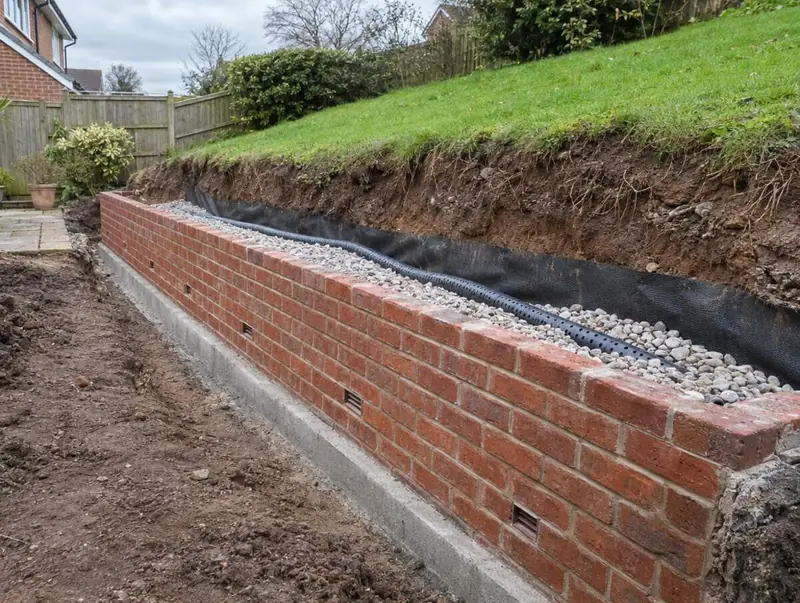
- No weep holes, or weep holes that never seem to drain
Guide prices for retaining wall repairs in East Sussex
Guide prices below are for homes in East Sussex, on South East rates and including VAT. A survey or good photos let us turn them into a fixed written price.
| Item | Guide price | Per |
|---|---|---|
| Minor repairs and drainage | £560 – £2,250 | per wall |
| Structural repair or partial rebuild | £3,350 – £16,800 | per wall |
| New retaining wall | £225 – £505 | per m² of wall face |
Methods for retaining wall repairs
Rebuilding on new footings
Where the whole wall is failing, it is replaced with a new retaining wall on a properly sized footing, with free-draining backfill, a membrane, weep holes and a drain at the base. Reinforced blockwork faced in brick or stone is common, so the wall matches its surroundings.
Best for: Walls failing along their length, or retaining significant height
Structural repair and partial rebuild
A leaning or bulging section is taken down, the soil behind dug out and supported, and the wall rebuilt on a new footing with drainage and, where specified, reinforcement tied into the sound wall either side. The engineer’s design sets footing size and wall thickness.
Best for: A section that has moved while the rest stays sound
Temporary support and reducing load
While a repair is designed and programmed, a dangerous wall may be propped, or soil and loads near the top removed to reduce the push. Moving parked cars or a shed back from the wall is sometimes the simplest first step.
Best for: Walls that are moving now and need making safe
From first photo to finished repair
Photos and measurements
Send photos of the whole wall from the front and the end, so any lean shows, plus close-ups of cracks and weep holes. Tell us roughly how tall it is and what sits at the top, such as lawn, patio, drive or a building.
Site assessment
On site we measure height and lean, check the drainage and the ground at the top and bottom, and look at access for digging out. Walls that support a drive, path or building, or retain more than a modest height, are referred to an engineer.
Written quote
You receive a no-obligation written quote covering demolition, excavation, temporary support, the footing, the new or repaired wall, drainage and spoil removal. It becomes a fixed price in writing once the repair is specified.
Do you need approval for retaining wall repairs in England?
In England, underpinning and other work that alters or strengthens a wall or foundation is building work under the Building Regulations (Part A, structure), so building control approves and inspects it. Like-for-like repairs often are not, and we tell you which applies before a price is agreed. Work to a party wall, or excavation close to a neighbour’s foundations, can also need a notice under the Party Wall etc. Act 1996.
Retaining wall repairs near you in East Sussex
Frequently asked questions
Does the ground around Brighton cause cracking?
Inland East Sussex is Weald Clay and Wealden sands, while the South Downs and the coast around Brighton and Eastbourne are chalk. The Weald Clay areas are prone to shrink-swell movement near trees. Ground movement here is more often linked to soils, drains and trees than to mining. Only an investigation on site can say why a particular building has moved.
How much will retaining wall repairs cost in East Sussex?
On South East rates, retaining wall repairs starts from about £560 per wall, including VAT. The written price depends on the extent of the damage, access and whether an engineer or building control is needed.
What are weep holes in a retaining wall?
Weep holes are small openings near the base of a retaining wall that let water drain out from the soil behind it. Without them, water builds up and adds hydrostatic pressure that can push the wall over. They work best with a drainage layer behind the wall, and they need to be kept clear.
Do I need an engineer for a retaining wall?
For low walls holding back a planting bed, often not. Walls retaining more than a modest height, often taken as more than about a metre, or supporting a drive, path, building or neighbour’s land, generally need an engineer’s design. An independent chartered structural engineer is appointed where needed, and we can arrange this.
Can a bulging retaining wall be saved?
Sometimes, if the bulge is small, the wall is low and the cause is mainly poor drainage. Improving drainage and repairing the face may stop further movement. A wall that has bulged a lot, cracked through or moved at its base usually needs that section rebuilding on a proper footing.