Argyll and Bute · Scotland
Retaining wall repairs in Argyll and Bute
Retaining wall repairs in Argyll and Bute starts with the ground. Most of Argyll and Bute is on firmer ground than the clay belts of the south-east, and the buildings here are mostly Victorian villas, so the repair has to suit both.
Guide price from£475per wall inc VAT
- Area
- Argyll and Bute
- Pricing region
- Scotland
- Ground
- Mostly firmer ground
- Towns listed
- 3
Why does the ground in Argyll and Bute matter for retaining wall repairs?
Argyll is hard rock with thin glacial soils and raised beaches along the coast; mainland towns such as Helensburgh and Oban sit on steep coastal slopes.
Ground movement here is more often linked to soils, drains and trees than to mining. Across Argyll and Bute, most homes are Victorian villas, stone terraces and cottages, and post-war estates.
Signs you may need retaining wall repairs
- Water seeping through joints, or white salt staining, after rain
- Wall leaning forward, or bulging out in the middle of its length
- No weep holes, or weep holes that never seem to drain
- Horizontal or stepped cracks running along the face of the wall
How much will retaining wall repairs cost in Argyll and Bute?
These are guide prices for Argyll and Bute, using Scotland rates and including VAT. Your written quote follows photos or a survey, and is fixed once the repair is specified.
| Item | Guide price | Per |
|---|---|---|
| Minor repairs and drainage | £475 – £1,900 | per wall |
| Structural repair or partial rebuild | £2,850 – £14,200 | per wall |
| New retaining wall | £190 – £430 | per m² of wall face |
Which repair method suits a home in Argyll and Bute?
Structural repair and partial rebuild
A leaning or bulging section is taken down, the soil behind dug out and supported, and the wall rebuilt on a new footing with drainage and, where specified, reinforcement tied into the sound wall either side. The engineer’s design sets footing size and wall thickness.
Best for: A section that has moved while the rest stays sound
Drainage and minor repairs
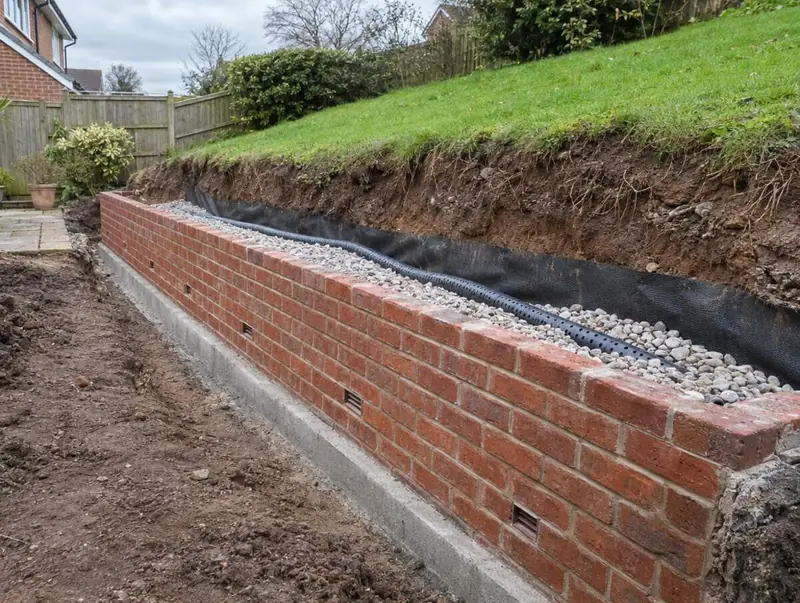
Blocked weep holes are cleared or new ones drilled, and where practical a drainage layer is formed behind the wall with an outlet at its base. Loose copings are rebedded, open joints repointed and a few damaged bricks replaced. For a low wall that has not moved much, this can be enough.
Best for: Low walls that are damp or slightly weathered but still upright
Rebuilding on new footings
Where the whole wall is failing, it is replaced with a new retaining wall on a properly sized footing, with free-draining backfill, a membrane, weep holes and a drain at the base. Reinforced blockwork faced in brick or stone is common, so the wall matches its surroundings.
Best for: Walls failing along their length, or retaining significant height
What happens when we carry out retaining wall repairs in Argyll and Bute?
Engineer’s design
Where the wall needs it, an independent chartered structural engineer is appointed to design the repair or new wall, including footing, thickness, reinforcement and drainage. We can arrange this, and the design forms the basis of the quote.
Written quote
You receive a no-obligation written quote covering demolition, excavation, temporary support, the footing, the new or repaired wall, drainage and spoil removal. It becomes a fixed price in writing once the repair is specified.
Build and drain
The failing section is taken down, the soil supported in short lengths, and the footing cast. The wall is rebuilt with drainage behind it, backfilled with free-draining material, and building control inspects where the work needs it.
Do you need approval for retaining wall repairs in Scotland?
In Scotland, underpinning and other structural alterations generally need a building warrant from the council’s building standards service before work starts, and a completion certificate at the end; small like-for-like repairs often do not. There is no Party Wall Act in Scotland; shared walls are covered by title deeds and, for flats, the Tenements (Scotland) Act 2004.
Survey visits in parts of Argyll and Bute are by arrangement because of travel and access. We can still give a free initial view from photos, and we tell you any travel cost before a visit is booked.
Retaining wall repairs near you in Argyll and Bute
Retaining wall repairs in Argyll and Bute: questions and answers
Does the ground around Helensburgh cause cracking?
Argyll is hard rock with thin glacial soils and raised beaches along the coast; mainland towns such as Helensburgh and Oban sit on steep coastal slopes. Ground movement here is more often linked to soils, drains and trees than to mining. Only an investigation on site can say why a particular building has moved.
How much will retaining wall repairs cost in Argyll and Bute?
On Scotland rates, retaining wall repairs starts from about £475 per wall, including VAT. The written price depends on the extent of the damage, access and whether an engineer or building control is needed.
How long does a retaining wall rebuild take?
Drainage and minor repairs usually take a day or two. Rebuilding a garden retaining wall on new footings typically takes one to three weeks, depending on its length, height, access for digging and any wait for the engineer’s design or inspections.
Can a bulging retaining wall be saved?
Sometimes, if the bulge is small, the wall is low and the cause is mainly poor drainage. Improving drainage and repairing the face may stop further movement. A wall that has bulged a lot, cracked through or moved at its base usually needs that section rebuilding on a proper footing.
Who is responsible for a retaining wall between two properties?
Usually the owner of the higher ground, because the wall holds up their land, but it depends on your title deeds and how the wall came to be built. Check the deeds first, take advice if it is unclear, and agree the repair with your neighbour before work starts.