Isle of Wight · England
Resin injection ground stabilisation in Isle of Wight
Isle of Wight has its own mix of ground and building types, and that shapes how resin injection ground stabilisation is done here. Much of Isle of Wight sits on clay that shrinks in dry summers and swells in wet winters.
Guide price from£895per metre of wall treated inc VAT
- Area
- Isle of Wight
- Pricing region
- South East
- Ground
- Shrinkable clay widespread
- Towns listed
- 4
How do local ground conditions affect resin injection ground stabilisation in Isle of Wight?
The island has clays, sands and chalk, and the south coast around Ventnor sits on one of the largest urban landslide complexes in Europe. Ground movement there is a landslip question as much as a clay one.
Ground movement here is more often linked to soils, drains and trees than to mining. Housing stock in Isle of Wight: Victorian seaside villas, terraces in Ryde and Newport, and post-war bungalows.
From first photo to finished repair
Is resin suitable?
Send photos and any reports you hold. We give a free initial assessment, and an independent engineer then checks soil type, depth to firm ground and the cause. We can arrange the engineer. Clay and tree problems need particular care.
Design and written price
The injection depths, spacing and target lift are set out before work starts. We confirm a fixed price in writing for the treated length, the monitoring and the making good, and deal with building control where the work needs it.
Level monitoring
Readings after treatment show whether the ground is holding. Once they are steady, cracks are stitched and redecoration can follow. If a section keeps moving, the engineer decides whether further injection or a different method is needed.
Symptoms that point to resin injection ground stabilisation
- Settlement after a drain leak has been found and repaired
- Sinking that trial pits trace to loose or washed-out soil
- Cracks over a section of wall built on loose fill
- Floor slab dropping or hollow-sounding near one external wall
Guide prices for resin injection ground stabilisation in Isle of Wight
For Isle of Wight we use South East rates. Treat the table as a budget guide, inc VAT; the price you pay is the one on your written quote.
| Item | Guide price | Per |
|---|---|---|
| Resin injection ground stabilisation | £895 – £1,700 | per metre of wall treated |
| Typical domestic project | £5,600 – £16,800 | per project |
| Level monitoring after treatmentest. | £390 – £1,000 | per programme |
Methods for resin injection ground stabilisation
Injection beneath strip footings
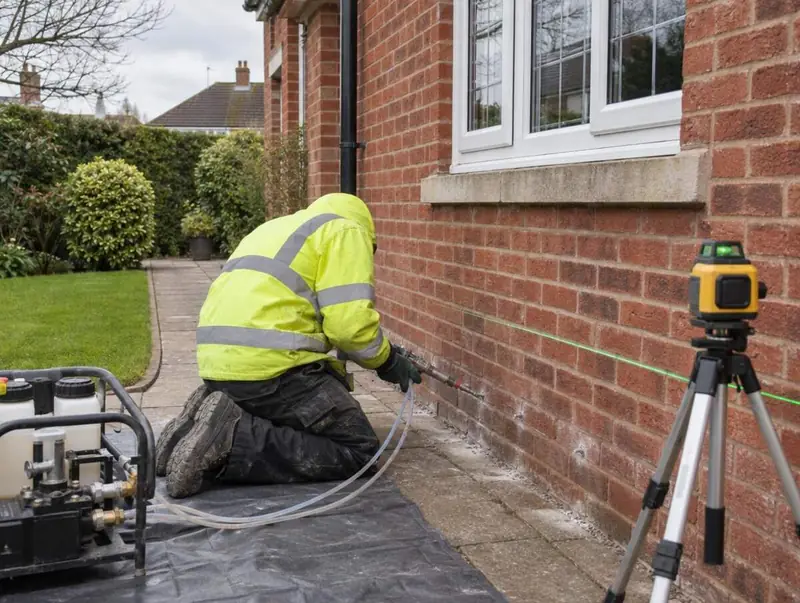
Holes are drilled at close spacing along the wall, and tubes are placed at one or more depths below the footing. Resin is injected in stages from the bottom up, building a stiffened zone of ground under the wall while levels are read continuously.
Best for: Settled walls on loose or washed-out soil at shallow depth
Slab void filling and lifting
Small holes are drilled through the floor, and resin is fed into the void between the slab and the fill. As it expands it fills the gap and can lift the slab by small, controlled amounts. Floor coverings are lifted locally and the holes filled afterwards.
Best for: Sunken concrete ground floors and garage slabs
Resin alongside other repairs
Injection often forms one part of a wider scheme: drains repaired first, resin under the affected section, then crack stitching and making good once readings settle. On a mixed site, one wall may suit resin while another needs conventional underpinning instead.
Best for: Localised settlement within a broader subsidence repair
Do you need approval for resin injection ground stabilisation in England?
In England, underpinning and other work that alters or strengthens a wall or foundation is building work under the Building Regulations (Part A, structure), so building control approves and inspects it. Like-for-like repairs often are not, and we tell you which applies before a price is agreed. Work to a party wall, or excavation close to a neighbour’s foundations, can also need a notice under the Party Wall etc. Act 1996.
Survey visits in parts of Isle of Wight are by arrangement because of travel and access. We can still give a free initial view from photos, and we tell you any travel cost before a visit is booked.
Towns in Isle of Wight we cover for resin injection ground stabilisation
Frequently asked questions
Is the ground in Isle of Wight prone to subsidence?
The island has clays, sands and chalk, and the south coast around Ventnor sits on one of the largest urban landslide complexes in Europe. Ground movement there is a landslip question as much as a clay one. Ground movement here is more often linked to soils, drains and trees than to mining. Only an investigation on site can say why a particular building has moved.
How much will resin injection ground stabilisation cost in Isle of Wight?
On South East rates, resin injection ground stabilisation starts from about £895 per metre of wall treated, including VAT. The written price depends on the extent of the damage, access and whether an engineer or building control is needed.
How do I know if my house is suitable?
An engineer decides, based on the soil type, the depth to firm ground and the cause of movement. Send us photos and any reports for a free initial assessment. We will say honestly if resin looks unlikely to suit and a different repair is worth considering.
Does resin injection work on clay soil?
Sometimes, but clay needs the most caution. If seasonal shrinkage from nearby trees is the cause, resin under the footing may not stop the drying below it. An engineer should look at the soil, the trees and the monitoring history before resin is chosen for a clay site.
Is resin injection better than underpinning?
It is better for some jobs and unsuitable for others. Resin is quicker and less disruptive where the problem is loose or washed-out soil close to the footing. Underpinning or mini-piles are usually the safer choice for deep soft ground or clay dried by trees that cannot be removed.