Ayrshire · Scotland
Mining subsidence repairs in Ayrshire
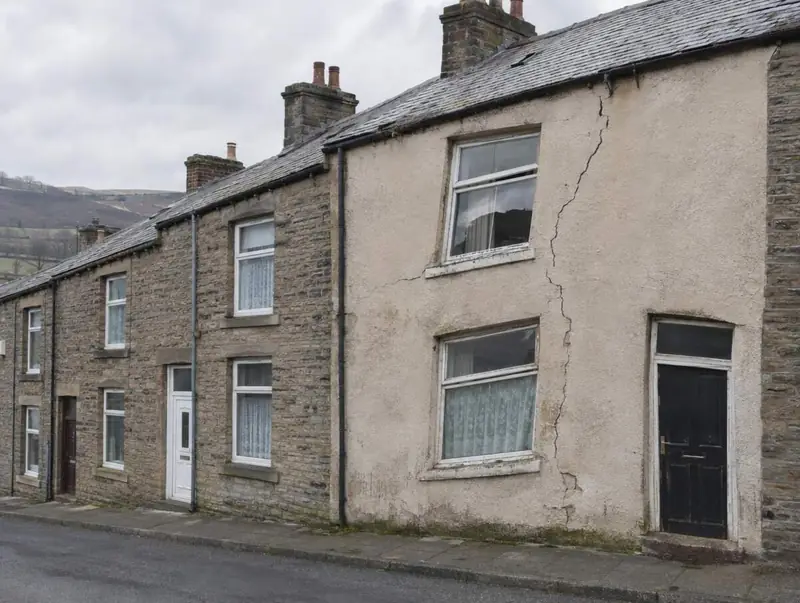
Homes in Ayrshire are mostly sandstone villas and terraces in the coastal towns. That matters for mining subsidence repairs: footings, wall construction and mortar all vary with the age of the building. Most of Ayrshire is on firmer ground than the clay belts of the south-east.
Guide price from£75per metre of crack inc VAT
- Area
- Ayrshire
- Pricing region
- Scotland
- Ground
- Mostly firmer ground
- Towns listed
- 7
Is Ayrshire prone to ground movement?
Ayrshire has a large coalfield, especially in the east around Kilmarnock and Cumnock, with recorded workings, and raised-beach sands and gravels along the coast.
Historic coal workings are recorded beneath parts of Ayrshire, and a coal mining search is worth checking where movement is unexplained. Typical buildings in Ayrshire: Sandstone villas and terraces in the coastal towns, miners' rows and post-war estates.
Signs you may need mining subsidence repairs
- The whole house leaning slightly, with doors swinging open
- Steps or ridges forming in paths, kerbs or garden walls
- Cracks running through the foundations and up both faces of a wall
- Damage that does not change with the seasons
How much will mining subsidence repairs cost in Ayrshire?
The ranges below reflect typical Scotland costs for mining subsidence repairs, including VAT. Scaffold, access and making good can push a job to the top of the range.
| Item | Guide price | Per |
|---|---|---|
| Crack stitching and making good | £75 – £170 | per metre of crack |
| Re-levelling or ground stabilisation by resin injection | £760 – £1,400 | per metre of wall |
| Underpinning where the engineer specifies it | £950 – £3,300 | per metre of wall |
| Repair schedule for a claim (pricing an engineer's scope)est. | Free to request | — |
Which repair method suits a home in Ayrshire?
Ground stabilisation by resin injection
For localised settlement in the upper soil layers, expanding resin can be injected beneath the footings to firm the ground and sometimes reduce a small tilt. It is not suitable for large voids deep below, which need grouting or other specialist treatment first.
Best for: Shallow settlement once deeper voids are ruled out or treated
Underpinning to sound ground
Where the engineer specifies it, foundations are taken down by mass concrete, beam-and-base or mini-piles to ground that will not move further. On mining sites the design often follows grouting of old workings so the new foundation sits above a stable mass.
Best for: Ongoing movement or damage beyond what crack repairs can hold
Crack stitching and making good
Where the ground has stopped moving and the damage is cracking, the walls are stitched with stainless helical bars, repointed and replastered. This covers a large share of mining damage, especially legacy movement that settled years ago and left cracks behind.
Best for: Cracking after movement that has now stopped
What happens when we carry out mining subsidence repairs in Ayrshire?
Report and photograph
Photograph every crack with a scale and note the date it appeared. Report suspected coal-mining damage to the Mining Remediation Authority, or the operator of a working mine, and notify your home insurer. Time limits can apply, so report promptly.
Check the mining record
A coal mining report or a search of mining records shows whether recorded workings or shafts lie near the property. Records are incomplete, so a clear report does not rule mining out, and a recorded seam nearby does not prove it is the cause.
Repairs and records
Work proceeds once any ground treatment is complete and the engineer is satisfied. We stitch, stabilise or underpin as specified, make good inside and out, deal with building control where needed, and hand over records for your file.
Do you need approval for mining subsidence repairs in Scotland?
In Scotland, underpinning and other structural alterations generally need a building warrant from the council’s building standards service before work starts, and a completion certificate at the end; small like-for-like repairs often do not. There is no Party Wall Act in Scotland; shared walls are covered by title deeds and, for flats, the Tenements (Scotland) Act 2004.
Mining subsidence repairs near you in Ayrshire
Mining subsidence repairs in Ayrshire: questions and answers
Does the ground around Kilmarnock cause cracking?
Ayrshire has a large coalfield, especially in the east around Kilmarnock and Cumnock, with recorded workings, and raised-beach sands and gravels along the coast. Historic coal workings are recorded beneath parts of Ayrshire, and a coal mining search is worth checking where movement is unexplained. Only an investigation on site can say why a particular building has moved.
How much will mining subsidence repairs cost in Ayrshire?
On Scotland rates, mining subsidence repairs starts from about £75 per metre of crack, including VAT. The written price depends on the extent of the damage, access and whether an engineer or building control is needed.
Can you repair mining damage that is not part of a claim?
Yes. If the damage is old and settled, or a claim has been closed, we can repair it privately. Send photos for a free initial assessment and you will receive a no-obligation written quote. If the cause is unclear, an engineer’s inspection first is sensible.
Can mining subsidence start again years later?
It can, particularly over shallow workings or old shafts, where collapse can happen long after mining ended. Movement from deep longwall mining generally settled within a few years of extraction. An engineer can judge whether current damage is old, settled cracking or new movement.
Who pays for coal-mining subsidence damage?
Liability for damage from past coal mining usually rests with the Mining Remediation Authority, or with the operator of a working mine. They investigate whether coal mining caused the damage before agreeing any repair. Tell your home insurer as well, because policy cover and the mining claim can overlap.